How Many Nits Do You Need for Window Display Screens?
Window facing digital displays operate in one of the most demanding photometric environments encountered in commercial signage: direct solar exposure, specular reflections from glass, and variable ambient illuminance measured in tens of thousands of lux. This paper establishes a quantitative luminance framework — expressed in candelas per square metre (cd/m², colloquially "nits") — for selecting and deploying displays in high-ambient-light retail and commercial window applications. We examine the contrast-ratio requirements that govern perceptual legibility, catalogue installation-specific brightness thresholds, survey thermal and power trade-offs at high output, and propose a specification methodology applicable across use cases from shaded interior windows to south-facing full-sun storefronts.
1. The Ambient Light Problem1
2. Understanding the Nit as a Specification Unit2
3. Luminance Thresholds by Installation Scenario3
4. Glass and Reflection Loss Factors4
5. Thermal, Power, and Longevity Trade-offs5
6. Specification Checklist and Minimum Requirements Table6
7. References7
§ 1The Ambient Light Problem
The legibility of any emissive display is governed not by its absolute luminance alone, but by the contrast ratio between the display surface and the ambient light field surrounding it. In interior environments — conference rooms, retail floors, transportation hubs — ambient illuminance typically ranges from 200 lx to 1,000 lx, conditions under which a display rated at 400 cd/m² performs adequately. Window facing installations invert this assumption entirely.
Direct sunlight incident on a south-facing glass façade can produce exterior illuminance levels exceeding 100,000 lx. Even diffuse overcast daylight in temperate climates commonly measures 10,000–25,000 lx. Because glass transmits a substantial portion of this flux into the interior, a display mounted at or immediately behind the glass plane must produce luminance sufficient to overcome reflected skylight, transmitted solar radiation, and the veiling luminance introduced by the glass substrate itself.
The Society for Information Display (SID) and IEC 62341 standards characterise display contrast under ambient light using the Contrast Ratio under Ambient Light (CRAL) metric. For a display to be considered legible to an observer standing at typical pavement distance (1.5–3 m), a minimum CRAL of 3:1 is generally required; a CRAL of 5:1 or greater is preferred for image-quality content such as product photography or video.
A display cannot be specified by peak brightness alone. The operative metric is the ratio of panel luminance to the sum of reflected and transmitted ambient luminance at the display surface — any specification exercise must therefore begin with an accurate ambient illuminance survey at the proposed mounting location.
§ 2Understanding the Nit as a Specification Unit
The candela per square metre (cd/m²) — universally referred to in the display industry as the "nit" — is the SI-derived unit of luminance, describing the intensity of light emitted from a surface per unit area per unit solid angle. It is directional in nature: a display rated at 2,000 cd/m² delivers that luminance along the viewing axis, with typical half-gain angles of 140° to 170° in modern IPS and VA LCD panels.
It is important to distinguish between peak luminance (the maximum output achievable for a brief period, often over a small portion of the screen) and sustained full-screen luminance (the output maintained across the entire active area under continuous operation). Window displays are typically loaded with full-frame content — product shots, brand graphics, pricing — meaning it is the sustained full-screen rating, not the peak HDR figure, that governs real-world performance. Reputable manufacturers will specify both; a purchaser should always request the sustained value explicitly.
Luminance vs. Illuminance: a necessary distinction
Ambient light is measured in lux (lx), a unit of illuminance — the total luminous flux incident on a surface. Converting between the two requires knowledge of the reflectance and geometry of the environment. As a working approximation, the reflected luminance of a white matte surface under a given illuminance E (lx) is approximately E/π cd/m². Under 80,000 lx of direct solar illuminance, a white wall reflects approximately 25,500 cd/m² — which immediately illustrates why sub-2,000 nit displays are essentially invisible when positioned against a bright exterior backdrop.
§ 3Luminance Thresholds by Installation Scenario
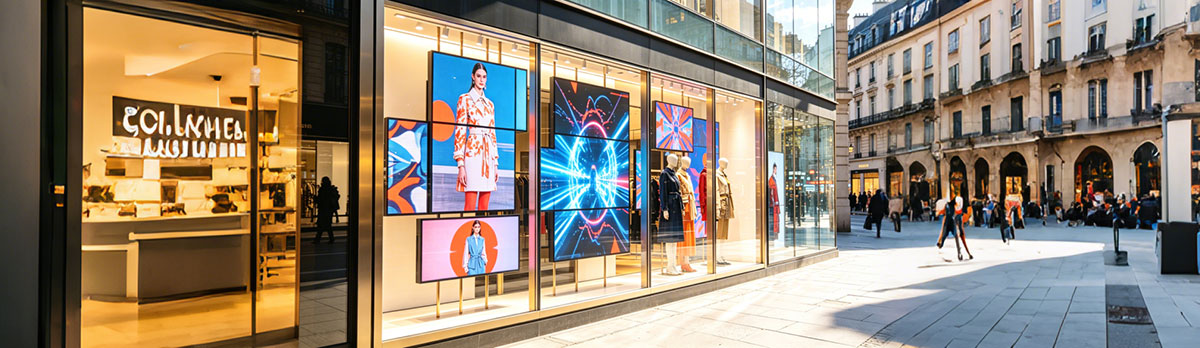
The following table consolidates field-measured ambient conditions with derived minimum display luminance requirements. Values assume standard low-e double-glazing (approx. 70% visible light transmission, 8% surface reflectance) and a target CRAL of 5:1. Operators requiring CRAL ≥ 7:1 for legibility in direct sunlight conditions should scale the minimum figures by a factor of 1.4.[1]
| Installation Scenario | Typical Ambient Illuminance | Reflected Lum. at Glass | Min. Display Brightness | Recommended Rating |
|---|---|---|---|---|
| Interior window — north-facing, overcast | 2,000 – 5,000 lx | ~150 cd/m² | 750 cd/m² | 1,000 nit |
| Interior window — east/west-facing, morning/evening sun | 10,000 – 30,000 lx | ~600 cd/m² | 3,000 cd/m² | 3,500 nit |
| Full window / semi-exterior — south-facing, midday summer | 60,000 – 100,000 lx | ~2,500 cd/m² | 12,500 cd/m² | 15,000 nit |
| Recessed window display — partial overhang shading | 5,000 – 15,000 lx | ~350 cd/m² | 1,750 cd/m² | 2,500 nit |
| Enclosed vitrine / double-glazed display case | 3,000 – 8,000 lx | ~200 cd/m² | 1,000 cd/m² | 1,500 nit |
§ 4Glass and Reflection Loss Factors
Window glass is not a neutral optical element. Every glass substrate between the display and the observer introduces both transmission losses and reflective veiling, each of which must be accounted for in the luminance budget. The following factors apply to standard commercial glazing types and should be obtained from the glazing manufacturer's technical datasheet where available.
| Glazing Type | Visible Light Transmission (VLT) | Surface Reflectance (each face) | Net Luminance Factor |
|---|---|---|---|
| Clear single-pane | 90% | 4% | 0.82 |
| Clear double-glazed (IGU) | 82% | 4–6% | 0.74 |
| Low-e double-glazed | 70–78% | 6–10% | 0.63 |
| Anti-reflective (AR) coated | 94–97% | <1% | 0.93 |
| Tinted / solar-control glass | 35–60% | 5–8% | 0.29–0.52 |
The net luminance factor indicates the fraction of display luminance reaching an external observer after accounting for transmission losses and reflective washout under a moderate ambient condition of 10,000 lx. Operators installing displays behind tinted glazing should treat this factor seriously: a 5,000 nit panel behind 40% VLT glass delivers an effective viewing luminance of approximately 1,500 cd/m² — adequate only for shaded or overcast conditions.
Anti-reflective coatings applied to the interior face of window glass are among the most cost-effective interventions available to improve perceived contrast. A single AR coat reducing surface reflectance from 8% to 0.5% can improve effective CRAL by a factor of 1.6×, equivalent to increasing display brightness by approximately 60% — often at a fraction of the cost of upgrading the display itself.
§ 5Thermal, Power, and Longevity Trade-offs
High-brightness operation imposes significant thermal loads on display panels and their mounting environments. LCD backlights running at 5,000–15,000 nit draw power densities of 300–900 W/m² of active screen area, compared with 80–150 W/m² for conventional commercial displays. In enclosed window installations — particularly south-facing double-glazed units with limited ventilation — panel temperatures can reach 65–80°C without active thermal management, substantially reducing LED backlight lifetime.[2]
Backlight technology and efficiency
Contemporary high brightness window displays predominantly employ direct-lit mini-LED or edge-lit LED array backlights with local dimming zones. Mini-LED architectures achieve superior luminance uniformity (<10% variation across zone boundaries) and enable more efficient power delivery at peak brightness. Manufacturers such as Dynascan, Philips Professional Display, and Samsung OMN series deploy this architecture for rated outputs of 3,000–7,000 nit with sustained full-screen operation at ambient temperatures up to 50°C.
For installations requiring 10,000 nit and above, direct-view LED (dvLED) tile technology is increasingly the preferred solution over LCD. dvLED modules at pixel pitches of 1.5–2.5 mm can achieve 8,000–20,000 nit with substantially better thermal distribution, longer service intervals, and the ability to segment arrays for non-rectangular window configurations.
Expected service life at rated brightness
The LED half-life (L70 — time to 70% of initial luminance) for high-brightness commercial LCDs operating at continuous full brightness is typically quoted at 50,000–70,000 hours by manufacturers, but this figure is invariably measured at 25°C ambient. Field data from installations in subtropical climates (Singapore, Dubai, Miami) consistently show 30–40% reduction in effective L70 when panels operate at sustained elevated temperatures. Automated brightness scheduling — reducing output during low-footfall hours and overnight — is therefore not merely an energy-saving measure but a material factor in asset lifecycle management.
§ 6Specification Checklist and Minimum Requirements Summary
The following checklist is intended to guide procurement decisions for window display hardware. Each criterion should be assessed during the site survey phase, prior to any hardware selection.
| # | Specification Criterion | Minimum Acceptable | Best Practice |
|---|---|---|---|
| 1 | Peak panel luminance (sustained, full-screen) | 1,500 cd/m² | ≥ 3,500 cd/m² |
| 2 | Contrast ratio under ambient light (CRAL) | 3:1 | ≥ 5:1 |
| 3 | Operating temperature range | 0°C – 45°C | −10°C – 55°C |
| 4 | Ingress protection (if semi-exposed) | IP54 | IP65 |
| 5 | Thermal management system | Forced-air internal fan | Active closed-loop cooling |
| 6 | Brightness scheduling (auto-dimming) | Manual timer | Ambient light sensor + CMS control |
| 7 | L70 backlight life (at operating temperature) | 40,000 hrs | ≥ 60,000 hrs |
| 8 | Anti-glare / anti-reflective surface treatment | AG coating | AR + AG dual coating |
| 9 | Viewing angle (horizontal, at 50% contrast) | 140° | ≥ 160° |
| 10 | Content management system compatibility | RS-232 / LAN | SMIL / HTML5 / REST API |
For the majority of retail window installations in temperate climates with standard clear double-glazing, a sustained full-screen luminance of 3,000–5,000 cd/m² represents the practical minimum for reliable daytime legibility. South-facing installations in high-insolation geographies, or installations behind tinted or solar-control glazing, should specify no less than 7,000–10,000 cd/m² with active thermal management. Specifying below these thresholds in the expectation of compensating with content optimisation (high-contrast graphics, white-on-black palettes) yields only marginal improvement — typically 15–25% — and does not substitute for adequate panel luminance.