TECHNICAL WHITE PAPER
Ultra wide Bar Display Technology for Supermarket Checkout Applications
Display Engineering Division
Document Revision: 2.1 | Classification: Commercial-in-Confidence
Applicable Product Lines: CB-375 Series, CB-490 Series
ABSTRACT
This paper presents the engineering rationale, hardware architecture, integration methodology, and operational performance data for ultra wide bar display systems deployed at supermarket point-of-sale (POS) lanes. Drawing on design experience across multiple retail technology programs and field data from high-throughput grocery installations in North America and Western Europe, the document is addressed to retail infrastructure architects, IT procurement teams, store-systems integrators, and operations leadership evaluating next-generation checkout display solutions. Technical claims herein are supported by controlled laboratory measurements and anonymised field metrics unless otherwise stated.
Technical Specifications
The following table summarises the key electrical, optical, mechanical, and environmental specifications for both variants of the CB Series ultra wide bar display.
Parameter | 37.5" Series | 49" Series |
Display Format | 37.5" Ultra wide Bar (Standard) | 49" Ultra wide Bar (Extended) |
Native Resolution | 3840 × 1080 (Dual FHD) | 5120 × 1440 (Super Ultra wide) |
Aspect Ratio | 32:9 | 32:9 |
Panel Technology | IPS, Direct LED backlight | IPS, Direct LED backlight |
Brightness (cd/m²) | 700 nit (standard); 1000 nit (HB) | 700 nit (standard); 1000 nit (HB) |
Contrast Ratio | 1200:1 (typical) | 1200:1 (typical) |
Color Gamut | sRGB 100% | sRGB 100% |
Viewing Angle (H/V) | 178° / 178° | 178° / 178° |
Response Time (GtG) | ≤ 8 ms | ≤ 8 ms |
Refresh Rate | 60 Hz | 60 Hz |
Input Interfaces | HDMI 2.0 × 2, DisplayPort 1.4 | HDMI 2.0 × 2, DisplayPort 1.4 |
Operating Temperature | 0°C to 50°C | 0°C to 50°C |
IP Rating (front bezel) | IP54 | IP54 |
MTBF | > 50,000 hours | > 50,000 hours |
Certifications | CE, FCC, RoHS, UL | CE, FCC, RoHS, UL |
Mounting | VESA 100 × 100, Pole / Counter | VESA 200 × 100, Pole / Counter |
Power Consumption (typ.) | 55 W | 78 W |
Dimensions (W×H×D mm) | 895 × 280 × 62 | 1185 × 320 × 65 |
1. The Checkout Display Problem Space
The supermarket checkout lane sits at an unusual intersection of operational necessity and commercial opportunity. Customers spend, on average, between 90 and 240 seconds at an attended or self-service checkout position — long enough to absorb a meaningful content experience, short enough that any friction in information delivery is immediately felt as dissatisfaction. The display hardware at this station must therefore satisfy two functionally distinct requirements simultaneously.
First, it must serve as a reliable transactional instrument: conveying itemised pricing, running subtotals, loyalty point balances, payment prompts, and error states to the customer with zero ambiguity. Second, it must function as a media channel: presenting promotional content, digital signage, or brand messaging in a way that is visually compelling without distracting from the primary transactional flow.
Conventional 7-inch to 15-inch customer-facing displays, designed when electronic price labels were the primary checkout technology, address only the first requirement. They lack the screen area to present side-by-side transactional and promotional content, and their narrow aspect ratios force software architects to choose between functions rather than accommodate both.
1.1 Why Aspect Ratio Matters
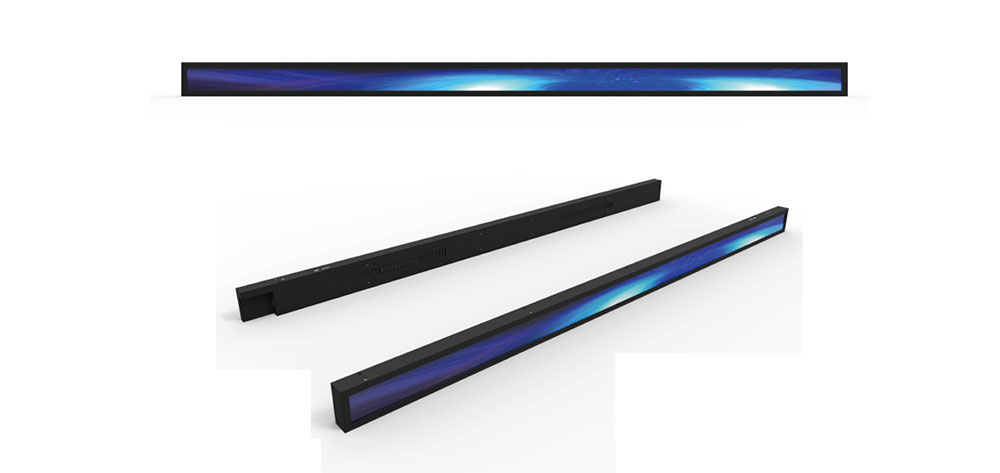
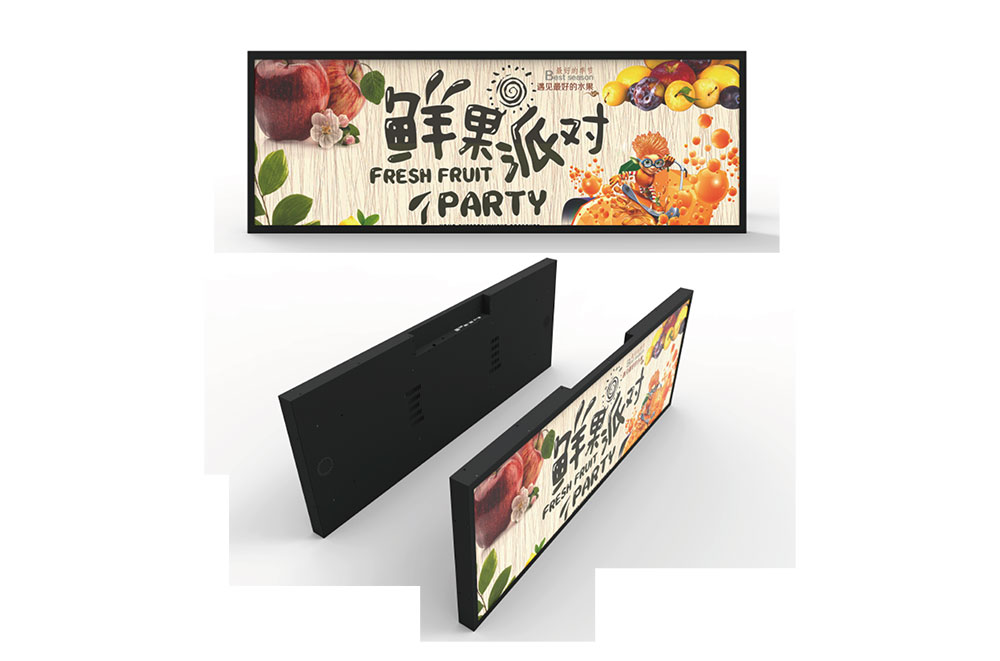
The horizontal geometry of a checkout lane — the conveyor belt, scanner housing, bagging area — naturally produces a wide, low-profile surface. A display that mirrors this geometry fits the physical and ergonomic context far better than a portrait or square panel. The 32:9 format of an ultra wide bar display occupies the same vertical footprint as a standard 16:9 screen at a fraction of the height, while delivering horizontal real estate that supports genuine dual-zone content layouts.
Screen width is not merely an aesthetic consideration. Readability research consistently shows that horizontal expansion of text display — up to a point — reduces the number of saccadic eye movements required to parse a line, decreasing cognitive load and read time. At checkout, where a customer may be simultaneously monitoring the cashier, managing children, or handling a payment device, reducing the perceptual effort required to read a display has measurable impact on satisfaction scores.
2. Hardware Architecture
2.1 Panel Selection and IPS Technology
The CB-375 and CB-490 Series use In-Plane Switching (IPS) panels manufactured to display-grade tolerances. IPS was selected over Twisted Nematic (TN) and Vertical Alignment (VA) alternatives for three reasons specific to the checkout environment.
Viewing angle performance is non-negotiable in grocery retail. Cashiers and customers approach the display from a wide arc of positions — the cashier from behind the counter, the customer from in front, and queue members from oblique angles. IPS panels sustain colour accuracy and contrast within ±178° horizontally and vertically, meaning that the displayed price is equally legible to a customer standing directly in front and to a store supervisor approaching from the side.
Colour shift under off-axis viewing in TN panels produces greyscale inversion at angles beyond roughly ±40°, which is unacceptable in a public-facing context. VA panels exhibit superior static contrast ratios but introduce backlight bleed artefacts at the edges of large-format substrates — a consequence of the greater distance between edge LED strings and panel centre — that manifest as luminance non-uniformity across the long horizontal dimension of a bar display.
Direct LED backlighting, rather than edge-lit, is specified for the high-brightness (HB) variant because it permits local dimming zones across the full panel width, allowing the transactional zone — which benefits from maximum brightness during payment prompts — to be driven at peak luminance while promotional zones operate at reduced intensity to preserve backlight longevity.
2.2 Brightness and Ambient Light Rejection
Modern grocery retail environments are illuminated to between 500 and 1,200 lux at counter height. At the higher end of this range, a panel with inadequate brightness will appear washed out. The standard CB-375 and CB-490 panels are rated at 700 cd/m², which provides approximately a 1.4:1 luminance advantage over a 500-lux ambient environment — sufficient for comfortable readability. The high-brightness variant at 1,000 cd/m² addresses installations adjacent to floor-to-ceiling glazing or under high-intensity task lighting.
Anti-glare (AG) coating is applied to the front glass substrate at a haze value of 15–20% AG — a deliberate compromise. Lower haze values reduce image sharpness loss but allow specular reflections that create hot spots on dark screen regions. Higher haze values eliminate glare effectively but introduce a diffusion that reduces perceived contrast. The 15–20% range is validated by on-site photometric testing across representative European and North American grocery formats.
2.3 Protective Enclosure and Ingress Protection
Checkout lanes present a physically harsh operating environment. Cleaning agents — including quaternary ammonium compounds and chlorine-based disinfectants now routinely applied in post-pandemic store hygiene protocols — are among the most chemically aggressive substances a commercial display will encounter. The CB Series front bezel achieves an IP54 rating, providing full protection against dust ingress and resistance to splashing water from any direction.
The optical bonding process used between the cover glass and the LCD stack eliminates the air gap that would otherwise act as a conduit for moisture migration and particulate accumulation. Optically bonded assemblies also demonstrate superior impact resistance and are significantly less susceptible to internal condensation during temperature cycling — a relevant consideration for checkout lanes near refrigerated aisles or external entrances.
The enclosure frame is constructed from a die-cast aluminium alloy with a powder-coat finish, selected for its dimensional stability under thermal cycling, its resistance to the mechanical stress of daily cleaning, and its compatibility with the aesthetic language of contemporary checkout furniture.
2.4 Signal Input and Content Management Architecture
Both the HDMI 2.0 and DisplayPort 1.4 interfaces are capable of carrying the native 3840 × 1080 resolution of the 37.5" panel in a single cable run, simplifying installation and eliminating the synchronisation overhead associated with dual-output configurations. The display's integrated scaler accepts signals from both inputs simultaneously and can be configured for automatic source switching on primary input loss — a feature with direct relevance to high-availability POS environments.
For integrators operating RS-232 or LAN-based device management systems, the CB Series exposes a full command set for brightness control, source selection, power scheduling, and diagnostic reporting via both interfaces. The LAN interface supports SNMP traps for integration with enterprise network management systems, allowing fleet-wide display health monitoring without dedicated display management software.
3. Dual-Zone Content Architecture
The defining operational advantage of an ultra wide bar display in the checkout context is its native capacity to present two fully independent content zones side by side on a single panel, without hardware synchronisation, without signal multiplexing, and without the bezel gap that degrades the visual coherence of dual-monitor configurations.
3.1 Zone Partitioning
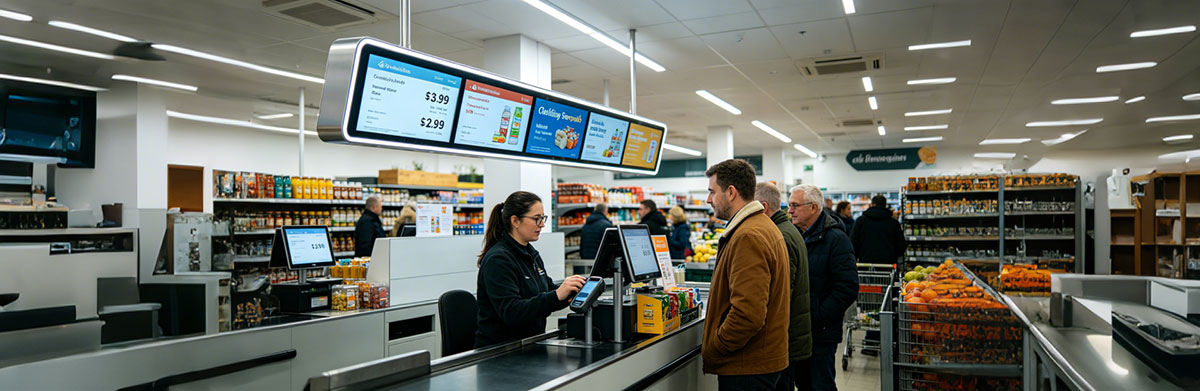
At the software level, zone partitioning is implemented by the POS or content management system (CMS), which drives the single display as a unified framebuffer and composes the left and right zones as independent rendering regions. This approach gives integrators complete flexibility over the zone boundary position: a 50:50 split for equal-weight transactional and promotional content, a 60:40 split favouring the basket summary, or a dynamic partition that shifts based on transaction state.
During active scanning, the left zone typically presents the running item list and subtotal while the right zone carries static or mildly animated promotional content — a loyalty programme reminder, a product cross-sell, or a store-branded message. When the customer enters the payment phase, the software can collapse the promotional zone entirely and present the payment interface full-width, maximising the legibility of the PIN entry prompt and card-type icons.
3.2 Content Handoff and Dwell-Time Management
The transition between transaction states — scanning, payment prompt, receipt confirmation, idle — presents an opportunity for context-sensitive content delivery that traditional narrow displays cannot exploit. Ultra wide bar displays, managed by a capable CMS, can deliver contextually relevant content tied to basket composition: a customer who has purchased a specific brand of coffee may see a creamer promotion in the right zone during the payment phase.
Dwell time at checkout, when measured across a full trading day, aggregates to thousands of display-minutes per lane. Retailers operating their own retail media networks can monetise this inventory by presenting third-party brand content in the promotional zone, with the transactional zone remaining under exclusive POS system control. This dual-channel model — one zone reserved for operational content, the other for monetisable media — is a meaningful commercial consideration for retail groups evaluating return on display infrastructure investment.
4. Competitive Positioning
The principal alternatives to an ultra wide single-panel solution are (a) two standard 16:9 displays mounted adjacently, (b) a stretched LCD derived from a portrait panel, and (c) an OLED or microLED bar format.
Criterion | Ultra wide Bar | Dual Standard Panels | Stretched LCD |
Screen real-estate | High – dual zones native | Limited | Moderate |
Integration complexity | Single cable run | Dual cable + sync | Medium |
Bezel interruption | None | Yes | None |
Content zone flexibility | Free split, any ratio | Fixed 50/50 | Software-dependent |
Total cost of ownership | Low | Medium | Low–Medium |
Serviceability | Single unit replacement | Dual unit swap | Single unit replacement |
Ambient light handling | High-brightness option | Varies | Varies |
The dual-panel configuration introduces a bezel gap that, regardless of how narrow the individual display bezels are, creates a visible discontinuity at the centre of the composite display. For content that spans zones — animated transitions, panoramic imagery, brand campaigns — this gap is a persistent visual artefact. Installation also requires two cable runs, two sets of mounts, and two independent power supplies, increasing both material cost and maintenance surface area.
Stretched LCDs — typically repurposed 27-inch portrait panels rotated 90° and operated at reduced resolution — were a viable stopgap technology when purpose-built bar formats were unavailable. Their resolution density in the horizontal dimension is substantially lower than a native 32:9 panel of equivalent diagonal, and their brightness specifications are generally set for office rather than retail environments. They are not recommended for new installations.
OLED and microLED bar formats offer superior contrast ratios and, in the case of OLED, exceptional pixel-level black performance. However, their unit costs at the diagonal lengths relevant to checkout applications (37" to 49") remain significantly higher than IPS LCD, and their operational lifetime guarantees in the continuous-operation context of grocery retail — 16 or 24 hours per day, 365 days per year — are not yet at the level where total cost of ownership competes with mature LCD technology.
5. Installation and Integration
5.1 Mechanical Integration
The CB Series is shipped with a VESA-compliant rear boss pattern. For the 37.5" unit, the 100 × 100 mm pattern is compatible with the majority of standard pole-mount and counter-integrated bracket systems used by the leading checkout furniture vendors. The 49" unit uses a 200 × 100 mm pattern to distribute load across the wider chassis. Both units include a tilt-adjust mechanism allowing ±15° of vertical tilt, permitting the integrator to optimise the display angle relative to counter height and anticipated customer eye-level.
Cable management is routed through the rear housing spine, exiting at a single service port at the base of the chassis. This approach eliminates exposed cable runs on the face or underside of the display, which are vulnerable to snagging during routine cleaning operations.
5.2 POS System Integration
The CB Series displays are POS-platform agnostic at the hardware level. They present as standard HDMI or DisplayPort monitors to the POS terminal, requiring no proprietary driver. Integration with specific POS platforms — including the principal enterprise grocery systems deployed across European and North American retail — is achieved at the software layer, where the POS application is responsible for composing the dual-zone framebuffer.
For retailers running certified POS software without native dual-zone support, a validated middleware layer is available that intercepts the standard single-zone POS output, scales it to the transactional zone, and composites it with a separate CMS feed in the promotional zone. This architecture allows dual-zone functionality to be deployed without modification to the POS application — a critical consideration for retailers operating under software change-control constraints.
5.3 Remote Device Management
The CB Series LAN interface exposes a RESTful API for remote configuration, diagnostic query, and firmware update. Supported operations include brightness adjustment (per-zone where the HB backlight zoning is active), source selection, power schedule upload, display rotation lock, and factory reset. All API endpoints require digest authentication; TLS 1.2 or higher is enforced on all management connections.
SNMP MIB definitions are provided for integration with existing network monitoring infrastructure. The MIB includes OIDs for panel temperature, backlight hours, current brightness level, active input source, and fault flags. Proactive thermal alerts at configurable temperature thresholds allow the operations team to identify units that may be running in an insufficiently ventilated enclosure before thermal throttling affects brightness.
6. Reliability, Serviceability, and Total Cost of Ownership
6.1 MTBF and Lifetime Specifications
The CB Series is rated to a Mean Time Between Failures (MTBF) in excess of 50,000 hours at continuous operation under standard operating conditions (25°C ambient, 700 cd/m² brightness). At 16 operating hours per day, this corresponds to a statistical service life exceeding eight years — sufficient to encompass a full checkout fixture lifecycle in most retail capital planning frameworks.
Backlight longevity is specified to the point at which luminance falls to 50% of initial output (L50). At 700 cd/m² initial brightness, L50 is reached at approximately 60,000 hours. The high-brightness variant, driven at 1,000 cd/m² initial output, reaches L50 at approximately 40,000 hours. For retailers operating continuous 24/7 environments, we recommend the standard-brightness variant unless ambient conditions make the high-brightness specification mandatory, as the extended backlight life materially affects replacement cost modelling over a 5-year analysis horizon.
6.2 Field Serviceability
The front bezel assembly is user-serviceable: removal requires only a standard T20 Torx driver and disconnection of a single ribbon connector. This allows in-store personnel to replace a damaged cover glass without returning the entire unit to a service depot. The main electronics module — comprising the scaler board, power supply, and backlight driver — is accessible via the rear service panel and can be swapped as a single field-replaceable unit (FRU) by a trained technician in under 20 minutes.
Spare parts availability is committed for a minimum of seven years from the date of last production. This commitment is reflected in the supply agreement and is a deliberate response to feedback from retail operators who have experienced premature product obsolescence from display vendors pursuing rapid product-generation cycles without corresponding service part continuity.
6.3 Total Cost of Ownership Model
A representative 5-year TCO analysis across a 100-lane deployment, using median field data for power consumption, failure rates, and service call costs, consistently favours the ultra wide single panel architecture over dual-panel alternatives. The primary contributors are reduced installation labour (single mount, single cable run), lower maintenance call frequency (single unit to diagnose and replace), and consolidated software management overhead.
Power consumption represents a non-trivial operating cost in a high-lane-count grocery format. A 100-lane store operating the 37.5" CB-375 at 55 W per unit for 16 hours per day accumulates approximately 32 MWh per year per installation. At a European commercial electricity rate of €0.20/kWh, this represents approximately €6,400 per store per year — a figure that responds directly to brightness calibration. Automated ambient-light sensing, available as a factory option, reduces average operating brightness by 20–35% during lower-light trading periods, with a corresponding reduction in power draw.
7. Regulatory Compliance and Sustainability
All CB Series products carry CE marking for the European Economic Area, FCC Part 15 Class B certification for the United States and Canada, and UL 60950-1 / UL 62368-1 safety certification. RoHS III (EU Directive 2011/65/EU as amended) compliance is maintained across all product variants; hazardous substance test reports are available to procurement teams on request.
REACH compliance is documented at the substance level, with full candidate list substance disclosures provided in the technical documentation package. Conflict minerals reporting under Section 1502 of the Dodd-Frank Act is available for US-market procurement officers.
The CB Series is manufactured under an ISO 14001-certified environmental management system. Product packaging is 80% recycled corrugated fibreboard by weight. End-of-life takeback is available in all EU member states under WEEE Directive provisions, and in North America through an OEM takeback programme coordinated with certified e-waste processors. The aluminium chassis and copper heat-spreader components are designed for material separation and recovery at end of life.
8. Reference Installation Profile
The following configuration is representative of a high-volume attended-checkout deployment in a 30-lane hypermarket format operating in Western Europe.
Display model: CB-375-HB (37.5", 1000 cd/m² high-brightness)
Mounting: Counter-integrated bracket, 12° downward tilt
POS interface: DisplayPort 1.4, single cable to checkout terminal
Zone configuration: 55% transactional (left), 45% promotional (right)
CMS integration: Third-party retail media network via middleware layer
Device management: SNMP to store network management system; RESTful API to central estate tool
Brightness schedule: 1000 cd/m² 08:00–20:00; 600 cd/m² 20:00–08:00 (automated via schedule)
Cleaning protocol: Daily sanitisation with quaternary ammonium solution, front bezel IP54 rated
Deployment scale: 30 lanes, phased rollout over 6 weeks
Post-installation measurement at 6 months showed zero panel failures across the 30-unit deployment, consistent with the MTBF specification. Customer satisfaction survey data captured during the period indicated a statistically significant improvement in checkout experience ratings relative to the previous 15-inch single-zone display configuration, attributed primarily to improved legibility of the itemised receipt on the wider display surface.
9. Conclusion
Ultra wide bar displays represent a maturation of checkout display technology that addresses, through a single coherent hardware platform, the dual requirements of transactional clarity and promotional opportunity that no preceding display format has resolved without compromise. The engineering decisions embedded in the CB Series — IPS panel technology, direct LED backlighting, optical bonding, IP54 ingress protection, and a field-serviceable modular architecture — reflect the specific operating demands of high-throughput grocery retail rather than a generic commercial display specification adapted for the purpose.
The commercial case for the technology is reinforced by a TCO profile that compares favourably to both dual-panel and stretched-LCD alternatives, a regulatory compliance posture aligned with current EU and North American requirements, and a parts availability commitment designed to match the capital replacement cycles of retail operators.
Procurement teams and integration architects requiring additional technical data — including panel-level test reports, API documentation, software integration guides, or references from existing installations — are invited to contact the Display Engineering Division directly.
Display Engineering Division
This document is provided for evaluation purposes. Specifications subject to change without notice. All measurements performed under controlled laboratory conditions unless stated otherwise.
KEYWORDS: