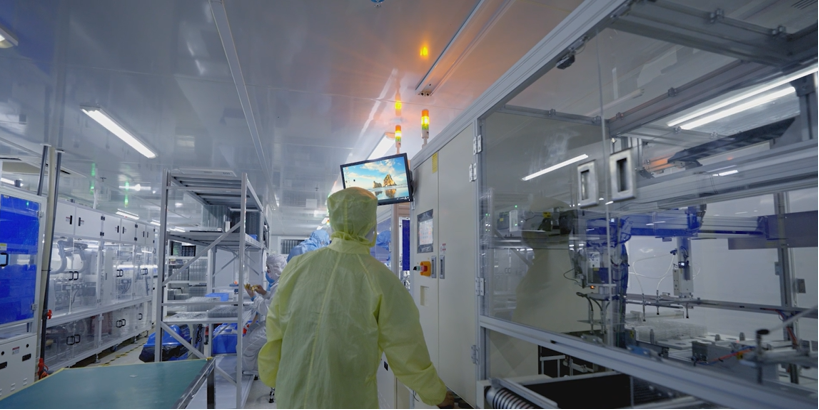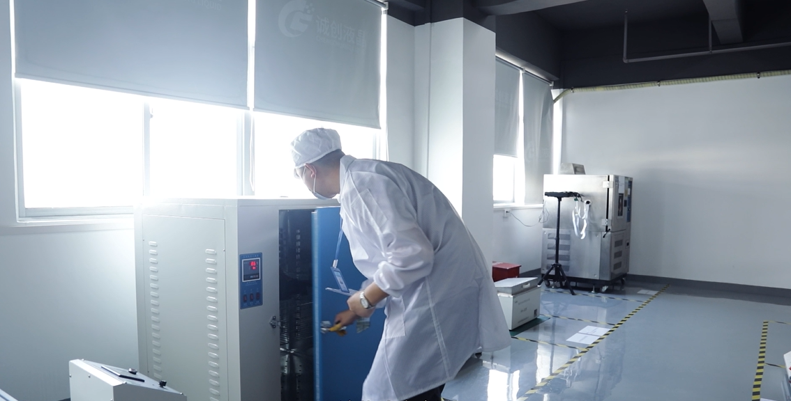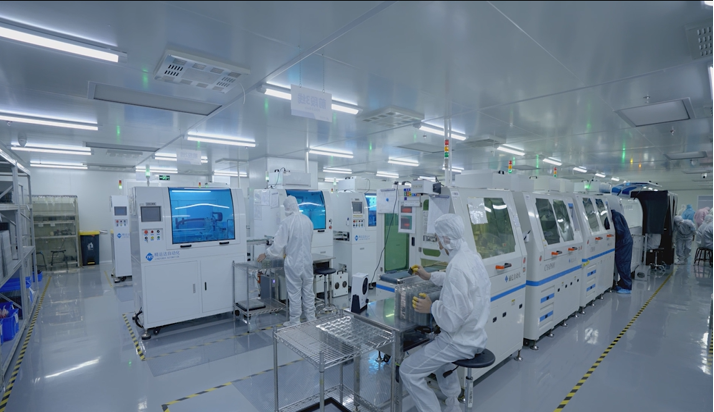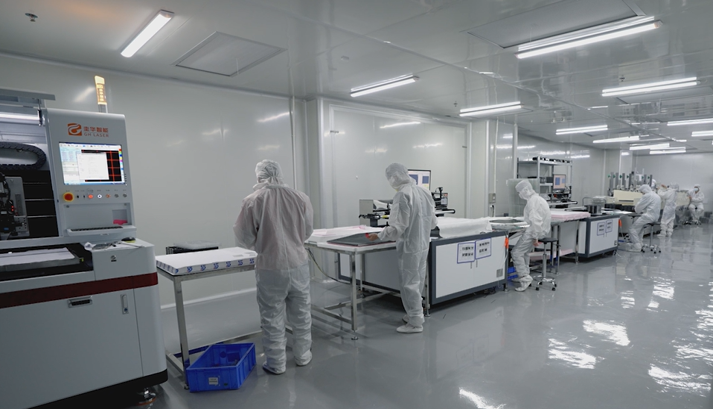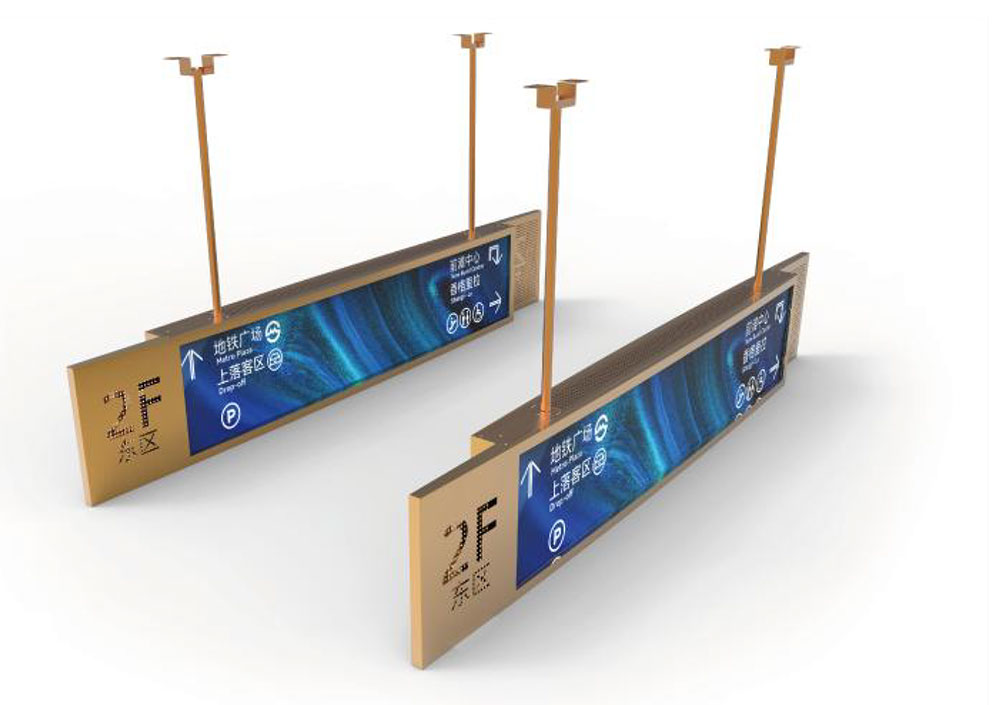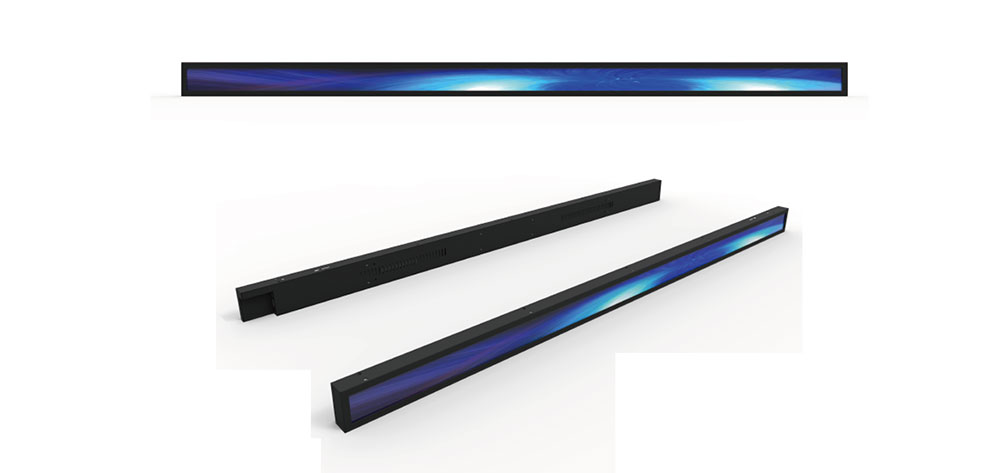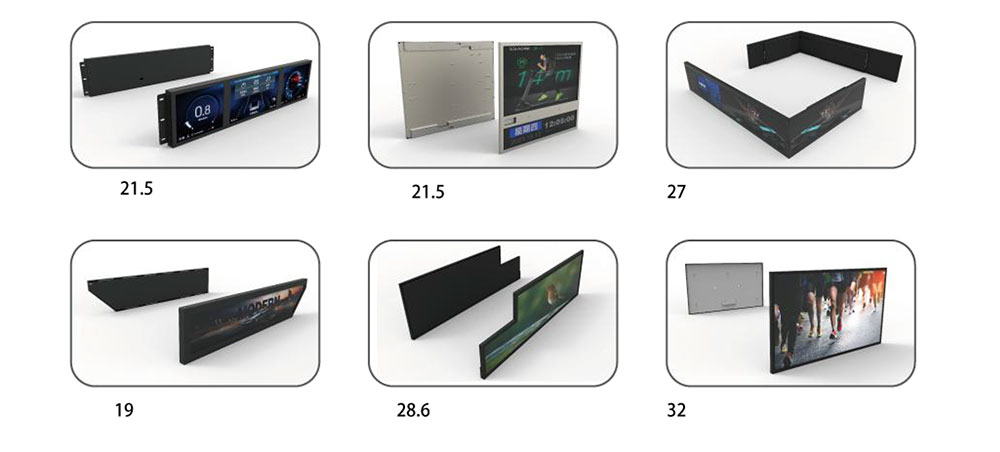
A stretched LCD — also sold as a bar-type, strip, or ultra-wide panel — is the workhorse of shelf-edge retail media. It occupies a price rail's footprint, fits between shelf decks, and turns a static facing into a controllable, POS-linked price and promotion surface. The category is also unusually prone to bad procurement, because the panels themselves are cut from mother-glass in low volumes, the operating environment is thermally hostile, and the failure modes (image sticking, brightness decay, condensation) appear months after acceptance. This paper sets out the technical and documentary criteria that separate a display that survives five years on a dairy case from one that is dead by the second Christmas reset.
1. Panel Geometry: What "Stretched" Actually Means in Practice
Stretched panels are cut to non-standard aspect ratios from the same glass as conventional monitors, which is why availability, resolution, and price move with panel-maker roadmaps rather than with your project schedule. Typical families run from roughly 16:3 to 16:1, in diagonal sizes from about 16 inches to 48 inches and beyond. You will encounter resolutions such as 1366 × 256, 1920 × 158, 1920 × 357, 1920 × 540, and 3840-class variants; the specific pairing of size and resolution changes between panel generations and even between grades of the same size.
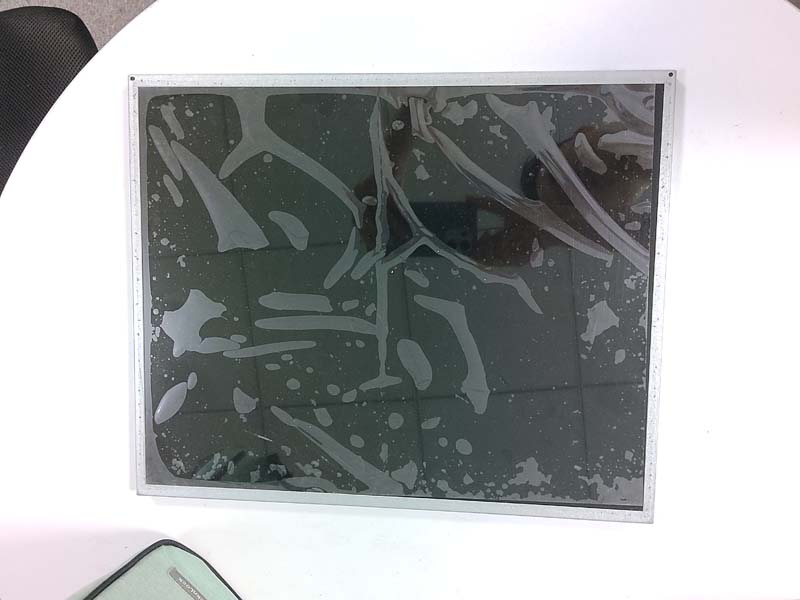
Two consequences follow. First, never specify by diagonal size alone — specify by visible active area (width × height in millimetres), because a 28-inch bar from two suppliers can differ by 15 mm in height, which is the difference between clearing the shelf above and fouling it. Second, check resolution against the text you actually intend to render:
- Pixel pitch = active width ÷ horizontal pixels.
- Minimum cap height for critical price digits should be at least 1/250 of the maximum viewing distance; at 0.8 m that is roughly 3.2 mm, and at 2 m roughly 8 mm.
- Convert: required pixels = required cap height ÷ pixel pitch. A 1920-wide panel measuring 660 mm gives a 0.344 mm pitch, so an 8 mm cap height needs about 23 pixels — comfortable — while a 4 mm-tall unit price needs about 12 pixels, which is workable but leaves no room for a two-line layout.
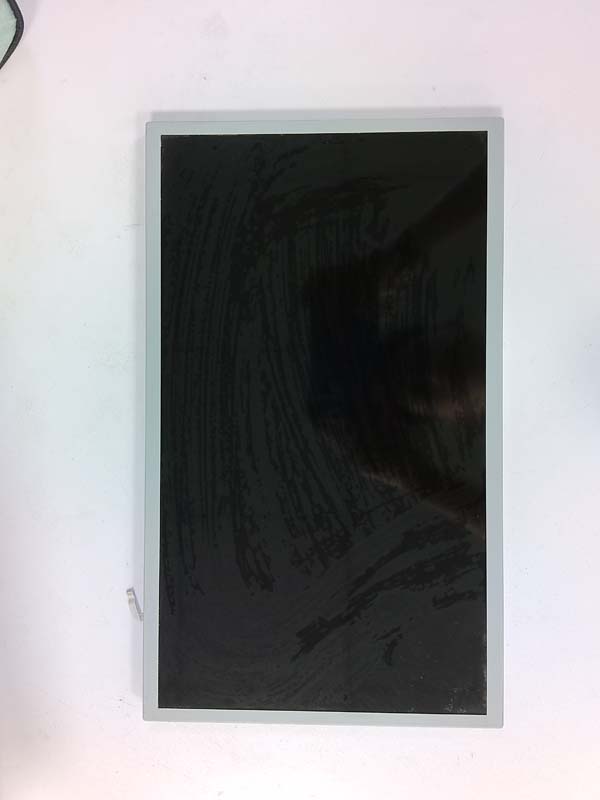
Also confirm panel orientation flexibility. Some bar panels are designed for landscape only; rotating them into a portrait strip changes the polarizer's off-axis behaviour and can produce visible colour shift down the length of the unit.
2. Optical Performance: Brightness Is a Calculation, Not a Badge
Shelf-edge displays sit in 500–1000 lux ambient in a typical store, 1500 lux or more in premium fresh-format lighting, and considerably higher near glazed façades. A common mistake is to chase headline nits without modelling what the panel has to overcome. The reflected luminance from the environment is:
Lreflected = E × ρ / π
where E is illuminance in lux and ρ is the panel's total diffuse reflectance. Take a matte anti-glare front with 4% reflectance under 1200 lux: reflected luminance is about 15 nits. A 500-nit display then delivers roughly 33:1 against the reflection — legible. Raise ambient to 2000 lux with a glossier cover at 6%: reflected luminance approaches 38 nits, and a 500-nit panel collapses to 13:1, which reads as washed out under specular hotspots and is unacceptable for price-critical content. In practice, specify 700 nits minimum for standard dry-grocery shelving and 1000 nits for window-adjacent, fresh, and high-ceiling formats. Do not go beyond roughly 1200 nits on static-content shelves without a burn-in mitigation plan.
Beyond peak brightness, insist on measured, not typical, values for:
- Luminance uniformity — 9-point minimum/maximum ratio of at least 75%, ideally 80%, measured to ISO 9241-305 or VESA FPDM practice. Bar panels are lit by edge LEDs along the long axis, so the far end is the weak point; ask for a uniformity map, not a number.
- Colour uniformity — Δu′v′ ≤ 0.005 across the field. Brand colour blocks (red cola, green produce) expose this instantly.
- Anti-glare treatment — AG haze of roughly 25–40% with low sparkle, or a laminated AR front for freezer doors where you are looking through glass at a steep angle.
- Viewing angle — shoppers look up at top shelves and down at bottom shelves. IPS-type panels with 178°/178° (CR ≥ 10) hold colour and gamma better than VA at 45–60° off-axis, which is exactly the angle at a low shelf.
- Flicker — demand DC-dimming or high-frequency PWM and a test against IEEE 1789 recommendations. Low-frequency PWM at high brightness is a documented source of operator discomfort and shows up as banding on phone cameras.
3. Mechanical and Thermal Integration
A shelf-edge display is a mechanical problem before it is a display problem. Establish these constraints before you shortlist:
- Depth — 20–40 mm is typical. On a 400 mm shelf, a 45 mm-deep unit plus brackets can remove a full facing row of product. Model the merchandising loss in units, not millimetres.
- Height versus the price rail — the display's active area should align with the rail it replaces. Units substantially taller than the rail obstruct labels and product on the shelf above, and store staff will remove them.
- Mounting — front-rail hooks, VESA patterns on the rear, or magnetic/rail adapters. Confirm the adapter is rated for the unit's mass plus cable load, and that shelf weight capacity is not exceeded when several units run in a row.
- Serviceability — can a unit be released and swapped in under two minutes without unloading the shelf? If not, plan for a maintenance backlog.
- Power distribution — 24 V DC is preferred over 12 V because cable losses fall fourfold for the same current. For a 30 W display on a 20 m run at 24 V, 1.0 mm² conductors drop roughly 1 V; the same load at 12 V drops about 4 V, which can push the input below the panel's tolerance and cause random shutdowns that look like firmware faults.
- Thermal — enclosed shelf cavities have poor convection. Specify the maximum ambient at which full brightness is sustained without derating, verify the touchable-surface temperature against IEC 62368-1 limits, and require an ambient-light sensor for automatic brightness reduction.
- Cold cases and freezers — at −20 °C, liquid-crystal response slows dramatically, backlight start-up can fail, and condensation forms on the inner face during defrost cycles. Units for frozen applications need heated front glass or internal thermal regulation, an IP-rated front seal, and a documented cold-start test, not a datasheet claim of "wide temperature."
4. CERTIFICATION EVIDENCE LIBRARY
For a retail chain, the compliance file is a procurement deliverable in its own right. A display without a coherent evidence library cannot be installed legally in some jurisdictions, cannot be insured cleanly, and cannot be defended in an audit. Build the library per SKU, and make it a condition of the purchase order.
4.1 What belongs in the library
| Category | Documents to hold | What to verify |
|---|---|---|
| Product safety | CB test certificate and CB test report to IEC 62368-1; national marks (UL/ETL to UL 62368-1 Ed. 3, UKCA, PSE, KC, BSMI, CCC, EAC, NOM, INMETRO, BIS, SIRIM, RCM) | Model number identical to the order SKU; factory name and address match the audited site; certificate not expired or suspended; CB report includes the adapter and any PoE module |
| EMC | Test report to EN 55032 Class B and EN 55035, plus EN IEC 61000-3-2 and -3-3; FCC Part 15 Subpart B report with FCC ID and grantee code; ICES-003 | Class B, not Class A — Class A equipment is not intended for residential use and chain legal teams increasingly reject it; results measured with the unit daisy-chained and at maximum cable length |
| Declarations | EU Declaration of Conformity (signed, dated, listing every harmonised standard applied); UKCA DoC with designated standards | Standards editions are current — for example the correct year suffix on EN 62368-1 and EN 55032 — and the signatory is an authorised representative, not a sales office |
| Substances & environment | RoHS 2 technical documentation per EN IEC 63000; REACH SVHC declaration dated against the current candidate list; WEEE registration per member state; packaging compliance to EU 2025/40 and applicable US state EPR schemes; California Prop 65 and TSCA statements; conflict-minerals CMRT | The REACH declaration date is within six months — the candidate list is updated twice yearly, so a two-year-old declaration is a finding |
| Photobiological safety | IEC 62471 / EN 62471 assessment; IEC 62471-7 where applicable | Risk group stated for the actual brightness setting at the specified viewing distance |
| Energy | External power supply efficiency to EU 2019/1782 and US DoE 10 CFR 430 Subpart B; measured power consumption at typical and standby | Adapter model on the certificate matches the one in the box, including its country variants |
| Reliability evidence | MTBF calculation basis; dead-pixel acceptance per ISO 9241-307 Class II; backlight L70 curve; burn-in and thermal-soak reports | Test conditions (temperature, brightness setting, duty cycle) are stated; a bare number without conditions is marketing |
| Factory quality | ISO 9001 and ISO 14001 certificates; per-lot inspection reports (hi-pot, earth-bond, ageing/burn-in); AQL sampling plan to ISO 2859-1 | Certification body is accredited and the scope covers display assembly, not trading |
4.2 Verification, not collection
A PDF is not evidence until it has been checked against an independent source. Validate CB certificates in the IECEE online certification database, UL and ETL listings in the relevant product-iQ style directory, FCC IDs in the FCC equipment authorisation database, and notified-body scope in the European NANDO register. Cross-check the label photograph supplied by the factory against the certificate: model, ratings, manufacturer address, and mark layout. Photograph the label on the first production unit and file it alongside the certificate — model-number drift between the certificate and the shipping label is the single most common compliance gap found in retail AV audits.
4.3 Document control and retention
Name files by SKU, document type, issuing body, and revision, and record three dates: issue, expiry, and next surveillance audit. Retain the file for at least ten years after the last unit is placed on the market, which is the retention expectation under the EU EMC and RoHS regimes, and longer if your own quality system requires it. Hold safety-critical component certificates — power supply, adapter, PoE injector, panel — in a BOM-linked sub-library so that a supplier's silent component substitution is detectable at goods-in rather than at the first failure.
4.4 Red flags
- A certificate whose model number is a family name ("Bar Series") that does not appear on your PO or the label.
- Class A EMC reports presented as suitable for retail installation.
- Declarations of Conformity with a typed signature block and no named authorised representative.
- Test reports from laboratories without ISO/IEC 17025 accreditation for the test in question.
- Photobiological safety statements that cite a risk group but not the luminance and distance at which it applies.
- REACH declarations with no date, or dated before the most recent candidate-list update.
- Any refusal to provide the CB test report on the grounds of confidentiality — the summary certificate is public, and the full report can be shared under NDA.
5. Signal Architecture and Content Delivery
Stretched displays are usually deployed in runs of twenty to two hundred units per store, which makes the distribution architecture a bigger cost driver than the panel. Three patterns dominate:
- Local player per screen — an embedded Android or equivalent SoC with an RJ45 connection and a cloud CMS. Simplest to scale, most resilient to a single cable failure, and the only practical option when content is per-shelf and POS-driven.
- Daisy-chained HDMI — cheapest in bill of materials, but each hop adds latency and a failure point, and a mid-run fault blanks everything downstream. Acceptable for three to five units with a loop-out that genuinely re-clocks.
- AV over IP or HDBaseT — appropriate where content must be synchronised across a run, for example a scrolling banner spanning several shelves. HDBaseT carries power and signal over Cat6 to roughly 100 m; passive HDMI beyond 5 m is not a design choice, it is a fault waiting for a busy Saturday.
Whatever the transport, require a documented API or at minimum a POS price-feed integration path. A shelf display that shows a price different from the till is a regulatory exposure in most markets, not just a customer-service issue.
6. Panel Grade, Backlight Life, and the Static-Image Problem
Two numbers determine how the wall looks in year four. The first is backlight life: L70 figures of 30,000–50,000 hours are common, and at 16 hours a day that is five to eight years — but only at the brightness and temperature stated. Running a 700-nit panel at maximum in an enclosed shelf cavity can halve that, because LED junction temperature drives lumen depreciation. Running at 80% of maximum with ambient-linked dimming is the cheapest reliability upgrade available.
The second is image sticking. Shelf content is by nature static: the same price block in the same position for weeks. High-brightness IPS panels with static white or saturated blocks will retain ghosting, and no warranty wording fixes a customer's perception of a "burnt" screen. Mitigations to require in the CMS and the hardware: pixel-shift or orbit, a scheduled full-screen refresh, avoidance of large pure-white fields, and brightness reduction when the aisle is quiet. Ask the supplier what duty cycle the warranty assumes — 16/7 and 24/7 are different products and should be priced differently.
Specify panel grade explicitly. A-grade modules carry a published defect allowance; "A-minus" and ungraded cells are common in low-cost bar panels and appear as bright sub-pixels against the black field of a price background, which is precisely the most visible failure mode on a dark shelf strip. Reference ISO 9241-307 Class II as the acceptance criterion in the contract.
7. A Test Protocol You Can Run Before the Rollout
- Incoming inspection — unbox a statistically valid sample to ISO 2859-1 at AQL 1.0 major / 2.5 minor; photograph labels; verify adapter and cable part numbers against the certificate library.
- Photometric bench — measure centre luminance at 100%, 9-point uniformity, colour coordinates, ΔE against sRGB at three grey levels, and contrast, using a calibrated colorimeter. Record the ambient temperature.
- Visual stress — display a test pattern set including full grey ramps, a scrolling ticker, a saturated brand red, and a black field for 30 minutes.
- Thermal soak — 8 KEYWORDS: How to Choose a Stretched LCD Display for Supermarket Shelving