Why the Display Module Is Now a Critical Path Item in UK Automation Design
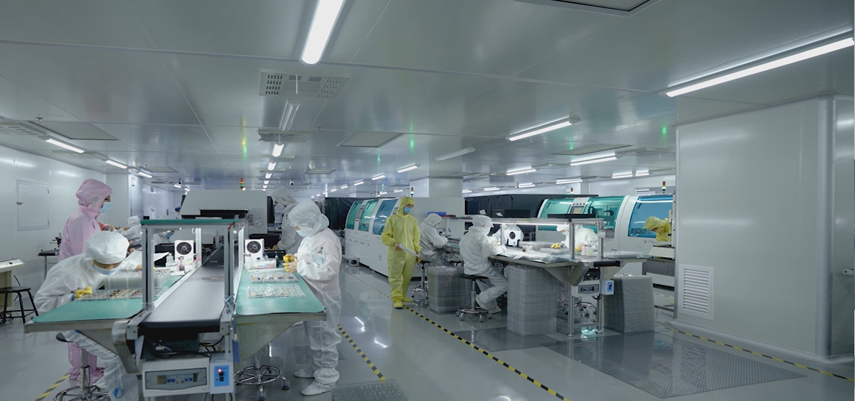
Walk onto any UK production floor today — a food packing line in East Anglia, a Tier 1 automotive cell in the West Midlands, a pharma filling suite in the North West — and you will find the same thing: operators, maintenance engineers and line supervisors reading information off a screen, several times a minute, for the whole shift. That screen is no longer an accessory bolted onto a cabinet. It is the primary interface between the machine and the people responsible for keeping it running, and its failure stops the line just as surely as a seized bearing or a tripped drive.
Yet display modules are frequently the last item specified and the first item cost-reduced. The result is a familiar failure pattern: a panel that looked crisp in the design office becomes unreadable under 40,000 lux of rooflight glare, a touch overlay delaminates after eighteen months of washdown, or the module goes end-of-life two years into a seven-year machine programme and forces an unplanned HMI redesign.
This paper sets out what UK automation equipment builders should actually be specifying in an industrial LCD display module, why the parameters matter in this market specifically, and where the usual specification mistakes occur.
The UK Automation Context: What Makes This Market Different
Industrial display requirements are not universal. The UK market has a distinctive set of pressures that shape module selection.
- Brownfield integration. A large share of UK automation projects are retrofit or line-extension work rather than clean-sheet builds. Modules must mechanically fit existing cut-outs, match legacy video timing, and often drop into enclosures that were never designed for modern display thermal loads.
- Compact machine footprints. UK factories are frequently constrained for space. Cabinets are shallow, panels sit close to the operator, and heat has fewer places to go — which pushes backlight efficiency and thermal design up the priority list.
- Washdown and aggressive chemistry. Food and beverage, brewing, dairy and pharmaceutical production drive demand for stainless-steel-fronted enclosures, IP65/IP66 sealing, and overlays that survive caustic and acid-based cleaning agents.
- Long machine life with short component life. A packaging machine may be in service for 15 years. A commercial TFT panel may be available for three. Managing that mismatch is now a core engineering discipline.
- Regulatory load. Machinery placed on the UK market requires UKCA marking, with CE marking still relevant for equipment moving into the EU. Both routes pull in EMC and electrical safety requirements that touch display wiring directly.
- Energy and ambient light. Many UK plants now run higher-efficiency LED lighting at high lux levels, or have glazed walls and rooflights. Displays that were adequate under older lighting are not adequate now.
Brightness: Getting Past the "Nits Are Nits" Assumption
The single most common specification failure is choosing a display on headline brightness alone. Luminance in cd/m² tells you only what the backlight emits at the centre of the panel, at full drive, at room temperature, with a fresh LED string. What the operator actually sees depends on several interacting factors.
Glare versus diffuse reflection
Factory floors generate two distinct reflection problems. Specular glare comes from point sources — task lights, machine indicator lamps, torches — and produces a sharp bright spot that wipes out a region of the display. Diffuse reflection comes from broad ambient illumination and lifts the black level across the whole screen, collapsing contrast. Surface treatment addresses the first; overall luminance and contrast ratio address the second.
Practical brightness classes
| Application environment | Typical ambient light | Recommended display luminance |
|---|---|---|
| Control room, enclosed cabinet HMI | 300–800 lux | 350–500 cd/m² |
| General factory floor, covered | 1,000–5,000 lux | 700–1,000 cd/m² |
| High-bay production, glazed end walls | 5,000–20,000 lux | 1,000–1,500 cd/m² |
| Outdoor canopy, dockside, rail, agriculture | 20,000–100,000 lux | 1,500–2,500 cd/m² with optical bonding |
A 1,000 cd/m² module with an anti-reflective bonded stack will outperform a 1,500 cd/m² module with a conventional air-gap assembly in almost every real installation. Bonding eliminates the internal glass-to-air interface, removing the double reflection that produces the characteristic washed-out look of unbonded panels under directional light.
Temperature, Vibration and Sealing
UK ambient conditions are mild, which encourages a false sense of security. The enclosure environment is what matters, not the weather.
Inside a sealed cabinet adjacent to servo drives, temperatures of 55–65 °C are routine, and a panel's own backlight adds to that. An LCD specified at 0–50 °C operating range may show slow response, contrast loss or outright black-out in a cabinet that has no active cooling. For automation equipment, target storage and operating ranges of −20 °C to +70 °C as a baseline, and confirm the manufacturer's definition of "operating" — some datasheets quote the panel itself, others the panel plus the specified driver board, and the two differ.
Vibration and shock requirements depend on where the display is mounted. A panel-head HMI on a machine base sees continuous low-level vibration that loosens connectors long before it damages the glass. Specifying locking or latching wire-to-board connectors, adequate strain relief on the LVDS or eDP harness, and a mounting frame that does not transmit chassis flex into the panel edge are all more effective than chasing ever-higher shock ratings.
For sealing, distinguish clearly between the front face of a panel-head unit and the module itself. An IP65 front face is normally achieved by the enclosure design — gasket compression, bezel thickness, fastener spacing — not by the raw display module. Modules rated IP65/IP67 on their own exist and are useful for cabinet-mounted and outdoor enclosures, but they change the mechanical and cost profile significantly.
Interfaces, Timing and Controller Compatibility
Display interface choice determines how much integration work sits between the panel and the machine controller.
- RGB/TTL parallel: Still widely used at smaller sizes and in legacy HMI platforms. Simple, but cable length and EMI become limiting factors as resolution rises.
- LVDS: The workhorse of industrial HMI. Robust over practical harness lengths, well supported by industrial SoCs and display controllers, and straightforward to route inside a cabinet if twisted-pair impedance is respected.
- eDP: Increasingly common where higher resolutions (1920×1080 and above) are needed on small physical panel sizes. Requires careful attention to link training and EMI, but reduces connector pin count considerably.
- MIPI DSI: Typical where the HMI is built around a consumer-derived or mobile-derived processor. Excellent for cost, but demands short, impedance-controlled routing and closer attention to ESD.
The frequent integration failure is not the interface itself but the backlight drive. Industrial panels commonly need a constant-current LED driver meeting a specified forward voltage and current window, sized for the worst-case cold-start conditions. Dropping a module onto a generic 12 V rail without proper current regulation produces short LED life, flicker, or immediate failure on the first cold morning in an unheated unit.
Where PWM dimming is used, keep the frequency well above the range that creates visible beat artefacts against machine vision systems, and confirm that the panel's own driver supports the minimum duty cycle the HMI software needs for low-brightness night operation.
Touch Technology Selection
Projected capacitive (PCAP) touch dominates new UK automation designs, but it is not automatically the right answer.
- PCAP gives multi-touch, high optical clarity and a long service life. It requires glove support tuned to the gloved-hand profile in use — thin nitrile, heavy leather and cut-resistant gloves all behave differently — and needs consideration of water films and conductive residue on the cover glass.
- Resistive remains valid where operators wear heavy gloves, where the surface is frequently wet, or where a stylus is used. Lower optical transmission (typically 75–85 % versus 88–92 % for PCAP) means brightness must be specified up to compensate.
- Cover glass and surface treatment deserve as much attention as the sensing layer. Chemically strengthened glass, anti-glare etching and anti-fingerprint coatings all affect both readability and cleaning durability. In food environments, verify chemical compatibility of the coating against the specific cleaning agents in use, not a generic "resistant to solvents" claim.
Lifecycle, Obsolescence and the Seven-Year Machine
This is where UK machine builders lose the most engineering time. Commercial display panels have short, fast-moving lifecycles. An automation platform may need ten years of build life plus fifteen years of spares support.
Practical mitigations:
- Design around a form-fit-function family, not a single part number. Confirm with the supplier that a replacement footprint, connector and interface exist before committing to a mechanical design.
- Require a documented product change notification (PCN) and end-of-life (EOL) process, with a stated minimum notice period — 12 months is a reasonable expectation for an industrial-grade module.
- Establish a last-time-buy (LTB) position early. LTB quantities should cover spares demand across the full service life, not just the remaining build programme.
- Keep the display behind a defined interface. Where the panel is driven through a standard LVDS or eDP interface, substituting an equivalent module is a firmware and mechanical exercise rather than a redesign.
- Qualify a second source before you need one. Qualification takes months; obsolescence notices do not wait.
Where the required supply horizon genuinely exceeds what a commercial panel will support, an industrial or long-life module — even at a premium — is usually cheaper than a mid-programme HMI redesign, requalification and field service campaign.
Compliance and Documentation for the UK Market
Display modules are components, not finished machinery, so the compliance burden sits mainly with the equipment builder. That said, the module choice affects how easily you demonstrate conformity.
- EMC: Industria KEYWORDS: Industrial LCD Display Modules for UK Automation Equipment