Why the Stretched Format Has Become the Default for Machine Interfaces
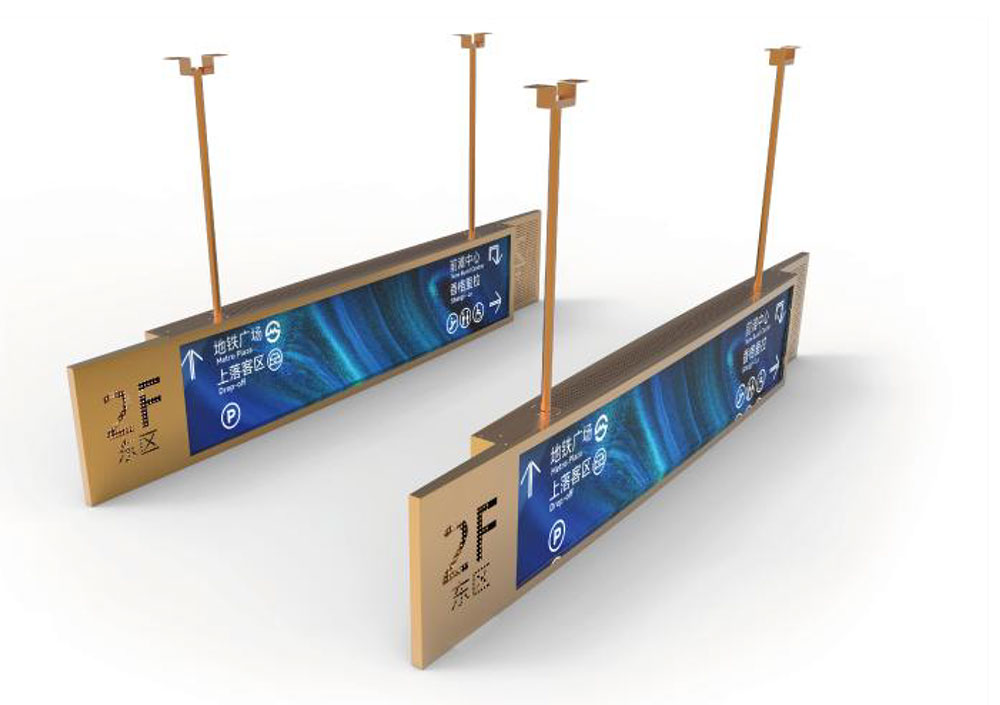
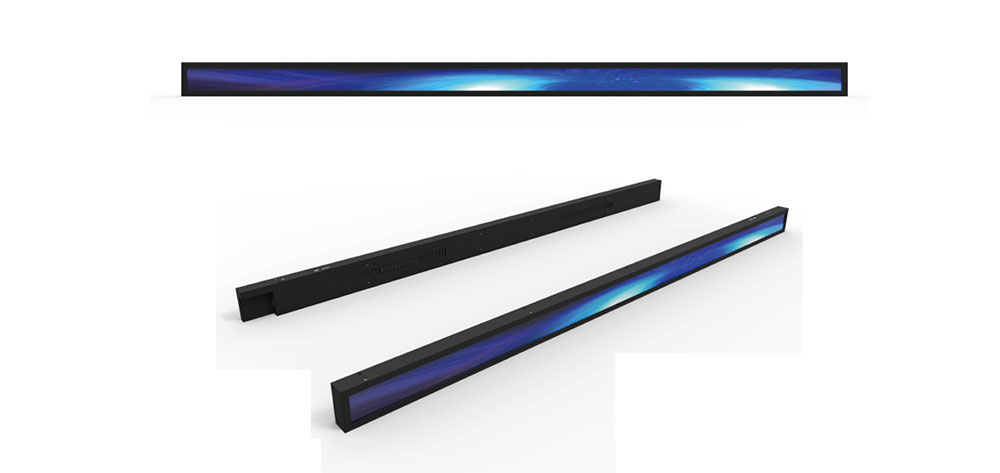
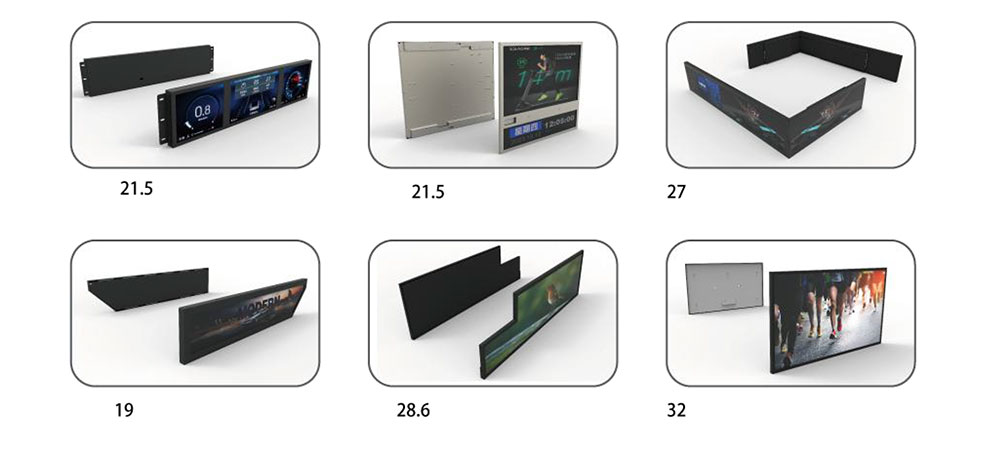
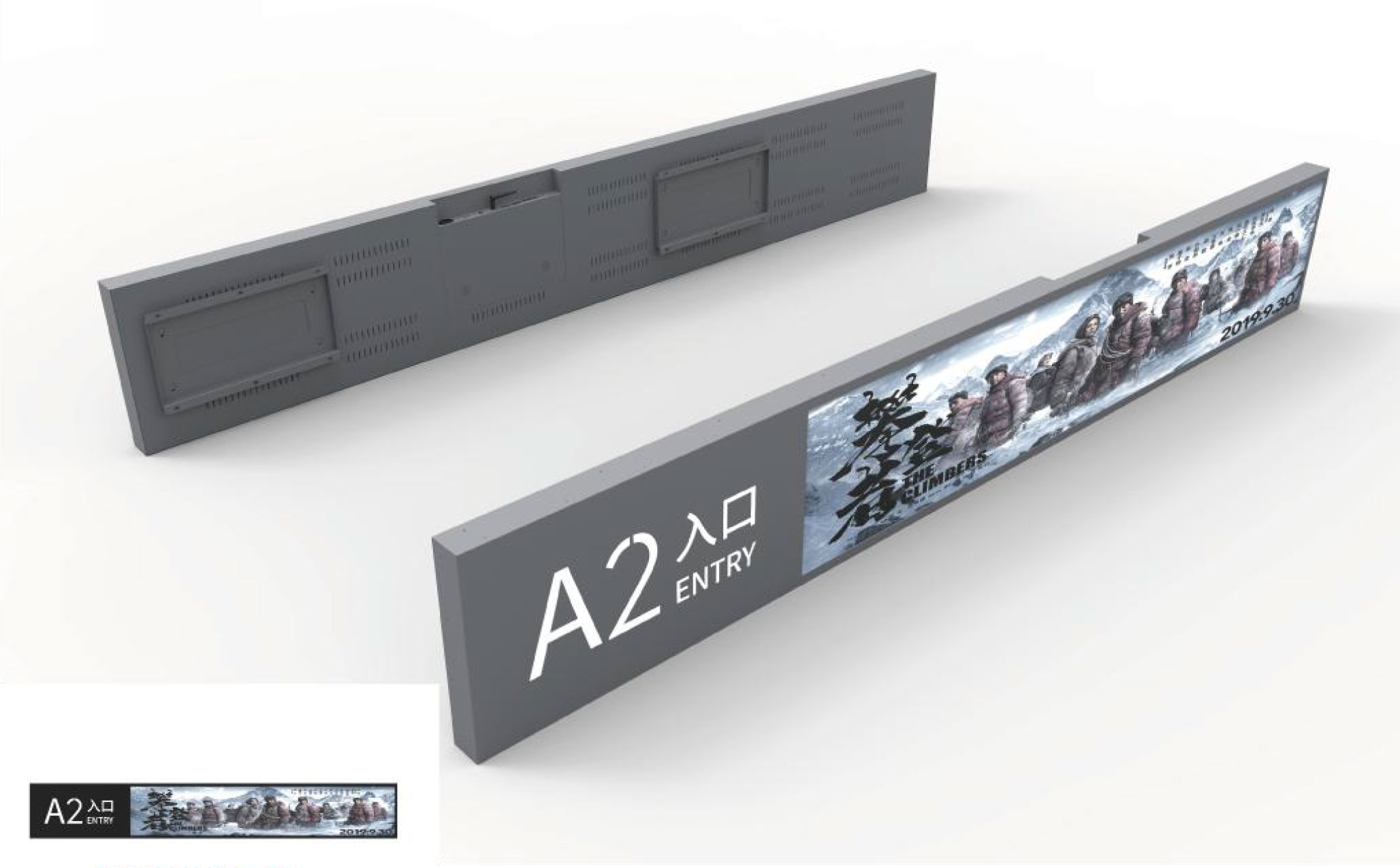
On a combine harvester, a CNC lathe or a bottling line, the operator interface has an awkward shape problem. The panel cutout is typically a shallow horizontal band across a dash, a guard rail or a control pedestal — perhaps 120 mm tall and 700 mm wide. A conventional 16:9 display either will not fit that aperture or wastes half its area on letterboxed space. A stretched LCD solves this geometrically: it is a bar-type panel built in ratios such as 16:4.5, 28:9 or 37:9, native resolutions like 1920 × 360, 1920 × 540 and 3840 × 1080, and diagonal sizes from 8.8 up to 49 inches. For a British original equipment manufacturer, the benefit is not cosmetic. A single 1,920-pixel-wide strip can carry a full instrument cluster — engine RPM, hydraulic pressure, DEF level, fault codes — in one bonded, sealed, sunlight-readable module, replacing a dozen discrete gauges and the harness that feeds them.
The engineering discipline lies in making that strip survive an agricultural yard in January, a quarry face in August, and a washdown hose in between. This article sets out the design decisions an OEM faces, and the documented testing evidence a display supplier should be able to hand over before a single unit goes onto a customer machine.
Brightness Is a System Property, Not a Specification Number
Bar-type panels for outdoor machinery are typically specified between 700 and 3,000 cd/m², but raw luminance misleads. What the operator actually experiences is the contrast between the displayed image and reflected ambient light, which is why high-brightness stretched displays are engineered as optical stacks rather than as panels with a bigger backlight:
- LED backlight architecture. Direct-lit arrays with local dimming let the panel push 1,500–2,500 cd/m² peak while keeping black regions dark, so a warning icon stays legible against a bright field rather than washing into grey.
- Anti-glare surface treatment. Haze values around 25 percent with reflectance pushed below 2 percent scatter specular reflections from a low sun without visibly blurring small text.
- Optical bonding. Laminating the cover glass to the LCD with an optical clear adhesive (OCA) removes the internal air gap. This raises transmittance, kills the double-reflection ghost that sits on unbonded assemblies, prevents internal fogging when a cold machine meets warm humid air, and improves impact resistance by distributing point loads across the glass.
- Thermal derating. Backlight lifetime and colour shift are functions of junction temperature. A display rated 2,500 cd/m² at 25 °C must still deliver usable output at 70 °C ambient inside an enclosure, which means current derating curves and a thermal path — often a bonded aluminium carrier — that moves heat into the machine's chassis.
Colour consistency matters especially for OEMs running multiple panels across a cab: a 5,000-unit order should hold ΔE within tight limits between units, which is achieved through per-unit calibration rather than bin sorting alone.
Environmental Survival: Matching the Standard to the Machine
British machinery manufacturers work to a mix of UK and harmonised European standards, and the display specification should mirror the machine's own duty cycle. A cab-mounted terminal on a tractor and a pedestal unit on a North Sea deck winch are different products with different evidence packs.
| Stress | Typical standard | Representative requirement |
|---|---|---|
| Dry heat / cold | IEC 60068-2-1, -2 | Operational −30 °C to +80 °C; storage −40 °C to +85 °C |
| Thermal cycling / shock | IEC 60068-2-14, -2-38 | Rapid transition between temperature extremes without seal failure or delamination |
| Damp heat | IEC 60068-2-30, -2-78 | Cyclic humidity with condensation, no internal fogging after OCA bonding |
| Sinusoidal and random vibration | IEC 60068-2-6, -2-64 | Engine and chassis excitation, typically 10–500 Hz at 1–2 g rms |
| Mechanical shock | IEC 60068-2-27 | 15–50 g, 11 ms half-sine, three axes |
| Ingress protection | BS EN 60529 / IEC 60529 | IP65 front face minimum; IP67 for washdown and hose-directed cleaning |
| Saline atmosphere | IEC 60068-2-52 | Cyclic salt mist for marine, offshore and coastal plant |
| EMC emissions and immunity | EN 55032, EN 55035, IEC 61000-4 series | ESD, radiated susceptibility, fast transients, surge on the harness |
| Product safety | IEC/EN 62368-1 | Audio/video and IT equipment safety for the display assembly |
| Materials compliance | RoHS, REACH, WEEE | Declaration of conformity and material declarations per part number |
Two British regulatory points are frequently missed. First, machinery placed on the GB market requires UKCA marking, and its HMI is often treated as a component within the assembly's risk assessment rather than as a standalone product — the display supplier's declaration must therefore be written to slot into the OEM's technical file, not to compete with it. Second, machinery safety functions that rely on the display (for example an operator confirmation step) sit under BS EN ISO 13849, which is a different regime from product safety and needs its own architecture discussion.
What "Supported by Documented Testing" Should Actually Mean
Purchasing a stretched display is straightforward. Proving it will still work in year seven is where suppliers separate. Documented testing should be treated as a deliverable with named artifacts, and an OEM should expect the following from a serious partner:
- A test plan agreed before tooling. The plan states which of the tests above apply, at what severity, on how many samples, and what constitutes a pass. It should reference the machine's own environmental spec, not a generic catalogue figure.
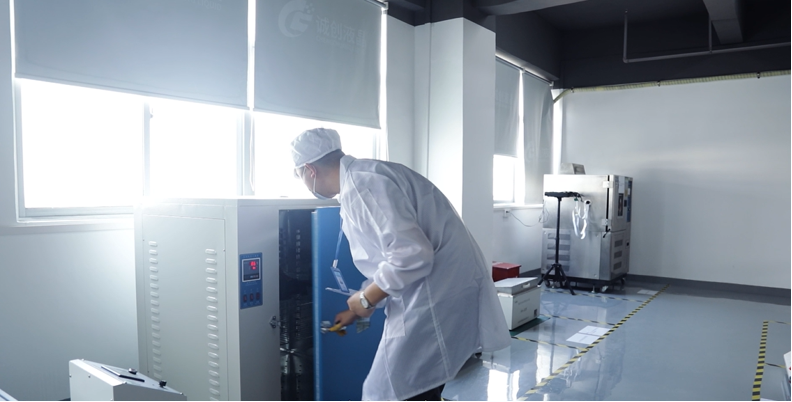
- Accredited execution where it counts. Thermal, EMC and ingress tests performed in third-party laboratories operating to ISO/IEC 17025 carry far more weight in a customer's audit than in-house screens. In-house reliability testing — high-temperature operating life (HTOL), temperature-humidity-bias, thermal shock — supplements rather than replaces it.
- Reports with traceable identifiers. Each report should name the sample serial numbers, the fixture and orientation, the test profile, the measurement equipment, and any deviations. Reports that omit the revision of the display under test are not evidence.
- Pre- and post-test functional characterisation. A pass is not "it turned on afterwards." The deliverable is luminance, colour, contrast and touch-accuracy data measured to the same method before and after each stress, with agreed drift limits.
- Optical and optical-bonding validation. Adhesive delamination, bubble formation and UV yellowing are the dominant field failures of bonded bar displays, which is why damp-heat cycling and UV exposure belong in the qualification matrix rather than in a marketing claim.
- Touch and haptic performance under stress. Projected-capacitive touch layers are validated with gloves, with water on the glass, and with a machine operator's hands, since a specification that only holds under laboratory conditions is not a specification.
- A change-control commitment. Any panel, driver IC, adhesive or LED bin change should trigger a delta qualification and a documented notification, so the OEM's own type approval is never invalidated silently.
The practical output is a qualification dossier that an OEM can fold into its CE/UKCA technical file, hand to a customer's engineering audit team, or use in a tender response without rewriting any of it.
Mechanical Integration and Long-Term Supply
Stretched displays are rarely catalogue items. An OEM solution typically defines the active area, the panel outline, a mounting pattern that suits the machine's carrier, connector position and harness exit direction, and a cover-glass geometry with a sealed edge and a defined bend radius for the bonded stack. Ruggedisation choices — an aluminium or steel backplate, gasket design, strain relief for the LVDS or eDP cable — should be decided early because they determine the flatness of the module and therefore the optical quality of the bond.
Signalling is a separate decision: LVDS and eDP are common for direct panel drive, while an integrated scaler board with DisplayPort, HDMI or CAN-capable host interface simplifies the OEM's own electronics and shortens the design cycle. Longevity planning matters as much as the specification. Machine platforms live far longer than consumer LCD generations, so an OEM needs a supplier who can commit to five-to-ten-year supply, hold a last-time-buy strategy, and offer a pin-compatible successor with a documented migration path rather than a redesign.
Getting the Specification Right the First Time
A brief for a stretched machine display should answer six questions before samples are cut: the physical aperture and the resulting aspect ratio; the ambient light environment and the required contrast rather than the required nits; the operating and storage temperature range with duty cycle; the ingress and cleaning regime; the host interface and degree of electronics integration; and the service life and supply horizon. When those are fixed, the correct brightness class, bonding method, touch technology and ruggedisation level follow logically, and the test plan can be written to the machine instead of to a datasheet.
For British machinery manufacturers, the competitive edge in operator interfaces is no longer resolution — it is confidence. A stretched LCD that has been thermally cycled, shaken, hosed, salt-sprayed and optically re-measured, with the paperwork to prove it, is what turns a display component into a platform decision that can be defended for the life of the machine.
KEYWORDS: OEM stretched LCD display, bar-type high brightness LCD, industrial stretched display supplier, EN IEC display testing, UKCA machinery HMI display