WHITE PAPER
Indoor vs Outdoor Digital Signage:
Key Differences Explained
A technical buyer's guide to display engineering, environmental protection, and total cost of ownership for digital signage deployments
Prepared for: AV Integrators, Signage Specifiers, Facility & Marketing Decision-Makers
Publication: Digital Signage Engineering Series
Edition 2026
Table of Contents
Executive Summary
Digital signage has become a standard fixture of the modern customer journey, from retail storefronts and transit hubs to corporate lobbies and stadium concourses. Yet one of the most consequential — and most frequently underestimated — decisions in any signage deployment is the choice between indoor-rated and outdoor-rated hardware.
This white paper provides a rigorous, engineering-led comparison of indoor and outdoor digital signage systems. It is written for procurement teams, AV integrators, architects, and marketing leaders who need to specify the correct display category the first time, avoid premature hardware failure, and build a defensible total cost of ownership model. The differences extend well beyond brightness: ingress protection, thermal design, structural engineering, and electrical safety all diverge significantly between the two categories, and getting any one of them wrong can compromise the entire installation.
1. Why the Indoor/Outdoor Distinction Matters
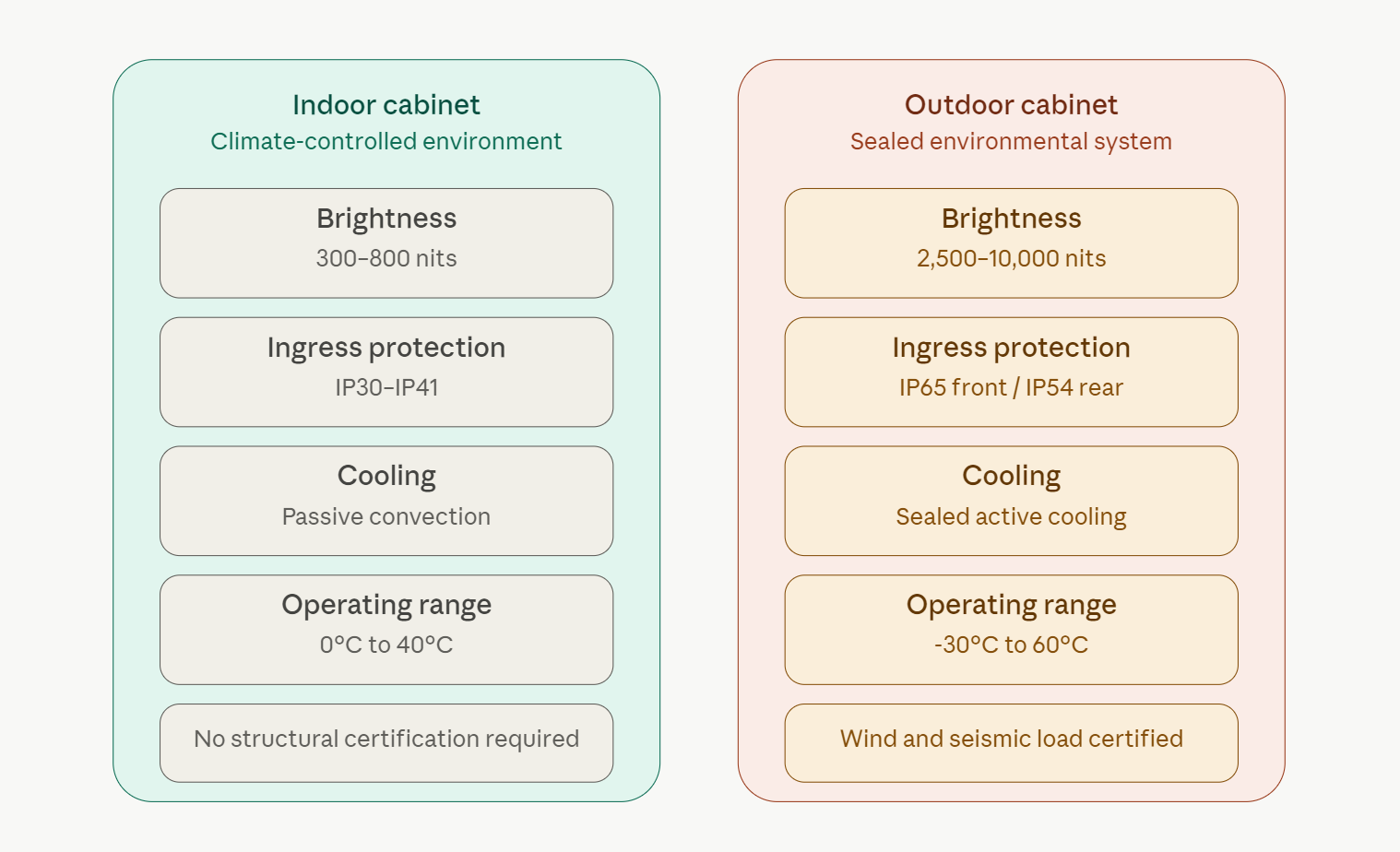
A display is not simply "brighter" or "dimmer" depending on where it sits — it is an entirely different engineering proposition.
Indoor and outdoor digital signage are frequently discussed as though they sit on the same product spectrum, differentiated mainly by brightness. In practice, the two categories are governed by distinct design briefs. Indoor signage is engineered for a stable, climate-controlled environment with predictable ambient lighting, minimal vibration, and no exposure to moisture, dust, or temperature extremes. Outdoor signage, by contrast, must be engineered as an environmental system first and a display second: every component, from the LED package to the cabinet gasket, is selected to withstand years of sun exposure, precipitation, temperature cycling, and in many installations, salt-laden coastal air or industrial pollutants.
Specifying an indoor-rated unit for an outdoor application — or over-specifying an outdoor-rated unit for a climate-controlled lobby — has direct financial consequences. Underspecification leads to premature panel failure, voided warranties, and safety liabilities; overspecification inflates capital expenditure without a corresponding return. The sections that follow examine each engineering dimension in turn.
2. Brightness and Optical Performance
2.1 Indoor Brightness Requirements
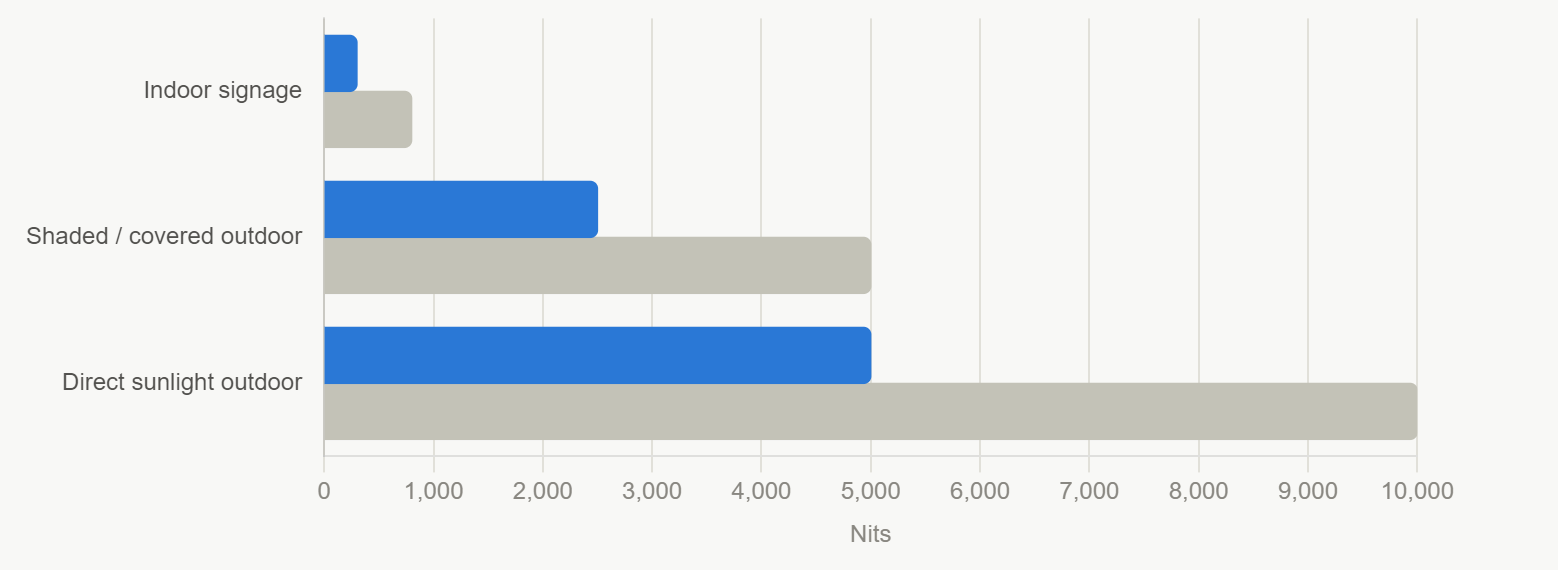
Indoor environments typically maintain ambient illuminance in the range of 300 to 500 lux. Within this range, displays operating between 300 and 800 nits deliver excellent contrast and color saturation without causing visual fatigue or excessive power draw. Indoor panels are generally engineered with finer pixel pitches, since viewing distances indoors are shorter and audiences expect higher image density for branding, wayfinding, and video wall applications.
2.2 Outdoor Brightness Requirements
Direct sunlight can exceed 100,000 lux at midday. To remain legible against this level of ambient light, outdoor signage must produce significantly higher luminance — typically 2,500 to 5,000 nits for shaded or north-facing installations, and up to 10,000 nits for displays in direct, unobstructed sunlight. Outdoor LED packages are also selected for superior anti-glare and wide-angle color consistency, since outdoor audiences view displays from a far broader range of angles and distances than indoor audiences.
Automatic brightness control, driven by ambient light sensors, is considered a baseline requirement for outdoor deployments. Without it, displays either become unreadable in daylight or uncomfortably bright — and wasteful of energy — after dusk.
3. Environmental Protection and Ingress Ratings
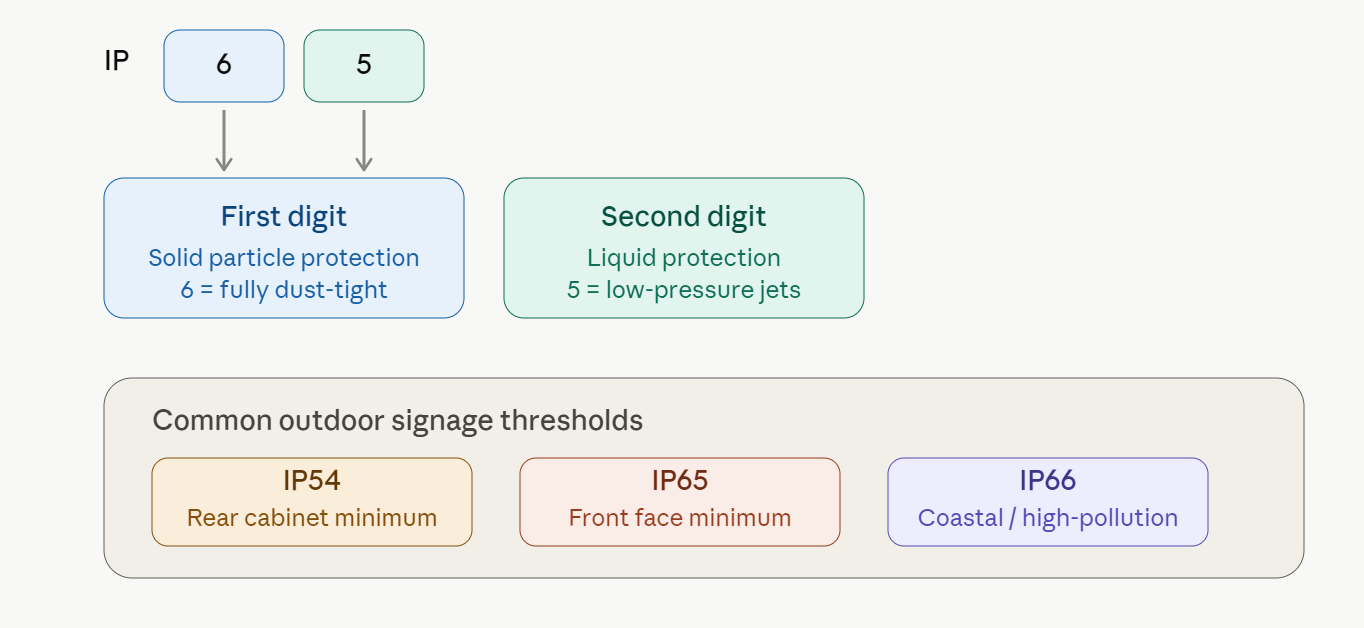
Ingress Protection (IP) ratings, defined under IEC 60529, describe a product's resistance to solid particles and liquid intrusion. This single specification is arguably the most important differentiator between indoor and outdoor signage hardware.
Rating | Protection Against Solids | Protection Against Liquids |
IP54 | Limited dust ingress permitted; no harmful deposits | Splashing water from any direction |
IP65 | Fully dust-tight | Low-pressure water jets from any direction |
IP66 | Fully dust-tight | Powerful water jets from any direction |
IP67 | Fully dust-tight | Temporary immersion up to 1 meter |
Table 1. Common IP ratings referenced in outdoor digital signage specifications.
Indoor signage is rarely rated beyond IP30 to IP41, since it is never exposed to rain, washdown, or significant dust loading. Outdoor signage, conversely, is expected to meet a minimum of IP65 on front-facing surfaces and IP54 on the rear cabinet, with premium installations specifying IP66 for coastal, desert, or high-pollution environments. Integrators should request third-party test certificates rather than relying on manufacturer self-declaration, as IP ratings are frequently inflated in non-certified product literature.
4. Thermal Management and Operating Range
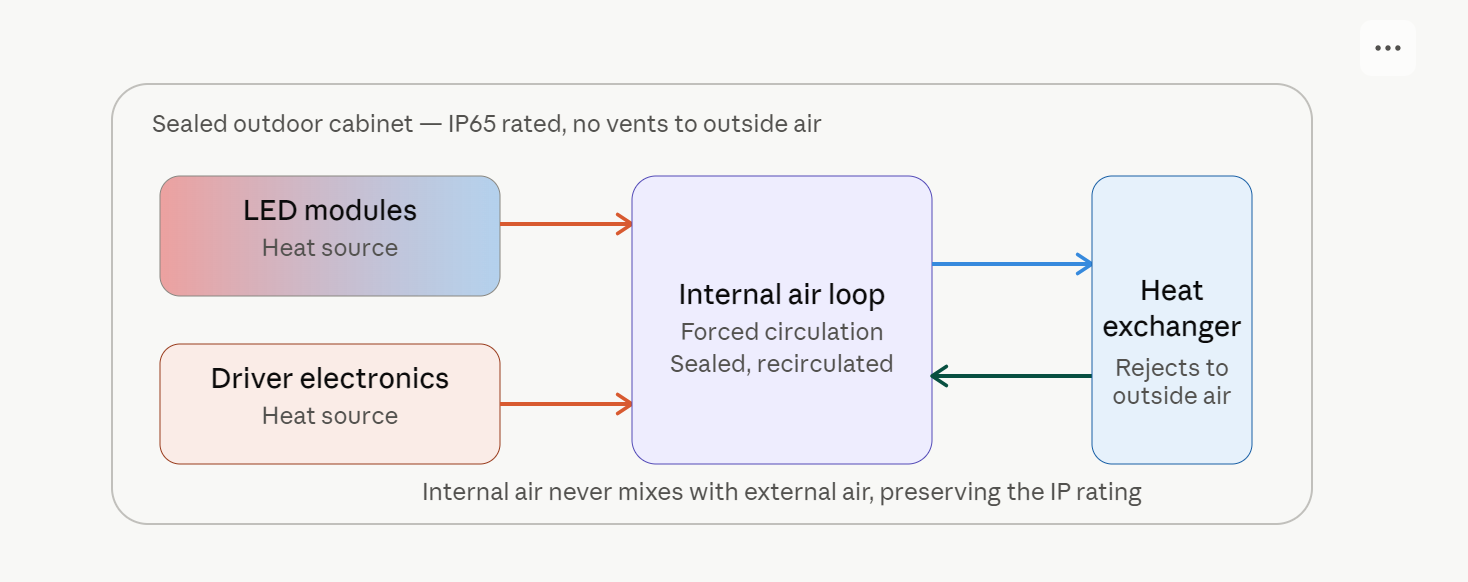
Indoor displays operate within a narrow, building-managed temperature band — typically 0°C to 40°C — and can rely on passive convection or modest fan-assisted cooling. Outdoor displays must instead be engineered as sealed thermal systems, since enclosures cannot be vented to the elements without compromising the IP rating. This creates a fundamental engineering tension: the cabinet must simultaneously reject heat generated by the LED modules and driver electronics while remaining fully sealed against moisture and dust.
Solutions adopted by reputable manufacturers include die-cast aluminum cabinets with internal heat-exchanger fins, sealed forced-air circulation loops, and, in extreme climates, integrated air conditioning or thermoelectric cooling units. A well-engineered outdoor cabinet is rated for continuous operation from -30°C to 60°C, with some Arctic and desert specifications extending beyond this range. Inadequate thermal design is the leading cause of premature LED degradation and driver IC failure in outdoor installations.
5. Structural Engineering and Mounting
Outdoor signage is, in most jurisdictions, treated as a structural installation rather than a piece of furniture. Wind load, seismic load, and snow load calculations are typically required by local building codes, particularly for freestanding pylon signs, digital billboards, and large-format wall-mounted units. Mounting hardware, anchor bolts, and support steelwork must be specified by a structural engineer and, in many EU and US municipalities, submitted as part of a building permit application.
Indoor signage carries no such requirement in the vast majority of cases. Mounting is governed primarily by the building's interior wall or ceiling load capacity, and the relevant safety standard is typically limited to fall-prevention bracketry rather than full structural certification.
6. Electrical Safety and Power Architecture
• Outdoor: Surge and lightning protection: outdoor installations require enhanced surge protection devices and, in many regions, dedicated lightning protection systems integrated with the building's grounding network
• Outdoor: Cable and connector sealing: outdoor power and data connectors must carry their own IP rating, independent of the cabinet, to prevent water ingress at the point of entry
• Indoor: Standard surge protection and conventional connector hardware are generally sufficient, since the installation environment is controlled and dry
Compliance with relevant regional electrical codes — including the IEC 60950/62368 series in the EU and UL 60950-1/62368-1 in North America — should be confirmed in writing by the manufacturer for any outdoor deployment.
7. Side-by-Side Technical Comparison
Parameter | Indoor LED/LCD Signage | Outdoor LED/LCD Signage |
Brightness output | 300–800 nits, optimized for controlled ambient light | 2,500–10,000 nits to remain legible under direct sunlight |
Ingress protection | Typically IP30–IP41; no exposure to moisture or dust | IP65 (front) / IP54 (rear) or higher, sealed against rain, dust, salt spray |
Pixel pitch | Finer pitch (P0.9–P2.5) for close viewing distances | Wider pitch (P3–P10) suited to longer viewing distances |
Operating temperature | Typically 0°C to 40°C, climate-controlled environment | -30°C to 60°C, engineered for extreme heat and cold |
Thermal management | Passive convection or light fan-assisted cooling | Active cooling, sealed heat exchangers, sometimes air conditioning |
Cabinet construction | Lightweight aluminum or steel, indoor-grade coatings | Die-cast aluminum, marine-grade coatings, corrosion-resistant hardware |
Power & surge protection | Standard surge protection | Enhanced lightning and surge protection per local electrical codes |
Structural/wind load | Not engineered for wind loading | Engineered and certified for regional wind load and seismic standards |
Typical lifespan (brightness-rated) | 60,000–100,000 hours at rated brightness | 60,000–100,000 hours, but environmental stress shortens real-world service life without proper protection |
Table 2. Summary comparison of indoor and outdoor digital signage specifications.
8. Total Cost of Ownership Considerations
Outdoor-rated hardware commands a materially higher upfront price than indoor-rated hardware of comparable resolution, typically reflecting the cost of sealed cabinetry, enhanced cooling systems, and certified electrical components. However, total cost of ownership analysis consistently favors correctly specified outdoor hardware over indoor hardware deployed outside its design envelope. Field data collected across commercial signage networks shows that indoor-rated panels installed in uncontrolled outdoor or semi-outdoor environments (such as covered walkways or transit shelters) experience accelerated LED degradation, condensation-related driver failure, and warranty voidance — costs that routinely exceed the original price differential within 18 to 24 months.
Buyers should also factor in maintenance access. Outdoor cabinets are typically front-serviceable to avoid scaffolding or lift access for routine maintenance, while indoor cabinets may be designed for rear access where wall or ceiling clearance allows. Specifying the correct service architecture at the outset materially reduces lifecycle maintenance cost.
9. Application Guidance by Use Case
• Indoor signage: Retail storefront windows, malls, corporate lobbies, conference rooms, and indoor video walls
• Outdoor signage: Building façades, transit shelters, drive-through menu boards, stadium and arena exteriors, fuel forecourts, and roadside digital billboards
• Transitional / semi-outdoor environments: Covered but unconditioned spaces — parking structures, open-air transit platforms, and semi-enclosed retail arcades — should default to outdoor-rated hardware unless the space is mechanically conditioned and fully enclosed
10. Specification Checklist
Before finalizing a digital signage purchase order, decision-makers should confirm the following with their manufacturer or integration partner:
• Verified IP rating with third-party test certification, not self-declared figures
• Documented operating temperature range matched to the installation's regional climate data
• Brightness specification validated against actual on-site ambient lux readings, including seasonal variation
• Structural and electrical compliance documentation appropriate to the local jurisdiction
• Warranty terms that explicitly cover the intended installation environment
• Serviceability plan, including access method and mean time to repair
Conclusion
The distinction between indoor and outdoor digital signage is not a matter of degree but of engineering discipline. Outdoor hardware must function as a sealed, structurally certified, thermally managed environmental system, while indoor hardware is optimized for image density and cost-efficiency within a controlled setting. Specifying the correct category — and verifying the underlying certifications rather than relying on marketing claims — is the single most reliable predictor of a digital signage deployment's long-term reliability and total cost of ownership.
Organizations evaluating a new signage program are encouraged to share site-specific environmental data — climate zone, ambient lighting conditions, structural constraints, and maintenance access — with their hardware partner at the earliest stage of the specification process. This data, more than any single product feature, determines which platform will deliver the lowest lifecycle cost and the most reliable customer-facing experience.
About this publication
This white paper is part of an ongoing technical series on digital signage engineering, intended to support informed procurement and specification decisions across commercial, retail, transportation, and public-sector signage programs.
KEYWORDS: