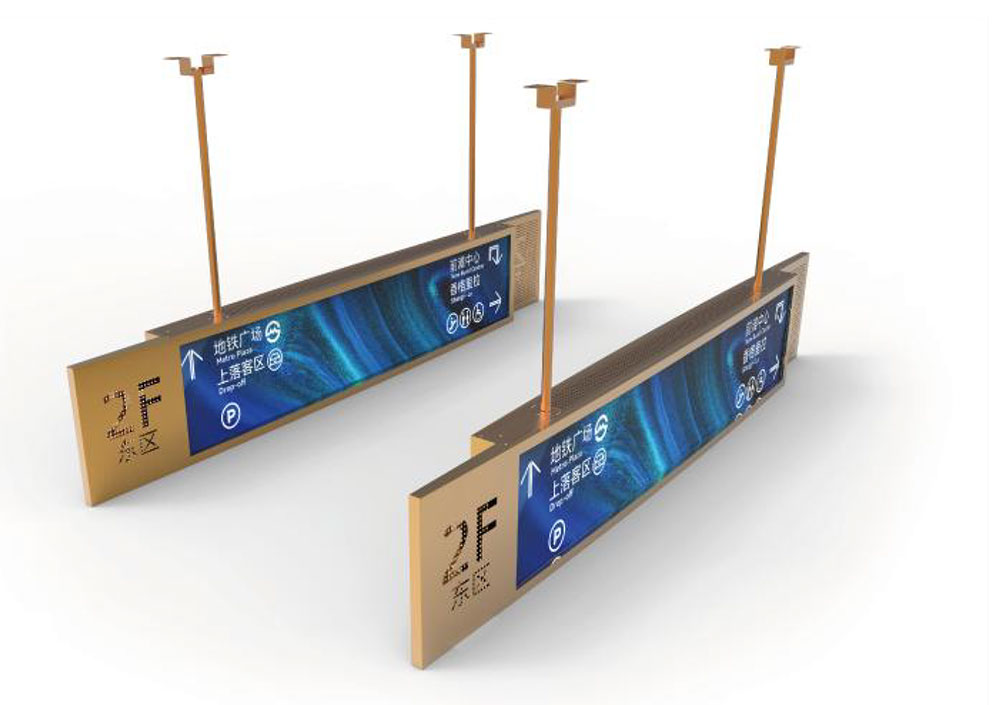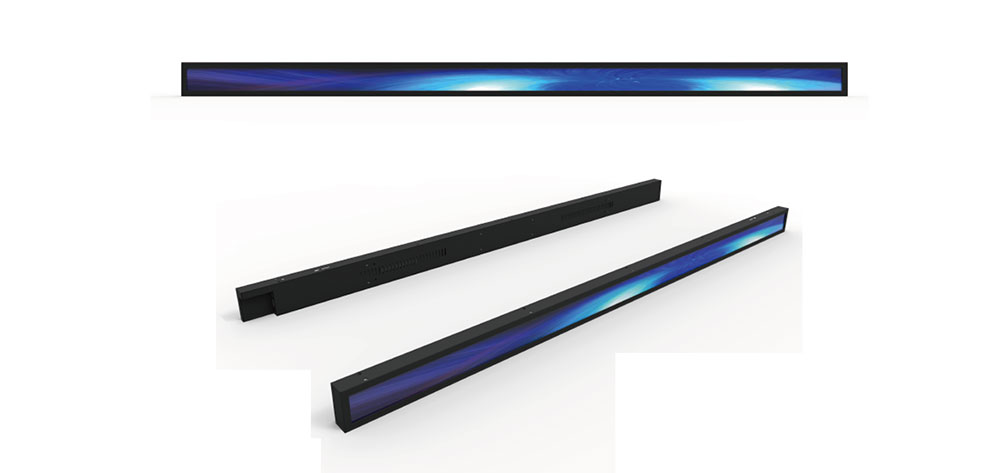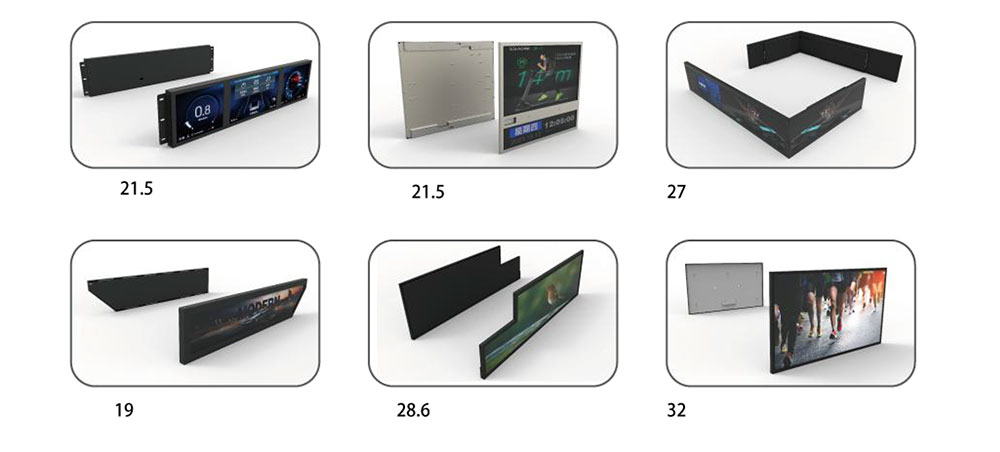
Industrial equipment designers in Canada work inside cabinets, racks, and operator consoles whose dimensions were fixed long before anyone thought about video aspect ratios. A 16:9 panel is the wrong shape for a 4U rack ear, a fertilizer spreader's armrest console, a municipal transit shelter, or the header strip above a packaging line. The result is wasted enclosure volume, dead bezel space, and a display that looks like an afterthought. Stretched LCDs — also called bar-type, banner, or ultra-wide displays — solve this by decoupling the display's geometry from consumer panel standards, letting the mechanical envelope drive the panel rather than the reverse.
What "Stretched" Actually Means
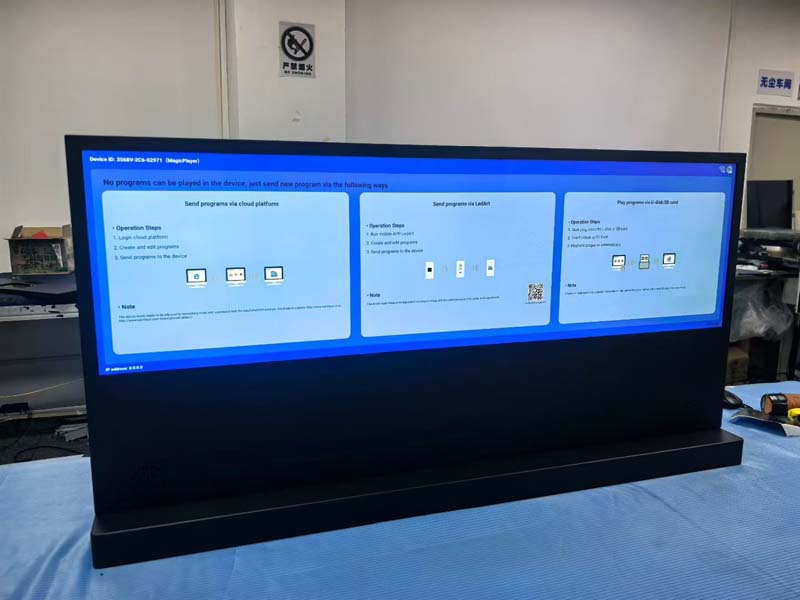
A stretched LCD is a TFT module built to a non-standard aspect ratio, typically between 2:1 and 10:1, with a diagonal between 6 and 40 inches. Physically it is the same thin-film-transistor stack as a conventional panel: an a-Si or IGZO backplane, a color filter, polarizers, and an LED backlight. What changes is the glass layout, the gate and source driver count and placement, and the backlight cavity design. Because a bar panel has a very high perimeter-to-area ratio, driver ICs, flex routing, and backlight LEDs all compete for the same narrow edge real estate — which is why genuinely narrow borders (3 to 8 mm) are a manufacturing capability, not a catalog option.
| Format | Typical resolution | Typical brightness | Common industrial use |
|---|---|---|---|
| ~3.5:1 (32:9) | 1920 × 540 | 500–1500 cd/m² | Machine HMI headers, kiosk secondary displays |
| 4:1 | 1920 × 480 | 700–2000 cd/m² | Transit shelter signage, shelf-edge rails |
| 5:1 | 1920 × 384 / 1280 × 256 | 800–2500 cd/m² | Vehicle exterior route signs, conveyor status bars |
| 8:1 to 10:1 | 1920 × 240 / 2880 × 288 | 1000–3000 cd/m² | Rack front panels, instrument strips, vending |
Why Canadian OEMs Specifically Need Custom Geometry
The demand pattern in Canada differs from consumer markets in a few concrete ways.
- Retrofit and legacy cabinets. Much of the installed base of agricultural, forestry, mining, and food-processing machinery in Western Canada and Ontario was designed around 4:3 or custom monochrome modules. A stretched panel can drop into an existing cutout with minimal tooling changes, avoiding a full enclosure redesign and recertification cycle.
- Bilingual labelling pressure. Canadian machinery must carry French and English operator text. A wide bar display can show a full status line in both languages simultaneously instead of toggling between them — a real usability gain in control rooms where language switching was previously the workaround.
- Rack-space economics. In telecom, broadcast, and industrial computing enclosures, vertical rack units are expensive. A 1U or 2U front panel populated with a stretched display gives far more readable status area per rack unit than a square module.
- Harsh-environment housings. Sealed stainless washdown enclosures in dairy and beverage plants, and NEMA 4X cabinets in coastal or potash-handling facilities, constrain depth and bezel. Bar panels are thinner and shallower than equivalently wide tiled solutions.
- Distributed, low-volume production. Canadian equipment builders often ship dozens to low hundreds of units per year per model. Custom stretched panels with modest minimum order quantities are economically viable in a way that custom 16:9 tooling is not.
Cold-Climate Engineering: The -40 °C Problem
This is where generic stretched panels fail in the Canadian market. A standard module rated to 0 °C storage and operation will not survive a Saskatchewan winter commissioning, a Northern Alberta wellsite, or an unheated rail yard in Manitoba.
Three physical effects dominate at low temperature. First, liquid crystal viscosity rises steeply, response time lengthens, and contrast degrades as the LC mixture approaches its nematic-to-smectic transition. Second, the backlight's LED forward voltage shifts and the driver's constant-current loop must compensate; poorly designed supplies either drop out or overdrive. Third, differential thermal expansion between the glass, the light guide, the frame, and the front window causes stress birefringence and, in severe cases, cell gap distortion or seal failure.
The engineering answer is a combination, not a single component:
- Wide-temperature LC mixtures rated for -30 °C or -40 °C operation, accepting a trade-off in response time at 25 °C.
- Integrated transparent heaters — ITO or fine-wire films on the front glass or bonded to the rear of the module — with a thermostatic controller and a defined warm-up curve. A 10 °C rise in two minutes is a realistic target for a modest heater; a full -40 °C to operating-temperature transition is a 5 to 15 minute specification that must be documented and accepted by the OEM.
- Thermal gap fillers and aluminum back plates to spread heat evenly across a bar panel, where the short thermal path in the vertical axis makes hot spots more likely than in square formats.
- Condensation and frost management — an anti-fog or hydrophobic coating on the outer glass, plus a sealed cavity with desiccant or a controlled dry-nitrogen fill, so interior fogging does not occur when a cold unit is powered in a warm shop.
Equally important is the storage specification. Shipping a display across the Prairies in February exposes it to -45 °C in an unheated trailer. Storage ratings of -40 °C and thermal-shock testing across the full range should be contractual, not assumed.
High Brightness and Sunlight Readability
Canadian industrial displays face a wider dynamic range than most engineers expect: direct summer sun at high latitude and low sun angle, combined with snow albedo that can push ambient illuminance well past 100,000 lux, and long winter nights where the same panel must dim to under 5 cd/m² without flicker or visible PWM banding.
Sunlight readability is not just a nit number. It is the product of luminance, contrast ratio under ambient reflection, and the front-surface treatment:
- Luminance. 1000 cd/m² is a reasonable indoor-through-window target; 1500–2500 cd/m² is required for semi-outdoor and transit applications. Above roughly 2000 cd/m² the thermal budget becomes the binding constraint and the backlight design must be co-engineered with the heatsink.
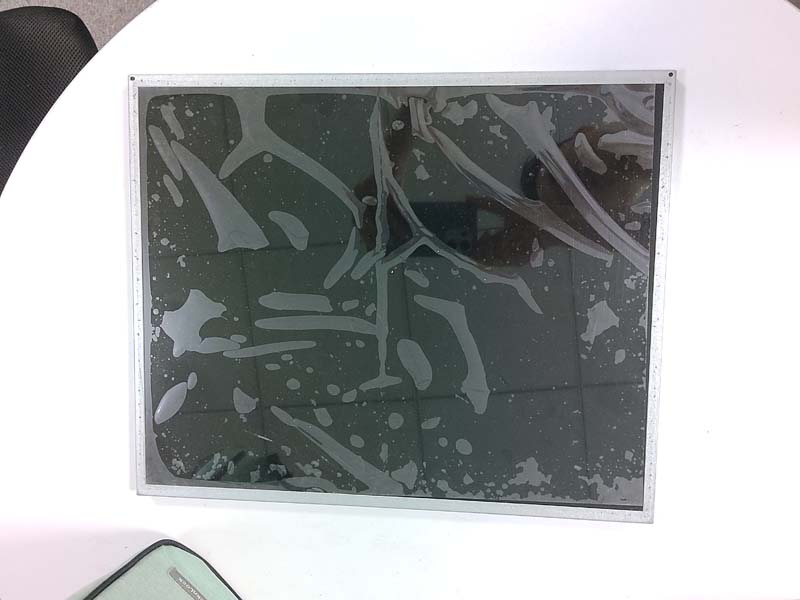
- Reflectance control. Anti-reflective front glass (below 1% average reflectance) or anti-glare etching does more for perceived readability in sun than an extra 500 cd/m², and it costs far less in power and heat.
- Optical bonding. Filling the air gap between the panel and the cover glass with an index-matched silicone or OCR adhesive eliminates internal reflections from three interfaces in a typical un-bonded stack. In a bar display, where the viewer is often at an off-axis angle, bonding also materially improves contrast uniformity. The trade-off is repairability: bonded assemblies are usually replaced, not reworked, so service strategy must be decided at design time.
- Dimming range. A 3000:1 dimming range with a flicker-free, high-frequency driver is a hard requirement for any display that will be read at night without dazzling the operator.
Electrical Interface and Mechanical Integration
Stretched panels are usually driven over LVDS (single or dual channel), eDP, or MIPI-DSI. For industrial equipment, LVDS remains the default because of its noise immunity over the one- to three-metre cable runs common in a machine cabinet, and because the ecosystem of long-life industrial bridge ICs and timing controllers is mature. MIPI-DSI is attractive where the display sits directly on the processor board in a compact module, but its short channel reach and tighter impedance tolerances make it a poor fit for cabinet-scale cabling without a serializer.
Customization in this area is where most of the practical value sits for an OEM:
- Flexible printed circuit tail length, exit direction, and connector type, so the display mates with the existing harness without a new adapter board.
- Backlight driver integrated on the panel versus supplied externally, depending on whether the OEM wants to route high-current LED lines through the cabinet.
- On-panel timing controller with selectable input timing sets, allowing one panel part number to serve several machine models with different host boards.
- EMI shielding on the FPC and a grounded rear frame, which matters for equipment that must meet ICES-003 or EN 55032 Class A emissions limits.
Mechanically, the specification should lock down frame material, mounting hole pattern and torque, bezel width, front glass thickness and edge treatment, and the compression path of any gasket — since the gasket load on a 5:1 panel is distributed over a long, thin perimeter and is easy to get wrong.
Touch Integration on Narrow Formats
Projected-capacitive touch on a bar display has specific difficulties. The sensor's electrode pitch and the controller's channel count must both scale to a long aspect ratio, and edge linearity degrades near the short ends of the strip. Practical requirements for Canadian equipment:
- Glove and wet-finger operation, mandatory for food processing, cold storage, and outdoor winter use. This drives up the required signal-to-noise ratio and usually forces a thicker cover glass (3–6 mm) with an optically bonded sensor.
- EMC immunity and emission, particularly on machines with VFDs and contactor-driven pumps, where a poorly designed touch controller will false-trigger on motor start.
- Interface simplicity. USB HID is fastest to integrate; I²C is preferred where the host has no USB host stack available or where cable length is a concern.
Where touch is not needed, a chemically strengthened or anti-glare cover glass with an optically clear adhesive bond is the simplest path to a durable, cleanable front surface.
Compliance and Certification for the Canadian Market
Display modules are components, not end products, but their characteristics feed directly into the OEM's certification work and should be documented accordingly:
- Electrical safety. The finished machine will typically be evaluated to CSA C22.2 No. 61010-1, CSA C22.2 No. 62368-1, or the relevant machinery standard, and marked cUL or CSA. The display's insulation, creepage and clearance, and the backlight's high-voltage section must be documented so the safety reviewer is not blocked late in the project.
- Mining. Equipment for Canadian mines may need to satisfy CSA M421 requirements for flame-resistant enclosures and wiring — relevant to the display's cable jackets and connector materials.
- Agriculture. ISOBUS (ISO 11783) terminals and virtual-terminal implementations impose specific display and input requirements if the panel is part of an implement control system, and the panel's native resolution and color depth become part of the conformance argument.
- Rail and transit. EN 50155 temperature classes, EN 45545 fire performance for materials, and shock/vibration to EN 61373 apply if the display is destined for rolling stock or a transit shelter installation.
- Materials and photobiology. RoHS, REACH SVHC declarations, and IEC 62471 photobiological safety for high-brightness emitters should be available as documents, not promises.
French-language documentation — datasheets, installation instructions, and safety labels — is a practical requirement for products sold in Quebec and is worth specifying at the purchasing stage rather than retrofitting later.
Lifecycle, Supply, and Cross-Border Logistics
Industrial equipment programs run seven to fifteen years, and a display that goes end-of-life in year three is a program-level problem. Four contractual items should be settled before the first production order:
- Longevity commitment. A written availability statement of at least five years from production release, with a defined PCN (product change notification) window — 90 to 180 days is typical — and the right to a last-time buy.
- Change control. Any change to the LCD glass, backlight LED bin, driver IC, adhesive, or FPC requires written approval. Silent LED binning changes are the most common cause of visible color shift between production batches, and are especially noticeable when two displays sit side by side in one console.
- Tooling and IP ownership. Who owns the custom tooling, FPC artwork, and mechanical drawings if the relationship ends, and whether the OEM can obtain the design package for a second source.
- Tariffs, duty, and inventory. Under CUSMA, industrial LCD modules originating in the relevant territories can move duty-free provided origin rules are met and documentation is correct. Many Canadian OEMs also benefit from a bonded or local consignment stock position near their assembly plant so that a production line in Guelph, Winnipeg, or Edmonton is not waiting on an ocean freight cycle.
The Custom Development Path
A realistic stretched-display program runs roughly 16 to 26 weeks from specification freeze to production release, and it benefits from being staged deliberately:
- Application definition — viewing distance, ambient light profile, operating and storage temperature range, ingress requirement, expected service life, and the mechanical envelope with tolerances.
- Feasibility and optical concept — glass utilization determines cost. An aspect ratio that tiles efficiently on a standard mother glass substrate can be dramatically cheaper than one that does not, and this is the single highest-leverage decision in the project, made within days rather than months.
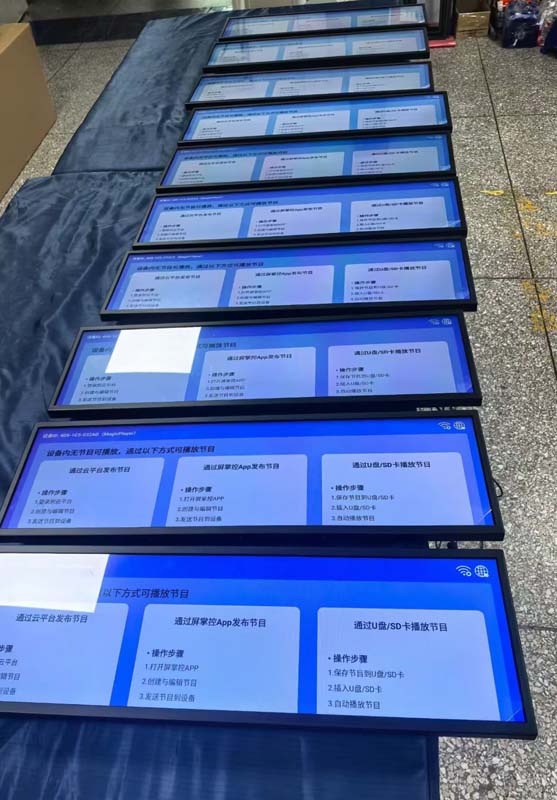
- Sample stage — one to three engineering samples, usually off shared tooling with the target glass and backlight, for mechanical fit and basic electrical bring-up.
- Design verification — thermal cycling, cold start, high-temperature/high-humidity soak, vibration and shock, EMC pre-scan, and a readability measurement under a solar simulator or in real outdoor conditions.
- Pilot build and production validation — a small lot through the OEM's actual assembly and test process, confirming that gasket compression, connector engagement, and firmware timing all hold in the fixture.
Common Failure Modes to Design Out Early
- Thermal crosstalk in the backlight. In a bar panel, an under-designed light guide produces a bright center and dim ends. Measure luminance uniformity at nine points on the production panel, not on the sample.
- Cold-start heater timing. Software that enables the backlight before the LC reaches operating temperature produces a black or ghosted screen at -30 °C and generates field complaints that look like hardware failures.
- Ignoring off-axis viewing. Bar displays are frequently viewed from below or above. Polarizer choice and bonding change the contrast falloff substantially; specify a viewing cone and test it.
- Assuming standard mounting hardware fits. The hole pattern and frame stiffness of a stretched panel are different, and a reused bracket will often bow the frame enough to create mura.
- Late discovery of documentation gaps. Missing French labels or an absent RoHS declaration can delay a machine's shipment by weeks.
Conclusion
For Canadian industrial equipment manufacturers, a stretched LCD is KEYWORDS: Custom Stretched LCD Displays for Canadian Industrial Equipment Manufacturers