
Industrial LCD Testing and Quality Verification
Industrial LCD displays must perform consistently under the environmental, optical and operational conditions specified for their intended applications. At HITULCD, engineering evaluation and manufacturing inspection are used to assess product performance, identify potential issues and verify compliance with applicable customer requirements.
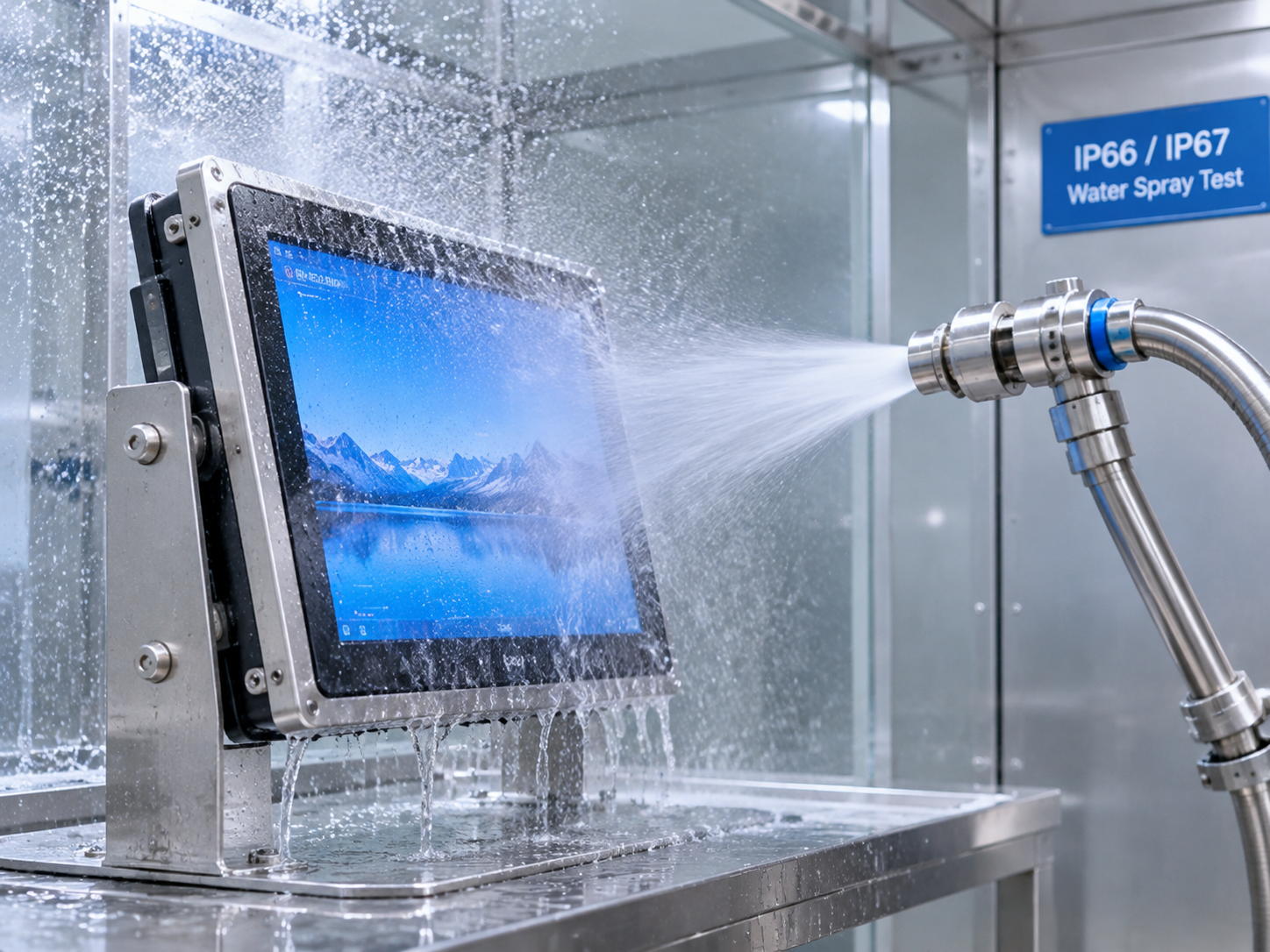
IP66 / IP67 Ingress Protection Testing
Enclosure sealing and resistance to water and dust ingress.
Why This Test Matters
Industrial displays installed outdoors, in transportation equipment, industrial machinery and public-facing terminals may be exposed to rain, water splashes, dust and cleaning operations. The enclosure must provide an appropriate level of protection for its intended installation environment.
Testing Principle
Ingress Protection (IP) ratings are defined by IEC 60529. The first digit describes protection against solid foreign objects and dust, while the second digit describes protection against water ingress.
| Rating | Water protection test | What it evaluates |
|---|---|---|
| IP66 | Powerful water jets | Resistance to water projected against the enclosure from specified directions. |
| IP67 | Temporary immersion | Resistance to temporary immersion under specified depth and duration conditions. |
Key Inspection Points
- Enclosure joints, cover interfaces and sealing surfaces.
- Gaskets, cable entry points and connector interfaces.
- Potential water ingress around mounting structures.
- Internal surfaces and electrical areas after testing.
- Display functionality following the applicable test.
Test Procedure and Result Evaluation
Before testing, the enclosure configuration, cable connections, mounting conditions and sealing components should be checked. The applicable IP test method is then selected according to the intended rating. Water exposure parameters must follow the relevant IEC 60529 test requirements.
Following exposure, the enclosure is inspected for water penetration and any resulting effects on protected components. The acceptance decision must be based on the applicable standard, product category and agreed evaluation criteria.
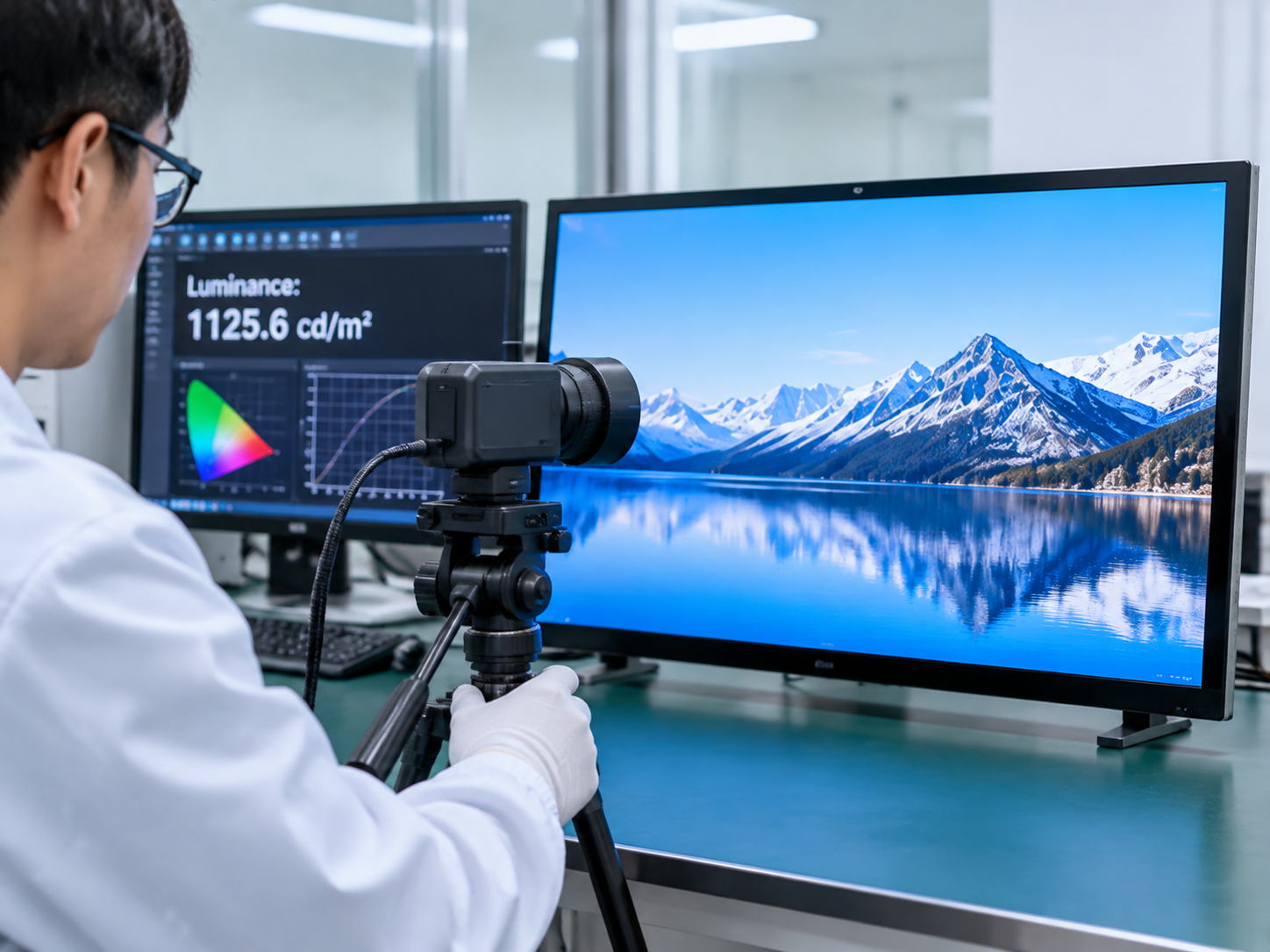
LCD Brightness & Optical Performance Testing
Luminance measurement, uniformity and display optical evaluation.
Why Brightness Measurement Matters
Display brightness directly affects readability under different ambient lighting conditions. For outdoor and sunlight-readable LCD applications, luminance must be evaluated against the actual optical requirements of the installation.
Measurement Equipment
A calibrated luminance meter or suitable photometric measuring instrument is used to measure the light output from the display surface. The instrument should be suitable for the display's luminance range and measurement geometry.
Measurement Conditions
- Allow the display to stabilize before taking measurements.
- Use a defined brightness setting and stable power supply.
- Control ambient light and unwanted reflections.
- Position the measuring instrument at a defined distance and viewing angle.
- Use consistent test patterns and measurement locations.
Multi-Point Luminance Evaluation
A single center-point measurement does not describe the brightness distribution across the entire LCD panel. For a more complete evaluation, luminance can be measured at multiple defined positions across the active display area.
| Evaluation item | Measurement approach | Engineering purpose |
|---|---|---|
| Center luminance | Measure at the defined center point. | Evaluate the main display brightness. |
| Brightness uniformity | Compare luminance at multiple positions. | Identify visible brightness variation. |
| Backlight stability | Observe luminance under defined operating conditions. | Identify abnormal brightness fluctuations. |
| Brightness adjustment | Evaluate specified brightness control settings. | Check the required dimming behavior. |
Brightness Uniformity Calculation
When a nine-point measurement method is used, one commonly applied uniformity calculation is the ratio of the minimum measured luminance to the maximum measured luminance. The exact evaluation method and acceptance threshold should be defined in the product specification.
High & Low Temperature Testing
Environmental evaluation and display operating stability.

Why Temperature Testing Matters
Industrial LCD displays may be installed in outdoor equipment, transportation systems, industrial control panels and enclosed machines. Temperature changes can affect LCD response characteristics, backlight performance, electronic components and startup behavior.
Test Equipment
An environmental temperature chamber provides controlled heating and cooling conditions for product evaluation. The test configuration should represent the intended product assembly and electrical operating conditions.
Key Test Items
- Operation at specified high and low temperatures.
- Cold-start behavior at the defined low-temperature condition.
- Display image stability during temperature exposure.
- Backlight operation and brightness behavior.
- Abnormal flickering, image retention or display artifacts.
- Functional condition after returning to normal temperature.
Temperature Test Sequence
A typical evaluation begins with a baseline functional inspection under normal laboratory conditions. The display is then placed in the environmental chamber and exposed to the specified temperature profile.
Depending on the project requirements, the evaluation may include temperature stabilization, powered operation, unpowered storage, cold-start testing and temperature cycling. During each applicable stage, the display should be monitored for abnormal operation.
| Test stage | What is evaluated |
|---|---|
| Initial inspection | Baseline display condition and electrical functionality. |
| Low-temperature exposure | Startup behavior, LCD response and image stability. |
| High-temperature exposure | Backlight, power behavior and continuous operation. |
| Temperature transition | Functional changes during defined temperature transitions. |
| Post-test inspection | Image quality, mechanical condition and electrical functionality. |
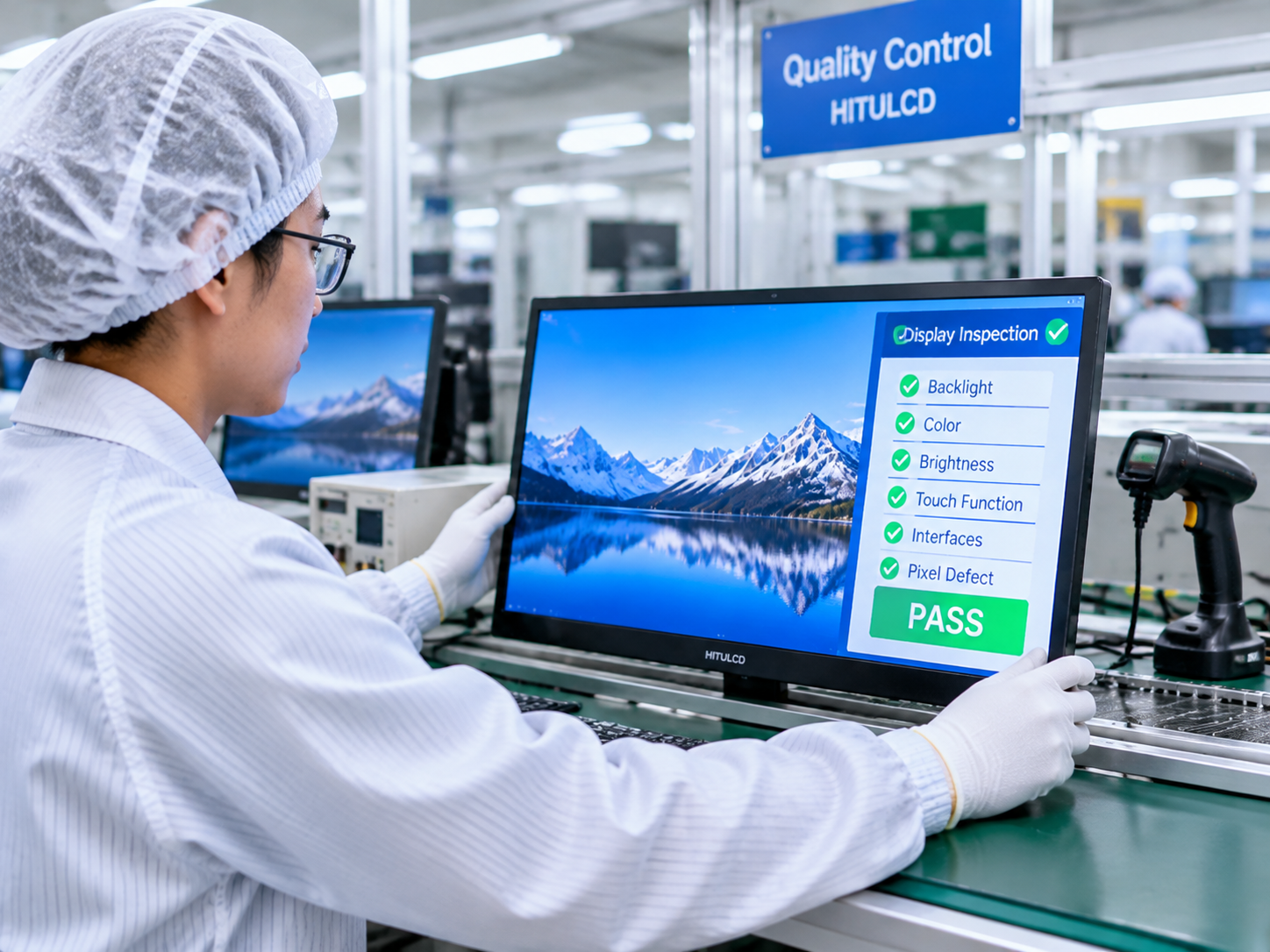
Production Inspection & Quality Control
Manufacturing consistency, functional inspection and final verification.
Why Manufacturing Inspection Matters
The performance of an industrial LCD display depends not only on the LCD panel itself, but also on the backlight, driver electronics, power supply, mechanical assembly, connectors and other components.
Manufacturing inspection helps identify assembly defects, component inconsistencies and functional problems before products are released for delivery.
Key Quality Control Areas
- Incoming inspection of LCD panels and electronic components.
- Verification of model specifications and component configuration.
- Inspection of mechanical assembly and mounting structures.
- Electrical connection and power-on checks.
- Display image, color and pixel condition inspection.
- Backlight operation and brightness verification.
- Interface and functional checks according to product configuration.
- Final visual inspection and packaging checks.
Functional Testing and Final Inspection
Following assembly, the LCD display can be powered on to check whether the panel, driver board, backlight and specified interfaces operate correctly. Inspection items may include image output, abnormal lines, flickering, backlight defects, connector condition and mechanical assembly quality.
Where specified by the product or project requirements, additional burn-in or continuous operation testing may be applied to observe abnormal behavior over a defined period. Such testing should be documented separately from routine visual inspection.
Inspection Records
For effective quality traceability, inspection records should identify the relevant product model, configuration, inspection items, acceptance criteria, date and inspection result. Where applicable, production batches and corrective actions should also be traceable.
Need an LCD Display with Defined Environmental Requirements?
Whether your project requires high brightness, water protection, extended operating temperatures or customized mechanical dimensions, HITULCD can discuss the relevant display configuration and verification requirements with your engineering and purchasing teams.
CONTACT HITULCD