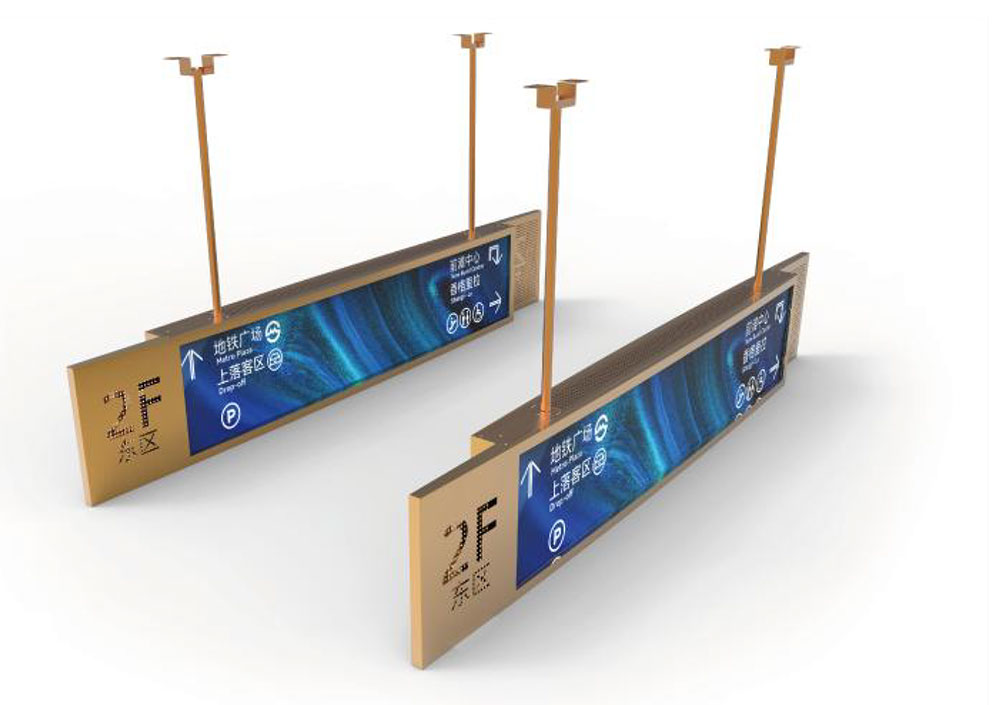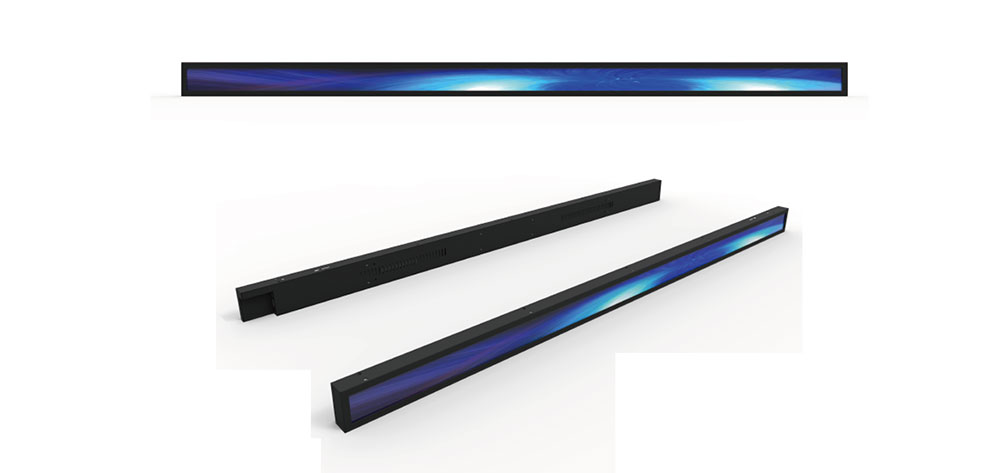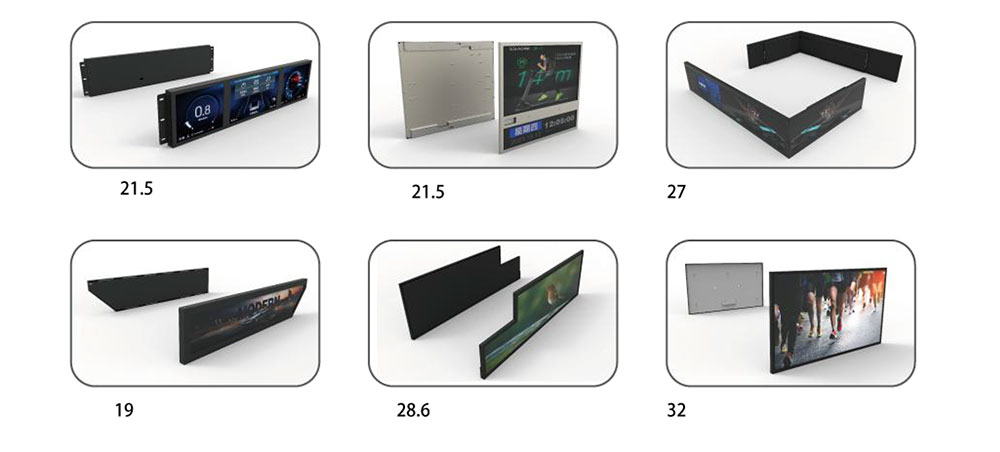
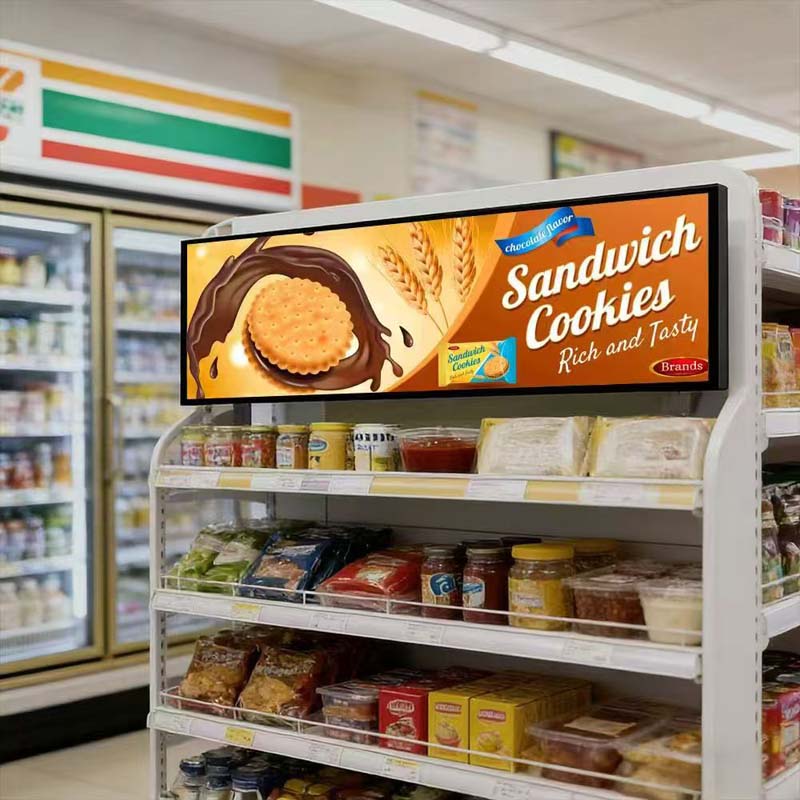
Bar-type LCDs — the long, narrow "stretched" panels used on shelf edges, transit canopies, vending fascia, elevator lobby signage, and industrial equipment faces — are almost never a catalog item in Canada. They are engineered parts. That single fact reshapes the entire sourcing process: you are not shopping for a display, you are commissioning one, and the commercial, technical, and regulatory work that surrounds that commission is where most Canadian OEM programs succeed or fail.
This guide lays out the practical mechanics: how to define a bar display that a factory can actually build, what to specify beyond resolution and brightness, how Canadian compliance and import obligations attach to the part, and how to structure samples, tooling, and long-term supply so a five-year product program does not strand you on a discontinued panel.
1. Why Bar Displays Are a Different Sourcing Problem
A standard 16:9 open-frame module can be pulled from distribution stock in Toronto or Vancouver the same week. A 1920 × 540 bar panel cannot. The reasons are structural:
- Panel supply is generation-driven. Bar formats are cut from mother glass on specific fab generations, often as companion products to a mainstream panel size. When the fab shifts that glass mix, the bar SKU disappears with roughly 6–12 months of notice — sometimes less.
- Mechanical customization is normal, not exceptional. Long thin formats almost always require a custom backlight cavity, a custom FPC or board-to-board connector position, a custom bezel or open-frame, and often custom mounting ears because the aspect ratio leaves little room for standard brackets.
- Tooling is light but real. Expect NRE for backlight tooling, FPC layout, firmware or EDID work, and cover-glass or bonding fixtures. It is measured in thousands of dollars, not hundreds of thousands — which is exactly why it gets under-budgeted.
- Minimum order quantities bite harder. MOQ on a custom bar module commonly lands between 100 and 1,000 pieces, and MOQ on custom cover glass with anti-glare or anti-reflective treatment can exceed that.
The practical consequence for a Canadian buyer: bar display sourcing is a program with a 12–20 week first-article timeline, not a purchase order.
2. Define the Format Before You Talk to Anyone
Suppliers quote what you describe. Vague descriptions produce quotes against the wrong panel, and the mismatch usually surfaces at first article, when schedule is already spent. Lock these down first:
| Parameter | What to decide | Why it matters downstream |
|---|---|---|
| Aspect ratio | Anywhere from ~3:1 to ~8:1 is achievable; narrower strips increasingly favor other technologies entirely | Drives which panel families exist at all, and whether a TFT is the right answer versus LED matrix or e-paper |
| Active area & diagonal | Exact mm dimensions, not nominal inches | Enclosure CAD, viewing window tolerances, and gasket design all key off active area |
| Resolution / pixel density | e.g. 1920 × 540, 1920 × 360, 3840 × 1080-class formats | Determines interface bandwidth, scalar or SoC selection, and text legibility at intended viewing distance |
| Brightness | 500 / 700 / 1,000 / 1,500+ nits | Sets backlight LED count, thermal load, driver topology, and enclosure ventilation requirements |
| Interface | LVDS, eDP, MIPI DSI, or parallel RGB | Constrains host board choice; LVDS remains the pragmatic default for long-cable industrial runs |
| Outline & mounting | Open frame, chassis mount, VESA, custom ears | Determines whether the factory tooling is bezel-only or a full mechanical redesign |
The legibility test before the spec sheet
Bar displays are read at unusual geometry — often from below, at an angle, at a distance of 1 to 4 metres. Before committing to a resolution, calculate character height: a comfortable minimum is roughly 1/200th of viewing distance for sustained reading and 1/300th for glance reading. A 1920 × 540 panel across a 28-inch diagonal gives excellent shelf-edge legibility at 2 m; the same panel used as a 4 m overhead transit sign will read as soft no matter how good the backlight is.
3. Optical Performance: Where Cheap Bar Modules Reveal Themselves
Two units with identical headline specs can look dramatically different in the field. The differences live in the second-order parameters.
Brightness uniformity and hot spots
A long, thin backlight cavity is hard to illuminate evenly. Light-guide extraction patterns designed for a 16:9 panel do not scale linearly to a 1:3.5 strip, and the result is often a bright centre band with falloff at the ends. Require a uniformity figure (min/mean or min/max across nine or thirteen measurement points) and require it be stated through the final stack-up, not at the bare panel.
Sunlight readability is not just nits
Canadian outdoor deployments — drive-through menu boards in Alberta, curbside pickups in Manitoba, wayfinding at a ski resort — face a dual problem: high ambient in July and extreme cold in January. Sunlight readability is a system property:
- Reflected luminance matters as much as emitted luminance. Anti-reflective coatings and index-matched optical bonding can recover more perceived contrast than an extra 300 nits of backlight.
- Optical bonding (OCR or OCA) eliminates the air gap, killing internal reflections and improving contrast roughly 2–4× in direct sun. It also improves impact resistance and thermal conduction out of the panel.
- Index-matched bonding against a cover glass is worth specifying explicitly; generic OCA under chemically strengthened glass can still produce a visible ghost reflection.
Cold-start behaviour
Standard TN and many IPS formulations slow dramatically below −20 °C: response time stretches, contrast shifts, and backlight driver electrolytics can be marginal at cold start. If the product must operate in an unconditioned Canadian exterior enclosure, specify:
- An operating temperature range with a stated cold-start figure, distinct from steady-state operation.
- Wide-temperature driver components and, where necessary, a heater film or ITO heater on the cover glass with thermostat control.
- Confirm the low-temperature response time and contrast ratio, not just "−30 °C operating."
Binning and colour consistency
For multi-unit installations — a bank of shelf-edge rails, a row of transit totems — unit-to-unit colour and luminance consistency is a procurement requirement, not a nicety. Ask for LED binning discipline, a stated ΔE tolerance between units of the same lot, and a documented re-binning policy for later lots. Without this, your second production run will not match your first, and replacing one failed unit in a row of twelve will be visible to every customer who walks past.
4. Electronics, Interface, and the Things That Break in the Field
Interface selection. LVDS over shielded twisted pair remains the workhorse for industrial bar displays because it tolerates cable runs of a metre or more and is well understood by embedded board vendors. eDP is preferable where you need higher bandwidth in a thin stack. MIPI DSI is attractive on cost and pin count but punishes long cables and poor impedance control. Decide based on cable length and host silicon, then hold that decision.
Backlight driving and dimming. For a signage or shelf-edge product that runs continuously, PWM dimming frequency should be high enough to avoid visible flicker and camera beat artifacts — specify ≥ 20 kHz, and confirm behaviour at very low duty cycles where some drivers become non-linear or audible. Where the display sits behind a camera (a common combination in retail analytics), flicker-free DC dimming or high-frequency PWM is mandatory.
EMI and cable routing. A bar display is a long aperture in an enclosure, which makes it a decent antenna. Keep the LVDS/eDP pair away from switching backlight drivers, specify a shielded FPC with a ground plane, and plan ferrites at the host end based on an actual pre-scan rather than hope. Canadian EMC compliance testing is not a place to discover a layout problem.
Connector and FPC robustness. Narrow modules often use fine-pitch FPC connectors that tolerate few mating cycles. If your assembly process involves rework, specify a locking connector type and a minimum mating-cycle rating, and design the harness so field service never touches the panel connector.
5. Canadian Regulatory Reality
This is the section most overseas suppliers will not help you with, and it is where Canadian programs get delayed at the worst moment.
EMC: ISED, not just FCC
A display module itself is usually not certified; the end product is. An information technology device sold in Canada must comply with ISED's ICES-003, and the label must carry the ISED Canada compliance notice — which for Canada is expected in both English and French. If your product includes Wi-Fi, Bluetooth, or cellular, the radio module must be certified to the applicable RSS standard, and the end product needs its own host certification and ISED registration number unless you are operating under a module grant with compliant host conditions. FCC approval does not transfer.
Safety: NRTL marks and the field-evaluation trap
Electrical safety approval in Canada comes from an accredited certification body — cUL, cCSA, cMET, and similar marks — typically to CSA C22.2 No. 62368-1 aligned with IEC 62368-1. Two practical notes:
- If you import pre-assembled displays or kiosks and modify them in Canada, you may move out of the scope of the original certification. A field evaluation (for example a CSA SPE-1000 evaluation) may be required, which costs money and time per unit.
- High-brightness backlights draw more current and run hotter than the panel the certification was written against. A brightness upgrade can invalidate a thermal assumption inside an existing certification. Treat any backlight change as a certification-relevant change and confirm with your certification body.
Language and labelling
Federal labelling requirements generally call for bilingual English/French marking on regulated products, and Quebec's Charter of the French Language imposes additional requirements on commercial documentation, packaging, and in-store display content sold in the province. If your bar display is a customer-facing retail fixture in Quebec, the content and interface strings are in scope. Confirm specifics with Canadian counsel rather than relying on a supplier's assurance.
Materials and sector rules
RoHS and REACH declarations are table stakes. Beyond that, the sector determines the regime: a medical device requires a Health Canada licence and ISO 13485 discipline from your supplier; a product for a food-service environment may need washdown-rated sealing and NSF-style considerations; anything mounted in a vehicle touches Transport Canada requirements. State the end application to your supplier in writing — it changes their material and process choices.
6. Import, Tariffs, and Landed Cost
Flat panel display modules are classified in the 8524 heading family, with subheadings that distinguish whether a touch-sensitive screen is incorporated. Classification drives the duty rate, and the rate depends on origin and on the trade program claimed — CUSMA for US/Mexico-origin goods, CETA for EU origin, CPTPP and others where applicable, and Most-Favoured-Nation rates otherwise.
Three practical cautions for Canadian buyers:
- Origin is about where the good was produced, not where it shipped from. A panel assembled in one country from cells made in another may or may not qualify for preferential treatment. Get a written origin statement and keep the bill of materials trail.
- Trade measures change. Surcharges and remission orders have moved repeatedly in recent years across many product categories. Verify the current treatment with a customs broker before you finalize a landed-cost model, and re-verify at each program milestone.
- Incoterms hide real cost. FOB pricing looks cheaper than DDP until you add freight, insurance, brokerage, duty, and the GST/HST cash-flow float. Build a landed-cost sheet with all of it, plus a scrap allowance for the 1–3% in-transit damage typical of large glass.
Also plan for the cash-flow mechanics: GST/HST paid at the border is recoverable as an input tax credit for most registrants, but it is real money out the door for 30–90 days. On a six-figure first order, that float is a line item.
7. Structuring the Supply Relationship
Know which kind of supplier you are talking to
There are three distinct tiers, and pricing comparisons across them are meaningless:
- Panel makers — the fabs. They set the formats. They rarely want small custom orders, but they control allocation when demand tightens.
- Module houses / ODMs — they buy cells, build backlights, add FPCs, bonding, and bezels. This is the right tier for most custom bar programs. HITULCD operates in this space, which is where customization actually happens.
- Distributors and brokers — stock and allocation plays. Useful for mainstream 16:9 modules, near-useless for a custom bar format.
Commercial terms to nail down in writing
- NRE and tooling ownership. Who owns the backlight tooling you paid for? Get it in writing that tooling is yours or is held exclusively for your part number.
- MOQ by phase. Sample quantity, pilot quantity, and mass-production quantity are usually different. Ask for the MOQ ladder explicitly.
- Price validity and material pass-through. Panel and LED pricing moves. Specify a validity window and a mechanism for raw-material adjustments, so neither side is ambushed.
- End-of-life and last-time-buy. Require a minimum 6-month written EOL notice and a last-time-buy window, plus a commitment to propose a drop-in or near-drop-in successor.
- Process change notification. Any change to cell source, LED supplier, backlight film, FPC vendor, or bonding adhesive should trigger a PCN with requalification rights. This clause is the single highest-value paragraph in the agreement.
- Warranty and RMA. Field failure rates of 0.5–2% annually are normal for commodity modules; define what counts as a failure, who pays freight both ways, and what the credit or replacement mechanism is.
- Spares commitment. For a five-year product life, reserve service stock at the start of production rather than trying to buy it in year four.
8. Sample and Qualification Plan
A disciplined Canadian buyer runs a three-gate process. Skipping gates to save six weeks reliably costs six months.
Gate 1 — Engineering samples (2–4 units)
Purpose: confirm the concept. Measure actual brightness, uniformity, and colour against the datasheet with a photometer or colorimeter rather than by eye. Photograph the module in the intended ambient lighting. Check the interface comes up first try with your host board.
Gate 2 — Design validation (10–30 units)
Purpose: prove it survives your product and your environment. KEYWORDS: Custom Bar LCD Displays: A Practical Guide to OEM Sourcing in Canada