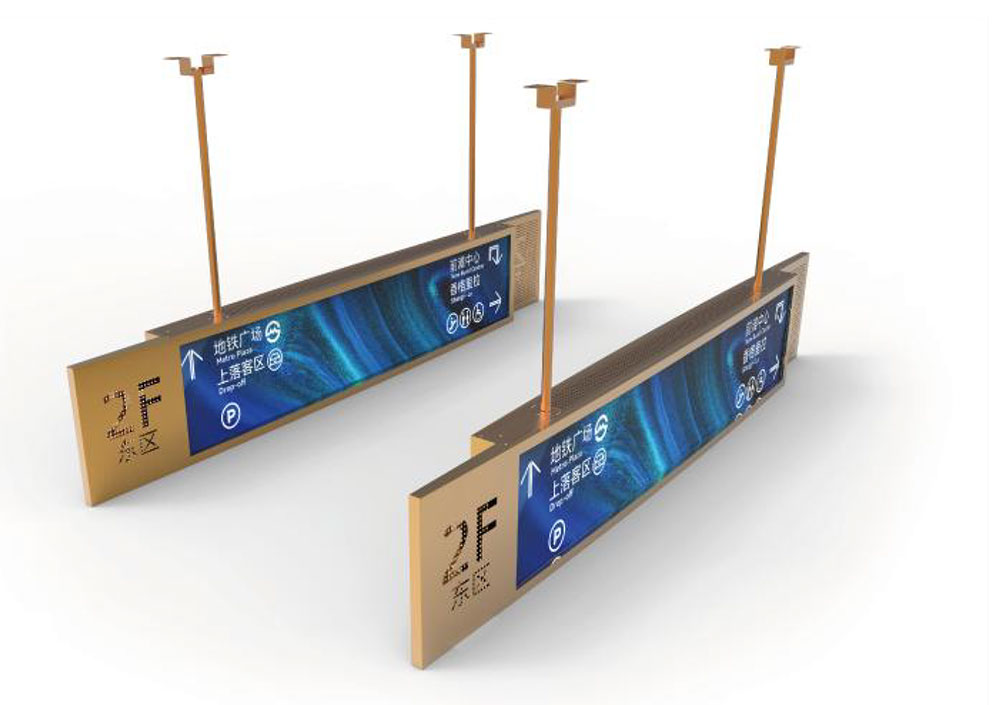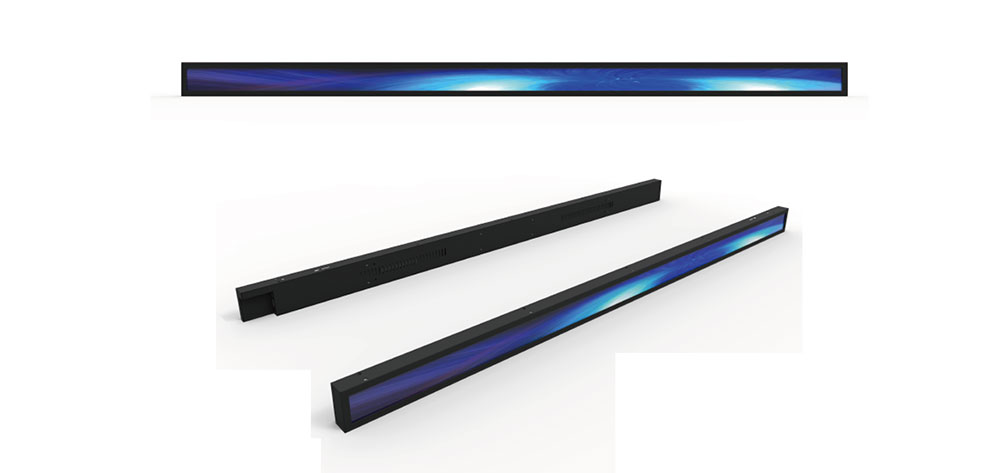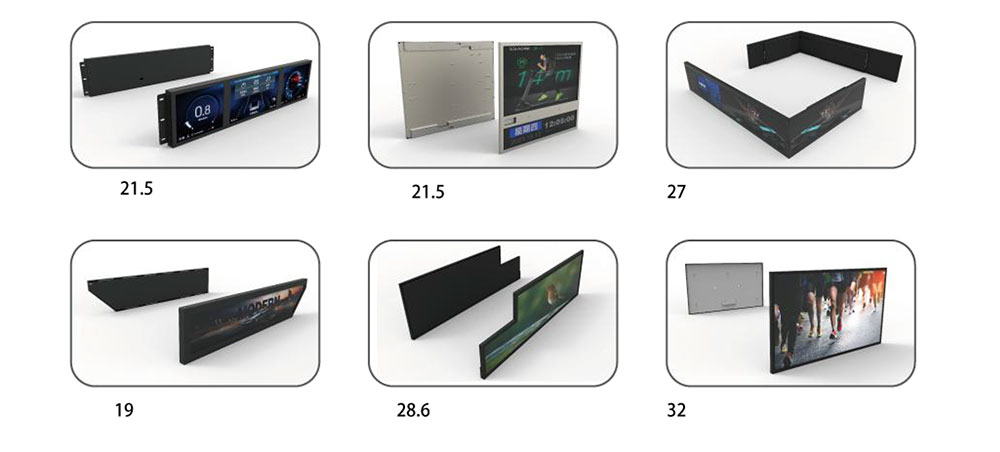
Stretched LCDs — the long, narrow bar-type panels that fit into spaces where a 16:9 screen will never go — have quietly become the default display in outdoor equipment across Canada. They sit above drive-thru lanes in Ontario, inside fuel dispensers along Highway 401, on transit shelters in Vancouver, at ski hill lift lines in British Columbia, and on curbside pickup pylons in Alberta where the mercury drops below −35 °C for weeks at a time. The engineering problem is not simply "make it bright." It is making it bright, cold, wet, sun-blasted, bilingual, and legally compliant on the same device.
Why Stretched Formats Win in Outdoor Equipment
Canadian outdoor equipment designers are constrained by geometry long before they are constrained by electronics. A transit shelter glazing panel accepts roughly 160 mm of vertical display height. A fuel dispenser head has a slot above the nozzle boot. A drive-thru menu pylon has a header band that must remain readable from 12 metres away without blocking sight lines across a lane.
A stretched panel in a 4:1, 5:1 or 16:4.5 aspect ratio matches those slots natively. Compared with tiling two or three small 16:9 panels, a single bar-type LCD eliminates bezel seams through the middle of the image, removes the multi-panel colour mismatch problem, and reduces the number of power supplies, controllers and sealing glands that can fail. It also reduces the sealed enclosure's total surface area — which matters directly to the thermal budget in both winter and summer.
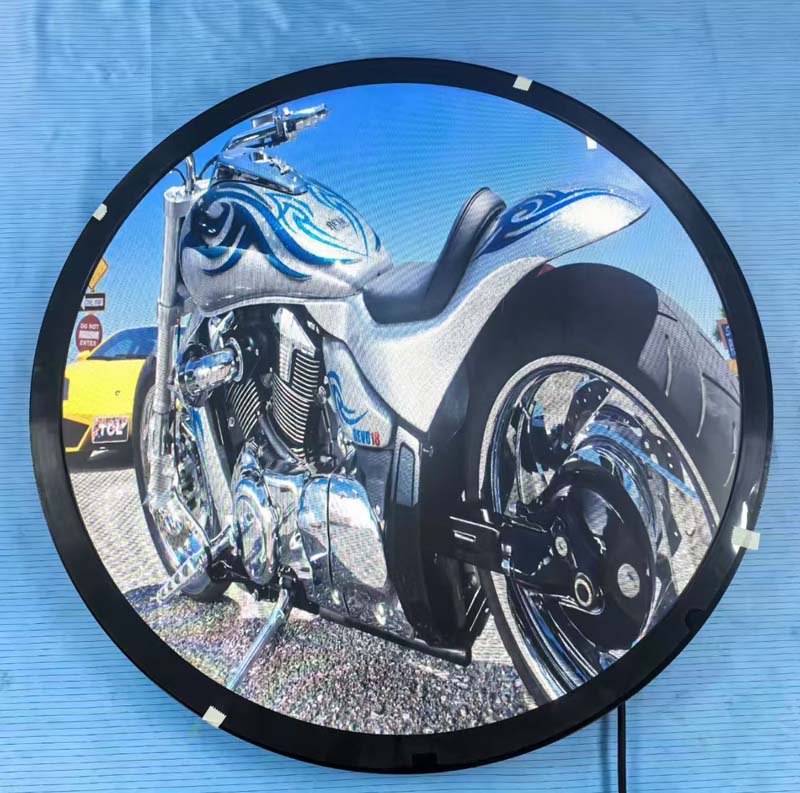
Common sizes in the Canadian outdoor market run from 24-inch and 28-inch shelf-edge bars up to 37-inch, 47-inch and 58-inch stretched panels, typically at native resolutions such as 1920 × 540 or 3840 × 1080 for full-width transit headers.
The Readability Problem: Brightness Is Necessary but Not Sufficient
Canada is not the sunniest country on earth, but it has two conditions that punish displays more than raw lux figures suggest: a low solar altitude for most of the year, and highly reflective snow cover for five to seven months.
Brightness targets
For an unshaded, horizontally-facing or downward-angled screen, 700 nits is adequate indoors but marginal outdoors. Practical guidance for Canadian outdoor equipment:
- Shaded or downward-facing (drive-thru canopy, shelter ceiling): 1,000–1,500 nits.
- Vertical, partially shaded (fuel dispenser face, kiosk wall): 1,500–2,000 nits.
- Direct sun, no hood, snow-bounce environment: 2,000–2,500 nits, with an aggressive anti-reflective stack.
Pushing beyond roughly 2,500 nits usually trades away more than it gains: LED junction temperatures climb, lifetime falls, and the panel becomes painful at night unless the dimming system is genuinely capable of deep, flicker-free dimming down to 5–10 nits.
The optical stack matters more than the nit number
In snow country, glare is dominated by specular reflection of a bright white surround. Three measures carry most of the benefit:
- Optical bonding of the cover glass to the LCD with a refractive-index-matched adhesive. This removes the internal air gap where sunlight produces a double reflection and, more importantly in Canada, where frost and condensation form.
- Anti-reflective and anti-glare treatment tuned to the deployment angle. A low-haze AR coating beats a heavy AG etch in a downward-facing drive-thru installation, and vice versa for a vertical panel facing south.
- Circular polarisation on the front surface where the audience wears polarised sunglasses — a genuine issue for outdoor equipment, since linear polarisers in the panel can black out the image entirely at 90° head rotation. A quarter-wave retardation film on the outer surface converts the output to circular polarisation and eliminates the blackout.
Contrast ratio also deserves scrutiny. In an environment where the screen must show white text on a black field at noon and again at 11 p.m. under LED floodlights, a native contrast of at least 1,000:1 with a well-implemented local dimming or global dimming curve is the working minimum; panels below that turn grey and washed out in a bright surround no matter how many nits the backlight can produce.
Cold: Canada's Defining Constraint
Liquid crystal viscosity rises sharply as temperature falls. At −20 °C an unbuffered panel shows visible lag and smearing; at −30 °C to −40 °C a standard panel may not produce a usable image at all, and some modules specify a storage limit of −20 °C that Canadian winter shipping will violate.
What a cold-rated outdoor display actually needs
- Extended-range panel and polariser specification — panel operating range to −30 °C or −40 °C, with matching storage range so equipment can sit unpowered in a yard over a Prairie winter.
- Integrated heater, typically an ITO transparent heater on the cover glass or a silicone heater pad behind the light guide. The transparent heater is preferred in outdoor equipment because it also clears frost and light snow from the outer surface.
- Thermostat and protection logic — a thermistor reading the actual panel temperature, heater enable below roughly 5 °C (frost clearing) and a separate threshold around 0 °C to 10 °C before full-brightness operation, plus a thermal fuse and a watchdog so a failed thermistor cannot cook the panel in summer.
- Cold-start response time disclosure — a display that takes 90 seconds to reach readable contrast is acceptable for a menu board and unacceptable for a fuel dispenser prompt. Specify the acceptable warm-up curve, not just the steady-state brightness.
Power and inrush
Heater power is often the dominant load during a Canadian cold start: a 47-inch bar display can draw 60–120 W of heater power during warm-up, on top of backlight and electronics. Where the equipment runs on a 24 V DC bus, a solar-buffered battery, or a limited 120 V branch circuit in a shelter, that inrush must be budgeted explicitly. Soft-start heater control, staged backlight ramping and a defined duty-cycle limit prevent the display from tripping the supply or browning out a companion controller.
Moisture, Ice and the Enclosure Interface
The most common field failure in Canadian outdoor displays is not the panel — it is water finding a path through the enclosure, or condensation forming on the inside of the cover glass after a freeze–thaw cycle.
- IP65/IP66 sealing with pressure equalisation. A fully sealed, rigid enclosure that heats and cools daily will breathe through its gaskets. A breathable ePTFE vent equalises pressure without admitting liquid water, and it is close to mandatory in equipment that sees spring melt and autumn freeze–thaw.
- Condensation control. Optical bonding and an internal desiccant or micro-heater address the inner surface. For equipment that is powered down overnight — a genuine scenario for seasonal municipal signage — the design must tolerate condensation forming and then freezing.
- Snow accumulation and meltwater. A downward-facing or hooded installation protects the top edge; a rising-sun exposure on a vertical face means meltwater runs down the panel. Both argue for a bezel that sheds water rather than trapping it, and for a heater that can hold the outer glass above freezing during a melt cycle.
- Salt and de-icing chemistry. Road-salt aerosol in Southern Ontario and Quebec attacks exposed fasteners and any unsealed aluminium. Specify anodised or powder-coated housings, stainless fasteners, and verify gasket material compatibility with chloride exposure.
Summer and Solar Loading
Canadian design conversations often over-weight winter and under-weight July. An enclosed outdoor display with 2,000-nit backlight in direct sun can see internal air temperatures 25–35 °C above ambient. At 32 °C ambient in Montreal or the Okanagan, that pushes panel temperatures past 70 °C, where LED lifetime collapses and the panel may grey out.
Mitigations that work in equipment-sized enclosures: a thermally isolated backlight chamber, a heatsink tied to the enclosure's structural frame rather than to stagnant internal air, filtered forced air where a fan is acceptable, and — most effective and most often skipped — automatic brightness reduction tied to panel temperature, not to ambient. A display that gracefully drops to 1,200 nits at 65 °C panel temperature will outlive one that fights for 2,000 nits and fails at year three. Specify L70 lifetime at the actual operating temperature and duty cycle, not the datasheet's 25 °C figure.
Power, Control and Integration in Canadian Equipment
Outdoor equipment rarely offers a clean, dedicated display circuit. Design assumptions worth locking down early:
- Wide-input DC supplies — 9–36 V DC or 18–75 V DC inputs tolerate the transients of vehicle-mounted or plow-adjacent equipment and the sag of long shelter runs.
- Industrial interfaces — LVDS or eDP internally, with RS-232, RS-485, CAN or Ethernet on the controller side. RS-485 and CAN are common in fuel-dispenser and transit-fleet integration in Canada.
- Deterministic dimming — an ambient-light sensor with a smooth, non-flickering curve. Flicker is both a comfort problem and a photographic one; a menu board photographed at the wrong PWM duty shows banding on the customer's phone.
- Remote monitoring — panel temperature, backlight hours, heater cycles and fault codes over the existing network. For a fleet spread from Halifax to Victoria, a display that reports its own degradation is worth more than one with a longer MTBF claim.
Canadian Compliance and Language Requirements
This is where imported outdoor equipment most often stalls at commissioning.
- Electrical safety: certification to CSA C22.2 No. 62368-1 (or the applicable CSA/UL harmonised standard) via a recognised certification body, with cULus or CSA marks as required by the authority having jurisdiction. Fuel-dispenser installations bring additional requirements tied to the dispensing equipment's own approval.
- EMC: compliance with ISED's ICES-003 for unintentional radiators — relevant because high-brightness backlight drivers are switching supplies, and a poorly filtered driver in a shelter can disturb nearby radio equipment.
- Quebec language law: signage and commercial display content in Quebec falls under the Charter of the French Language, as amended. A drive-thru menu board in Gatineau needs a content and typography strategy that satisfies French-language requirements, not an English layout that gets translated at the last minute. Stretched formats are actually well suited to bilingual layout — the extra horizontal space accommodates side-by-side or alternating English and French content without shrinking type below legibility thresholds.
- Accessibility: transit and municipal wayfinding deployed in Ontario and other provinces should account for accessible-design guidance such as CSA B651 and provincial accessibility legislation — which in practice means minimum character heights, contrast ratios and viewing angles that constrain the display's pixel pitch and brightness choices.
Specification Checklist for Procurement
| Parameter | Recommended outdoor Canada specification |
|---|---|
| Brightness | 1,500–2,500 nits, with dimming to ≤10 nits |
| Contrast | ≥1,000:1 native, local or global dimming |
| Operating temperature | −30 °C to +70 °C panel; storage to −40 °C |
| Heater | ITO front heater + thermistor control, soft start |
| Optical | Optical bonding, AR/AG per mounting angle, circular polariser option |
| Sealing | IP65/IP66, ePTFE pressure vent, condensation management |
| Lifetime | L70 stated at operating temperature and duty cycle, ≥50,000 h target |
| Certification | CSA/UL 62368-1, ISED ICES-003 |
| Interface | LVDS/eDP + RS-485/CAN/Ethernet controller, wide-input DC |
Design Practices That Fail in the Field
Three patterns recur in Canadian outdoor deployments that underperform:
Over-specifying brightness and under-specifying the optical stack. A 2,500-nit panel with an air gap and no AR coating can be less readable in snow glare than a 1,500-nit bonded panel with good AR.
Treating the heater as an accessory. A heater without thermistor control, a thermal fuse and a warm-up acceptance criterion is a reliability liability in both January and July.
Designing for the datasheet rather than the duty cycle. Outdoor equipment often runs 24/7 at full brightness in summer and is powered down at −30 °C in winter. Lifetime and cold-start behaviour must be specified against that pattern, not against a 25 °C bench test.
Conclusion
For Canadian outdoor equipment, a high-brightness stretched LCD is a system, not a component. The panel format solves the geometry problem, the backlight solves the daylight problem, and the heater, sealing, optical bonding and control electronics solve the conditions that actually decide whether the installation is still working in year five. Teams that specify brightness, cold-start behaviour, condensation management, thermal derating and Canadian certification together — and treat Quebec language requirements and accessibility guidance as design inputs rather than afterthoughts — get displays that survive a Canadian winter and still read cleanly in the low July sun.
KEYWORDS: high brightness stretched LCD, outdoor stretched bar display, sunlight readable LCD Canada, cold weather outdoor display, stretched LCD for fuel dispenser