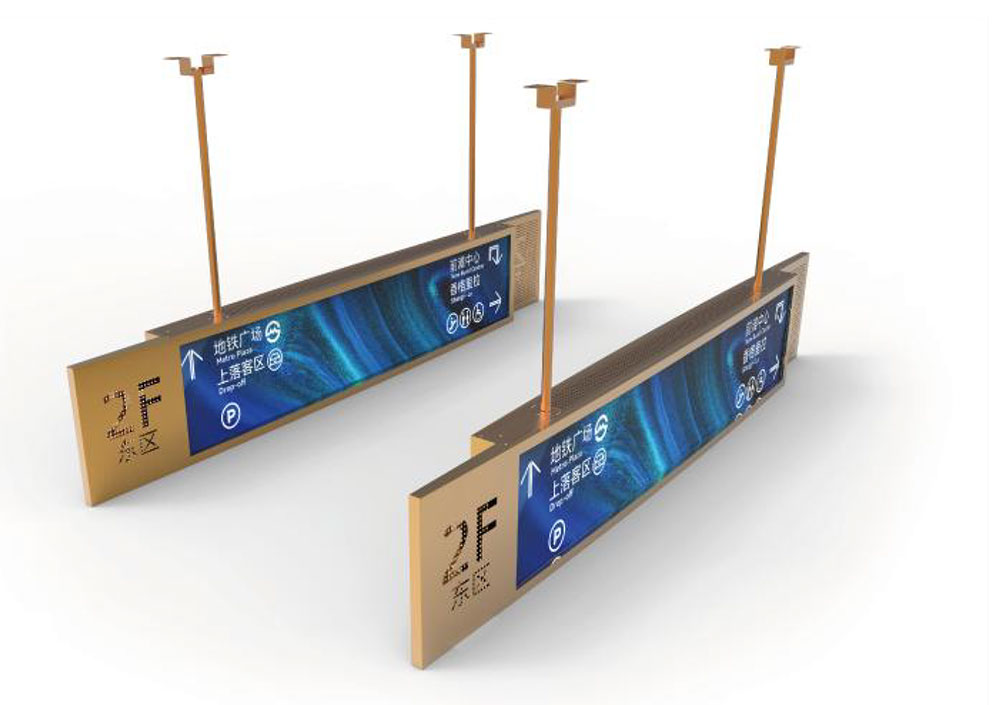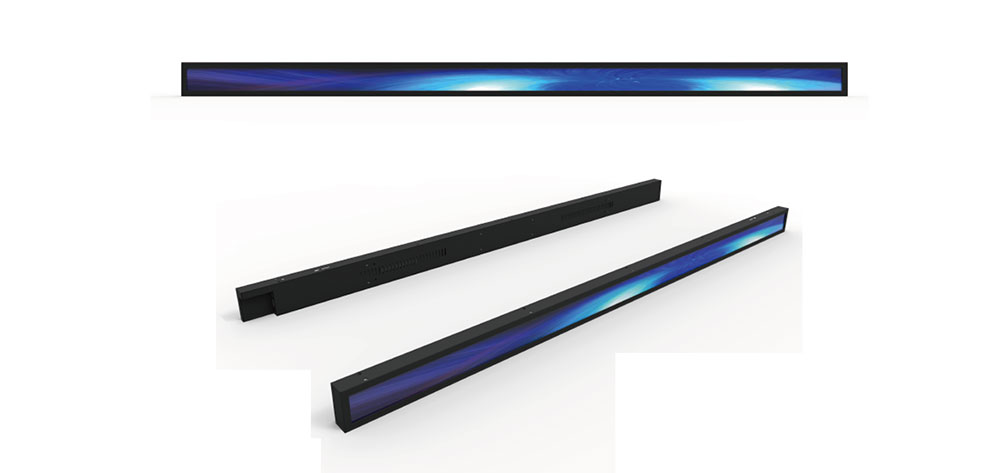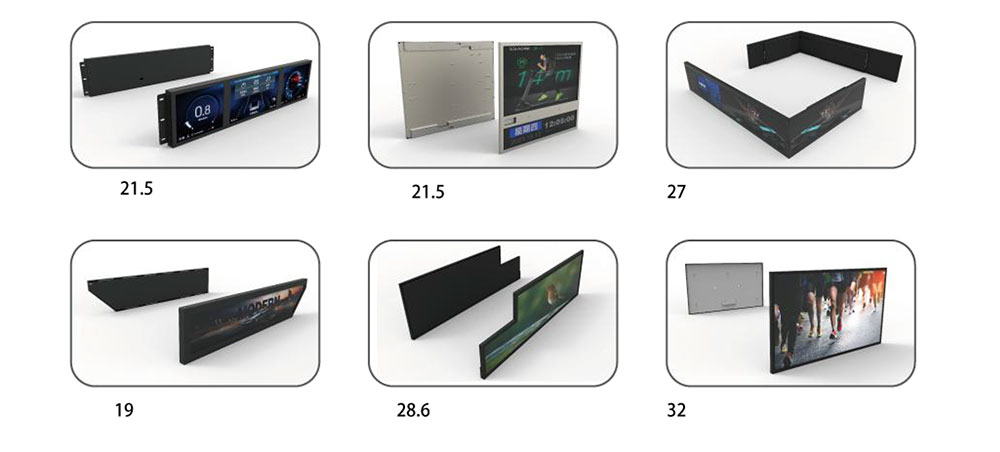
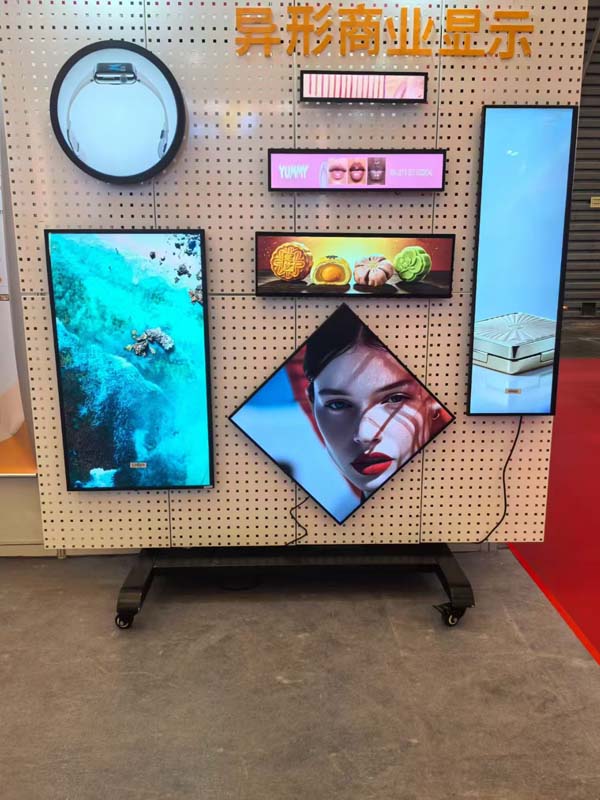
Bar-type LCDs, also called stretched or ultra-wide displays, have an aspect ratio far outside the usual 16:9. A panel might measure 1920×158 or 1920×360 pixels instead of a conventional rectangle. In industrial settings this shape is not a styling choice. It matches the physical slot available on a machine fascia, a shelf edge, a transit vehicle header, or an elevator door frame. Because the form factor is unusual, the specification process differs from picking a standard monitor. This article walks through the parameters an engineer at HITULCD reviews before committing a bar LCD to an industrial design.
Start with the mechanical envelope, not the diagonal
A bar LCD is usually defined by its active area and outline dimensions rather than a diagonal measurement, because the diagonal tells you almost nothing about fit. Record the active area in millimeters, the module outline, the bezel width on each edge, and the depth including the backlight and driver board. Confirm where the flexible printed circuit exits the panel, since a cable leaving the wrong edge can force an awkward enclosure. Mounting options matter too: panels are secured by brackets, VESA-style plates, bonded frames, or clips, and the chosen method affects both vibration tolerance and serviceability.
Brightness and the ambient light it must overcome
Luminance, measured in candela per square meter (nits), is the parameter that most often decides whether an industrial bar display succeeds. An office monitor runs at 250 to 350 nits. A display behind glass, under factory lighting, or facing a window needs far more. HITULCD high-brightness bar panels typically range from 700 to 2500 nits. For direct-sun outdoor positions, specify 1500 nits or higher together with optical bonding to cut internal reflection. Pair the luminance figure with a contrast ratio and, for sunlight, a measurement of reflectance, because a bright panel with a mirror-like surface can still wash out.
High brightness generates heat, so the brightness specification is inseparable from the thermal and dimming specifications. Ask whether the backlight supports automatic brightness control through an ambient light sensor, and whether it dims at high temperature to protect the LEDs. A panel rated at 2500 nits that throttles to 1200 nits at 60°C may still be the right choice, but only if you know that behavior in advance.
Temperature range and thermal management
Industrial environments swing well beyond office conditions. Separate the operating temperature range from the storage range, and check both against the installation. Common industrial grades run −20°C to +70°C for operation and −30°C to +80°C for storage. Two failure modes drive these limits. At low temperature the liquid crystal response slows and images smear, which is why cold-start locations need a panel with a heater or a wide-temperature LC formulation. At high temperature a phenomenon called isotropic or black-spot failure can occur, where the crystal loses its ordered state and the display blacks out until it cools. High-brightness backlights add their own heat load, so the enclosure design, airflow, and any heat sink must be validated together with the panel, not after it.
Resolution, pixel pitch, and viewing distance
Resolution on a bar LCD is driven by content and reading distance rather than by a marketing number. A shelf-edge price strip viewed from half a meter needs fine pixel pitch for crisp small text. A header display read from across a train platform can use a coarser pitch. Calculate the pixel pitch from the active width and horizontal pixel count, then confirm that your smallest intended font remains legible at the real viewing distance. Verify that the resolution is supported by your graphics source over the chosen interface, since nonstandard bar resolutions sometimes need a custom timing (EDID) file.
Interface and driver board
The raw panel speaks LVDS, eDP, or MIPI DSI depending on size and resolution. Most industrial integrations need a driver or controller board that converts a usable input such as HDMI, DisplayPort, or USB-C into the panel's native signal. Specify the input connector, the supply voltage (commonly 12V or 24V in industrial cabinets), and the power budget at full brightness, which for a high-brightness bar panel is dominated by the backlight. If the display must run continuously for years, confirm the controller's duty rating and whether it supports a watchdog or auto-recovery after a power interruption.
Touch, cover glass, and optical bonding
If the application is interactive, decide between projected capacitive touch for a smooth glass surface and resistive touch where gloves or styluses are in use. Specify the cover glass thickness and its surface treatment, anti-glare for diffuse reflection control or anti-reflection coating for maximum clarity. Optical bonding fills the air gap between the touch sensor or cover glass and the LCD with a clear adhesive. It improves sunlight readability, removes internal condensation risk, and strengthens the assembly against impact and vibration. Bonding is worth specifying early because it changes the stack-up thickness and the repair strategy.
Viewing angle and orientation
Bar displays are frequently mounted in portrait or at eye level in a narrow slot, so viewing angle behavior deserves a direct check. IPS and similar wide-angle technologies hold color and brightness across a broad cone, while cheaper TN panels invert or darken off-axis. Confirm the specified angle matches how people actually stand relative to the panel, and verify the optical top direction of the LCD, because a panel installed upside down relative to its designed viewing direction will look dim and washed out.
Reliability, lifetime, and compliance
Industrial deployments expect years of continuous service, so review the backlight half-life rating, usually given in hours to half the initial luminance. Confirm vibration and shock ratings against the mounting environment, and ingress protection (IP rating) for the exposed face if the display meets dust or liquids. Check certification needs early: CE, FCC, RoHS, and REACH for most markets, plus any sector-specific standard such as railway EN 50155 or medical IEC 60601 where relevant. For long product lifecycles, ask about the panel's expected production longevity so a redesign is not forced by an early end-of-life notice.
A practical specification checklist
- Active area, outline, depth, FPC exit edge, and mounting method
- Luminance in nits, contrast, reflectance, and dimming behavior over temperature
- Operating and storage temperature range, plus heater or wide-temperature LC if needed
- Resolution, pixel pitch, and legibility at the true viewing distance
- Native panel interface, controller board input, supply voltage, and full-brightness power
- Touch technology, cover glass treatment, and whether optical bonding is required
- Viewing angle technology and correct optical orientation
- Backlight lifetime, vibration and IP ratings, and applicable certifications
Conclusion
Specifying an industrial bar LCD is a systems exercise. Brightness, heat, interface, and mechanics constrain one another, and a choice that looks fine in isolation can fail in the enclosure. Working through the parameters above, and validating the complete module in its real thermal and lighting environment, gives engineers a bar display that stays readable and reliable for the life of the product. HITULCD supports this process with high-brightness bar panels and matched controller, bonding, and thermal options engineered for demanding industrial conditions.
KEYWORDS: industrial bar LCD display, high brightness bar LCD, stretched LCD specifications, bar display engineering, sunlight readable LCD