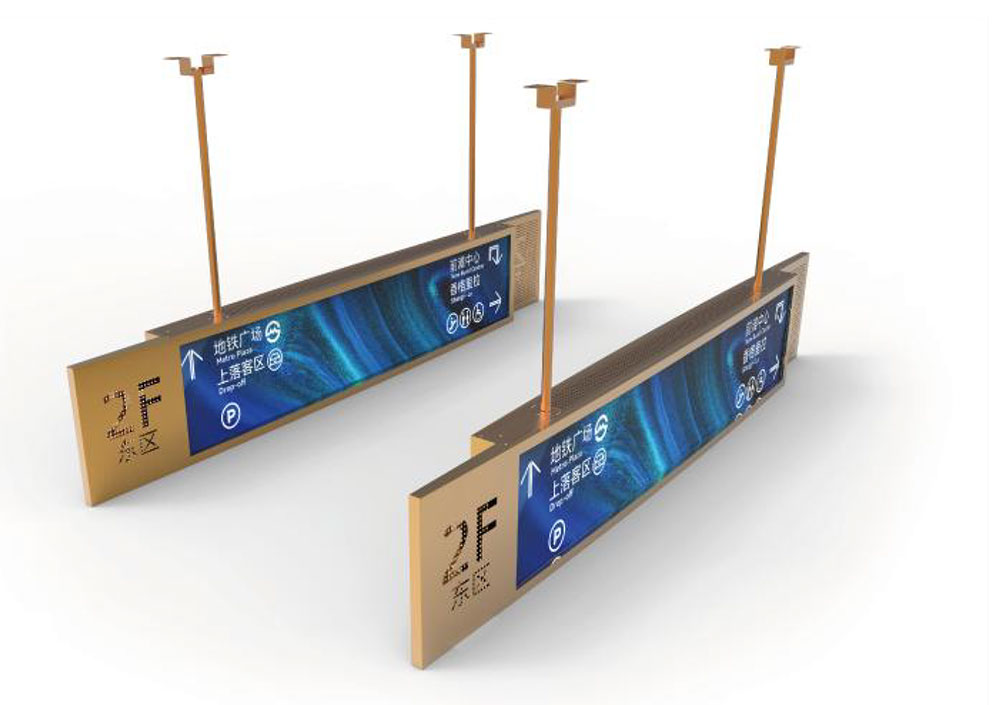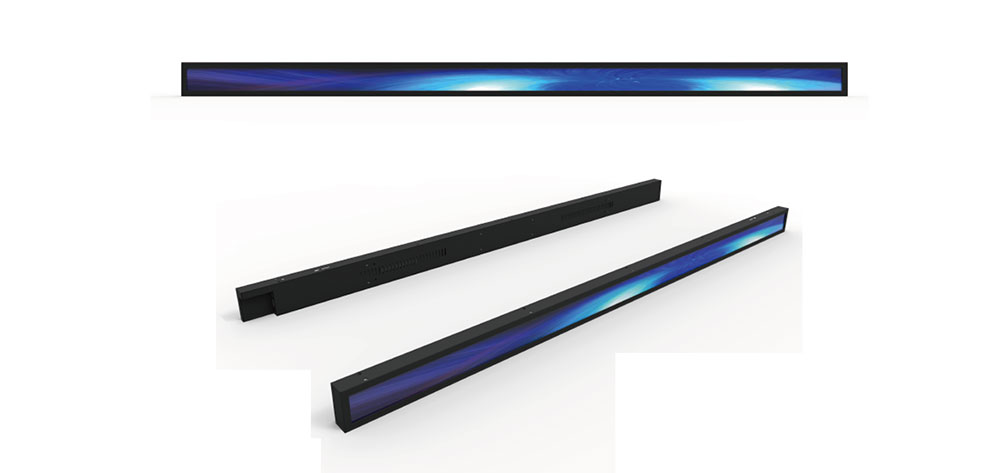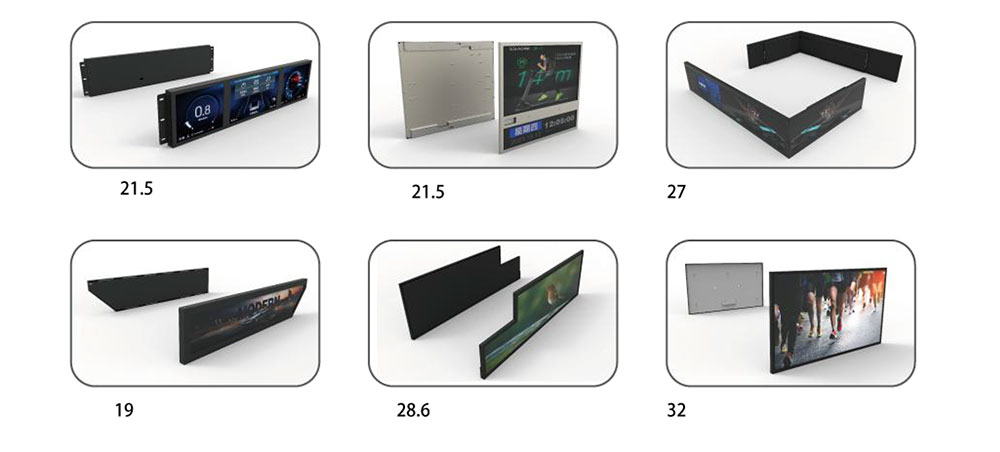
A stretched LCD — also called a bar-type, elongated, or ultra-wide display — is one of the few components where the buyer's specification choices are effectively irreversible once tooling and glass are committed. For Canadian OEMs, the risk profile is a step higher than for buyers in Asia, Europe, or the southern United States, because the physical environment, the certification regime, and the import chain all push in directions that standard catalogue modules were never designed to handle. This paper walks through the decisions that determine whether a custom stretched display becomes a durable product advantage or a two-year engineering liability.
Why stretched panels are a different procurement category
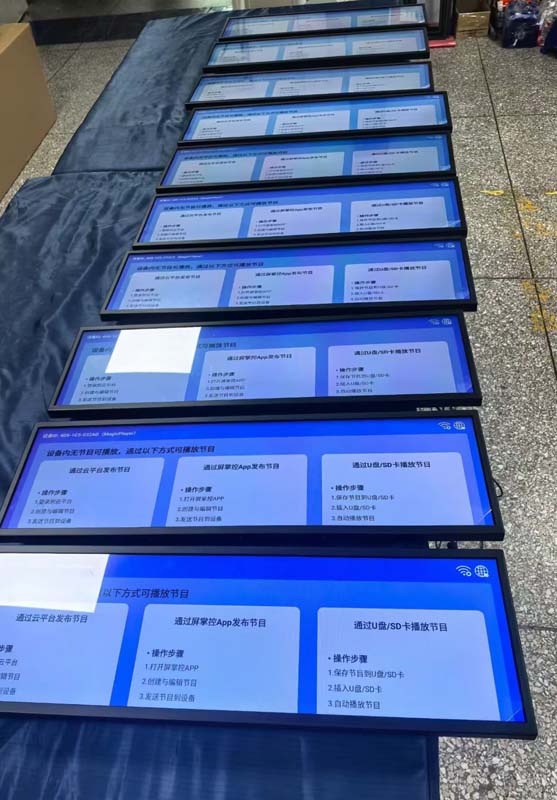
Standard 16:9 TFT modules are cut from mother glass in layouts that have been optimized for more than a decade. Supply is deep, second sources exist, and a failed module is usually a swap away from recovery. A stretched panel breaks all three of those assumptions.
Stretched displays are produced by re-cutting mother glass into formats such as 16:3, 21:9, 28:9, 35:9, or 37:9. Each cut layout yields a fixed number of panels per sheet, and the economics only work at volume. That produces three consequences a Canadian OEM must plan around:
- Tooling is dedicated. The backlight, light guide, frame, FPC, and often the driver IC initialization set are unique to the format. There is no drop-in alternate part if the program falters.
- Minimum order quantities are structural, not negotiable. MOQ reflects sheet yield, not sales policy. A supplier quoting a low MOQ on a 37:9 format is either absorbing inventory risk or planning to substitute a different cut later.
- Lifecycle is shorter. Niche formats are usually built on a generation of glass that the fab wants to retire. Expect a five-to-seven-year production window on many stretched formats, versus ten or more on mainstream industrial panels.
None of this is a reason to avoid stretched displays. It is a reason to negotiate lifecycle terms before, not after, the first purchase order.
Defining the specification: the numbers that actually constrain the design
Most stretched-display RFQs that fail in prototype do so because the buyer specified a desired outline dimension rather than a panel active area that already exists. The productive sequence is to work backwards:
- Active area and aspect ratio. Fix the visible image area from the mechanical design, then accept the nearest available panel geometry rather than demanding an exact match.
- Resolution and pixel density. Common stretched resolutions include 1920×540, 1920×720, 2560×720, 3840×1080, and 2880×864. Higher pixel counts on long formats stress the source driver count and the LVDS/eDP lane budget, which affects both cost and EMI.
- Bezel and mechanical tolerance. Stretched formats frequently have asymmetric borders because of gate-driver placement. Confirm the datum and the tolerance stack before finalizing the enclosure.
- Interface and controller. LVDS, eDP, and MIPI DSI are all available, but non-standard timings require either a matched timing controller or a scaler with a custom EDID. Specify the host platform early; retrofitting a controller board into a sealed product is expensive.
Brightness is a thermal problem disguised as an optical one
Canadian projects frequently specify 1,000 to 2,500 nits for outdoor kiosks, transit shelters, fuel dispensers, and drive-through signage. The optical target is easy to quote. The thermal consequence is where projects break.
A high-brightness backlight on a stretched format concentrates LED heat into a long, narrow light guide with limited surface area for convection. In an ambient of −30 °C this is helpful — the backlight self-heats the panel. Inside a sealed enclosure at +30 °C with direct sun loading on the front glass, the same backlight becomes a liability. Practical guidance:
- Design the thermal path around the worst-case combination, which in Canada is rarely summer ambient alone but summer ambient plus solar gain through a bonded, low-reflectance cover glass.
- Ask for the panel's measured luminance at the panel surface after optical bonding and cover glass, not at the backlight. A 1,500-nit backlight can deliver 1,000 nits through a bonded stack and considerably less through an air gap with a tinted glass front.
- Specify the dimming method. PWM dimming below roughly 200 Hz produces visible flicker on camera-based systems and can interact badly with rolling-shutter capture in security and transit applications. DC dimming or high-frequency PWM is worth specifying explicitly.
- For sunlight readability, pair luminance with an anti-reflective bonded cover glass. A 1,000-nit display with 1.5% reflectance reads substantially better outdoors than a 1,500-nit display with 6% reflectance.
The Canadian variable: cold, condensation, and cold-start behaviour
This is the single most under-specified parameter in stretched-display RFQs coming from Canadian OEMs, and the one most likely to produce field failures in the first winter.
Liquid crystal viscosity rises sharply as temperature falls. At −20 °C a panel rated at 25 ms response at room temperature may respond several times more slowly, producing smear on scrolling text and ghosting on animated content. Below the panel's specified operating floor, the drive electronics may fail to initialize at all, or the backlight inverter may refuse to strike.
Four requirements close most of this gap:
- Operating temperature range stated for the assembled unit, not the bare panel. A panel rated to −30 °C inside an enclosure with a heater film, a metal chassis, and a thermally insulating front bezel behaves very differently from the same panel in free air.
- Integrated heating. Transparent heater films on the cover glass or heater pads on the light guide bring the panel to operating temperature in a defined time. Specify the heat-up time at −30 °C and the heater power budget; a 400 mm × 150 mm stretched display can easily draw 15–30 W of heater power, which affects PoE budgets and Class 2 / SELV supply sizing.
- Condensation control. Canada's freeze-thaw cycles and heated enclosures produce internal condensation that air-gapped designs handle poorly. Optical bonding eliminates the internal air cavity where fog forms, and an IP-rated gasket with a breathable membrane vent manages pressure equalization without admitting moisture.
- Cold-start sequencing. Firmware should delay backlight enable until the panel reaches its minimum operating temperature, and should stagger inrush across the heater and backlight rails.
| Parameter | Typical industrial baseline | Canadian outdoor requirement |
|---|---|---|
| Operating temperature | 0 to +50 °C | −30 to +70 °C at the enclosure surface |
| Storage temperature | −20 to +60 °C | −40 to +80 °C (unpowered, unheated warehouse) |
| Cold-start time | Not specified | Full luminance within 5–10 minutes at −30 °C |
| Humidity | Non-condensing | Condensation-tolerant with bonded stack and vented enclosure |
Touch, gloves, and the bonded stack
Projected-capacitive touch on a stretched format introduces two constraints that do not appear on standard modules. First, the ITO sensor pattern must be designed for the format's aspect ratio; a 37:9 sensor has very different resistance and RC characteristics at the far ends of the long axis than a 16:9 sensor, and poorly designed sensors show dead zones or reduced accuracy near the extremities. Second, the touch controller's tuning must be validated through the actual cover glass thickness.
In Canada, glove operation is a functional requirement rather than a feature — outdoor payment terminals, transit ticket machines, and industrial control panels are used in gloves for five months of the year. Specify glove-mode support and the maximum cover glass thickness (typically 3–6 mm for a well-tuned controller) at the RFQ stage, and require the supplier to demonstrate multi-touch accuracy through that stack, not on bare glass.
Optical bonding is strongly recommended for any outdoor or high-vibration Canadian deployment. It removes the internal reflection that washes out contrast in sunlight, eliminates the condensation cavity, and dramatically improves impact resistance and resistance to vibration-induced FPC fatigue. The trade-off is repairability: a bonded assembly is generally not field-serviceable, which raises the importance of the warranty and RMA terms discussed later.
Compliance: what "certified for Canada" actually means
Canadian market access involves requirements that are distinct from the US, and a UL listing alone does not cover them.
Electrical safety
End products require certification by a Standards Council of Canada–accredited certification body, marked with the appropriate Canadian identifier (cUL, cCSA, cETL, or equivalent) and evaluated against the Canadian adoption of IEC 62368-1, i.e. CSA C22.2 No. 62368-1. A "UL recognized" component is not the same as a certified end product. Ask your display supplier for the component recognition file number and confirm the ratings match your enclosure's thermal environment.
Wireless and EMC
If the display assembly includes a Wi-Fi, Bluetooth, or cellular module for content delivery, the module must carry ISED Canada certification — a separate certification number from the FCC ID — and the host integration must respect the module's RF exposure and antenna restrictions. Display driver boards that are purely internal still need to be evaluated as part of the host's EMC testing, which is why requesting the panel's FPC shielding and grounding documentation early saves a re-test cycle.
Bilingual labelling
Federal and provincial requirements mean that product labelling, safety warnings, and user documentation sold in Canada generally must be in both English and French. In Quebec, the Charter of the French Language sets a stricter standard: French must be markedly predominant on packaging, labelling, and commercial documentation. If your stretched display is embedded in a product sold into Quebec — especially a public-facing kiosk or signage unit — plan the nameplate and warning label artwork accordingly. Suppliers who print the label at the factory need the bilingual artwork before the first build, not after.
Environmental and end-of-life
Canada has no single federal RoHS equivalent; obligations arrive through provincial electronics recycling programs (EPRA-affiliated in most provinces), provincial hazardous waste rules, and your customer's own supply-chain requirements. In practice, Canadian OEMs specify EU RoHS and REACH compliance as the de facto baseline and register with the relevant provincial stewardship program. Confirm that your supplier can supply material declarations and a conflict-minerals statement, and that the backlight LED binning documentation is available for your compliance file.
Import, landed cost, and the customs file
Stretched LCD modules typically clear under HS headings 8524.91 or 8524.99 depending on construction. Three practical points for Canadian buyers:
- Use CARM-compliant processes. CBSA's assessment and revenue management system now governs importer accounting; your customs broker needs correct tariff classification and origin documentation before the first shipment, not after.
- Confirm country of origin separately from country of shipment. Cells, backlights, and assembly may originate in different jurisdictions, which affects duty treatment and any applicable trade program eligibility.
- Budget freight and duty into the NRE decision. Stretched panels ship in reinforced trays with significant volume-to-value ratio; air freight on a 20-piece pilot build can exceed the unit cost difference between two suppliers.
Also verify standby and no-load power draw against Natural Resources Canada energy efficiency requirements if the finished product is a consumer-facing display, and confirm the power supply carries the appropriate Canadian certification mark.
Lifecycle management: the terms that matter more than the price
Because stretched formats have no second source, the commercial terms in the supply agreement carry more weight than on any standard panel. Insist on:
- Product change notification with a defined notice period — 12 months is a reasonable ask for a display, and anything under six months should be treated as a red flag.
- End-of-life notice with a last-time-buy window, plus a written commitment on how long after EOL the supplier will hold inventory for warranty replacements.
- Documented firmware and EDID version control, so that a silently revised timing controller does not create a field population with two different behaviours.
- Tooling ownership — clarify whether the backlight mold, frame tooling, and FPC artwork are yours, the supplier's, or shared, and what happens to them if the relationship ends.
- Warranty and RMA terms measured against your field failure cost, not the panel price. Replacing a $200 display inside a sealed, pole-mounted transit unit can cost twenty times the part.
An RFQ checklist for Canadian OEM buyers
A stretched-display RFQ that answers these questions up front typically shortens the quotation cycle by weeks and removes most of the specification ambiguity that leads to prototype rework:
- Active area, aspect ratio, and resolution — stated as a range with priorities, not a single target.
- Target luminance measured at the bonded cover glass surface, with the dimming range and method.
- Operating and storage temperature at the assembled unit level, plus required cold-start time and heater power budget.
- Touch type, cover glass thickness, glove operation, and whether optical bonding is required.
- Host interface, controller or scaler requirement, and EDID handling for non-standard timings.
- IP rating, vibration and shock profile, and the mounting orientation (portrait stretched formats invert the thermal problem).
- Required certification documentation: component recognition file, material declarations, and label artwork in English and French.
- Volume forecast, MOQ acceptance, NRE and tooling amortization, and desired lifecycle and PCN terms.
Conclusion
Custom stretched LCD displays reward buyers who treat them as an engineering program rather than a component purchase. The formats are genuinely valuable — a 37:9 bar display can replace a row of smaller panels in transit information systems, shelf-edge signage, instrument clusters, and industrial HMI, reducing part count and enclosure complexity. But the same properties that make them attractive — dedicated tooling, fixed cut layouts, no second source — mean that every specification decision is a long-term commitment. For Canadian OEMs, the additional requirements are environmental and regulatory rather than optional: a cold-start strategy, condensation control, bilingual labelling, ISED and CSA compliance, and a lifecycle agreement that survives the panel's end of life. Getting those settled before the first tooling payment is the difference between a differentiated product and an expensive lesson.
KEYWORDS: custom stretched LCD displays, stretched bar LCD Canada, high brightness stretched display, sunlight readable bar-type LCD, stretched LCD OEM supplier