
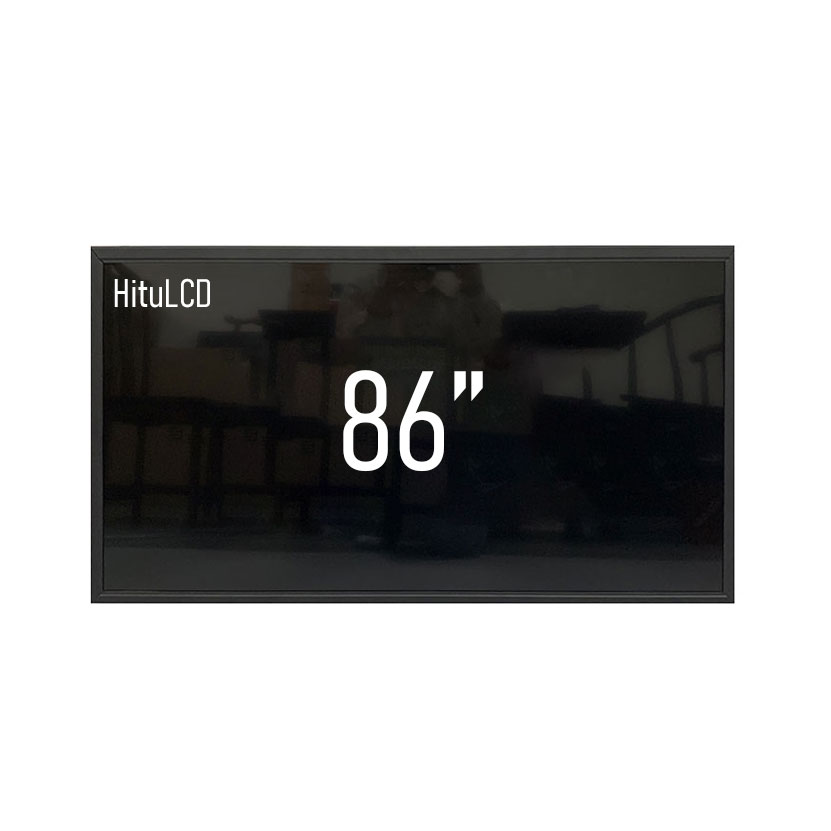
86 Inch Outdoor LCD Panel with Sunlight Readability for Commercial Displays
MODEL: HT860FHD-D3000
Need customized solution?
Our engineering team is always ready to provide you with professional technical support and flexible customized services.
Understand light customization servicesBuilt by us. Configured for you.
HITULCD supplies LCD modules and display solutions directly from our manufacturing operation, giving OEMs, integrators and distributors direct access to engineering, customization and production.
Supply
Supplier Qualification
VerificationTechnical Specifications
| LCD PANEL PARAMETERS | HDMI/CONTROL BOARD SPECIFICATIONS | ||
|---|---|---|---|
| ITEM | DETAILS | ITEM | DETAILS |
| Description | HITULCD 86" QLED QUANTUM DOT HIGH COLOR GAMUT 350CD | Input Interface | HDMI, VGA,DP |
| Size | 86 | Power Input | AC 100~240V |
| Display area (mm) | 698.4(H)x 392.85(V) | OSD KEYS | 5 KEYS (POWER SWITCH, MENU, +, -, EXIT) |
| Resolution | 1920*1080 | OSD CONTROL | BRIGHTNESS, COLOR, CONTRAST, AUTO ROTATION, H/V POSITION, ETC. |
| Aspect ratio | 16:9 | ||
| Contrast ratio | 1200:1 | ||
| Pixel per inch (PPI) | 69 | ||
| Viewing angle | 178(H),178(V) | ||
| Display Colors | 16.7M, 72% NTSC | ||
| Response time(Typical) | 8ms | ||
| Signal Type | LVDS (2 ch, 8-bit) | ||
| Backlight | WLED, 30K hrs, With LED Driver | ||
| Power consumption | 50W | ||
| Dimensions (mm) | 718x412x14 | ||
| Mounting | VESA400x200 | ||
| Bezel size (U/B/L/R) | 7.9/7.9/7.9/7.9 | ||
| Operating temperature | 0℃~+50℃ | ||
| Storage temperature | -20℃~+60℃ | ||
| Weight (Net) | 5KG | ||
OEM/ODM Manufacturing at HITULCD
One Factory, Any Application — Custom Display Solutions Built Around Your Integration, Not the Other Way Around
The Core Idea
Most display suppliers sell you a fixed catalog and expect your product to adapt to their panel. HITULCD works the other way: we design and manufacture the display around your integration, your enclosure, and your application — whether that's a fuel dispenser terminal, a hospital bedside monitor, a subway platform information board, or a piece of equipment that doesn't exist in any catalog yet. If your project has non-standard requirements, that's the starting point of an OEM/ODM conversation, not a reason to compromise.
This matters most to the people actually responsible for making the integration work: engineers who need a panel that fits the mechanical and electrical constraints of their design, procurement managers who need a supplier that won't force a BOM change mid-project, and project owners who need one factory that can carry a design from prototype to volume without re-sourcing.
Customization Across Every Dimension
We don't treat "customization" as a single checkbox — it spans the full stack of what makes a display fit into your product:
Size & form factor: From 5.5" embedded panels to 98" large-format displays, including non-standard cut sizes, stretched/ultra-wide bar formats, and open-frame designs sized to your existing chassis
Brightness: Full range from 350 nits for indoor signage up to 3000 nits for direct sunlight readability — matched to your actual deployment environment, not the nearest standard tier
Interface & control: HDMI, VGA, DP, and custom AD board designs supporting mixed signal inputs, automated dimming sensors, and application-specific control logic
Touch & bonding: Projected-capacitive touch tuned for gloved or wet-environment use, full/air optical bonding for outdoor sunlight and vibration resistance
Housing & mechanical integration: Bezel width, VESA mounting pattern, enclosure assembly, and structural adaptation to fit your existing product design rather than requiring you to redesign around ours
Environmental rating: Wide-temperature operation from -20°C to +70°C, sealed/weatherproof construction for outdoor and harsh-environment deployment
Built for Any Field, Not Just Our Existing Catalog
Because customization happens at the engineering level rather than the SKU level, HITULCD panels currently run across industries that have very little in common with each other operationally — which is exactly the point:
Smart Retail — shelf-edge displays, digital window signage, self-service kiosks
Transportation — fleet displays, platform information systems, in-vehicle terminals built for vibration and continuous duty
Medical Equipment — bedside and diagnostic displays with the reliability and certification pathway medical integration requires
Outdoor Advertising — 2000–3000 nit sunlight-readable signage rated for 24/7 unattended operation
Industrial Automation — HMI panels and control terminals for factory-floor conditions
Gas Station Terminals — outdoor fuel dispenser displays combining brightness, weatherproofing, and vandal-resistant mounting
If your application doesn't fit neatly into any of these categories, that's not a problem — it's the normal starting point for an ODM engagement. The engineering process is the same regardless of end market: understand the integration constraints first, then design the panel to fit them.
What "Convenience" Actually Means Here
For procurement managers and project owners evaluating suppliers, the practical value of OEM/ODM sourcing from one factory comes down to a few concrete things:
One point of contact from design to volume — the same engineering team that reviews your feasibility drawings also owns the production line, so specifications don't get lost in a handoff between a design house and a separate contract manufacturer
No forced compromise on your BOM — because sizing, brightness, interface, touch, and housing are all adjustable independently, you don't have to accept a "close enough" standard part and redesign your product around it
Engineer-to-engineer communication — technical questions go directly to the people who will actually build the panel, not through a sales layer that has to relay and wait
Scalable from prototype to production — the same factory that produces first-article samples runs the 12,000+ units/month production capacity for volume orders, so there's no re-qualification step when a project moves from pilot to scale
Certification support built in — panels are designed to help your finished product clear CE, RoHS, FCC, and (on request) UL/CCC/EAC, reducing time-to-market rather than leaving certification as a downstream problem you solve alone
How an OEM/ODM Engagement Typically Starts
Share your constraints, not just a spec wish list — enclosure drawings, target environment (indoor/outdoor/temperature range), interface requirements, and target volume
Engineering feasibility review — our team confirms what's achievable within your constraints and flags any conflicts before committing to a design direction
Sample/prototype run — first-article units built to your confirmed spec for validation in your own integration
Production scale-up — the same design moves to volume manufacturing without a supplier change or re-qualification cycle
Next Step
Send your integration drawings, target application, and environmental requirements to our engineering team via Contact The Manufacturer or explore the full customization scope at OEM/ODM. You'll get a feasibility response from the people who will actually build the panel — not a generic quote.
Custom Panel Cutting Services for the 86" Direct-Lit LCD Series (HT860FHD-D3000)
Technical Content for Overseas Engineers, Procurement Managers & Project Owners
Many customers ask us to cut a standard panel — including this 86" 3000-nit series — down to a non-standard size for their enclosure or product form factor. Below are the questions we get most often before a customer commits to a custom cutting project, answered directly.
1. Process Feasibility & Cutting Method
What cutting method do you recommend, and what tolerance can be held?For glass thicknesses typical of this panel range, we evaluate case-by-case between mechanical wheel scribing and ultrafast laser cutting. Mechanical scribing is lower-cost and faster for simple straight-line cuts on non-critical edges; ultrafast laser cutting is used when the cut line runs close to active circuitry, when a tighter edge tolerance is required, or when micro-crack risk needs to be minimized. We confirm the method during feasibility review once we see your target dimensions and cut-line location — we don't default to one method across all projects.
Will the cut interfere with the Gate/Source trace routing or TFT array?This depends entirely on where your cut line falls relative to the original panel's active area and routing. To confirm feasibility before quoting, we need:
Target outline dimensions with the intended cut-line position marked
The panel's Gate/Source driver IC layout and trace routing diagram (or panel model/part number so we can pull it from our own records)
TFT array boundary and any keep-out zone requirements from your side
Your enclosure or bezel drawing, if the cut is being sized to fit a specific housing
Feasibility review happens before sampling begins, so any conflict with active circuitry gets flagged and resolved on paper rather than after a wasted sample run.
What's the edge flatness and micro-crack control standard after cutting?Cut edges are inspected for flatness and chip/micro-crack presence against our internal QC threshold before proceeding to sealing. Projects with tighter cosmetic or structural requirements (visible edge, load-bearing mounting point, etc.) can specify a stricter acceptance standard at the quotation stage — this is confirmed per project rather than a single fixed number across all sizes and cut methods.
2. Reliability & Edge Sealing
How do you prevent liquid crystal leakage and moisture ingress after cutting?Cut edges go through a secondary sealing process — typically UV-cure dispensing along the cut edge — to re-establish the barrier the original panel edge seal provided. The dispensing pattern and cure process are adjusted based on cut location and panel construction; we can walk through the specific approach for your cut geometry once we have your drawings.
Can the cut TFT module pass standard reliability testing, and what benchmark data do you have from similar projects?Yes — cut-and-sealed modules from this process have been run through consumer- and industrial-grade reliability testing depending on the target application. We can share double-85 (85°C/85%RH) high-temp/high-humidity test data, thermal shock cycling results, and structural drop test benchmarks from comparable past cutting projects once we know your target size and application (consumer vs. industrial duty cycle affects which benchmark set is most relevant). This is shared under project discussion rather than as generic marketing figures, since results vary meaningfully with cut size and location.
Does the sealed edge show light leakage or color shift (Mura) at the border?Edge-region light leakage and color shift are the two failure modes we specifically inspect for after sealing, since a cut edge sits closer to the backlight and active area than the original factory edge. Panels are checked under dark-room conditions before shipment; any project with unusually tight cosmetic requirements near the edge should be flagged early so we can adjust the sealing and inspection process accordingly.
3. Cost, Yield & Lead Time
What's the NRE cost to start a custom cutting project, and how long does first sampling (20 pcs) take?NRE and first-sample lead time depend on cut complexity, panel size, and whether new fixtures/jigs are needed for the specific cut geometry — this isn't a flat fee across projects. Once we've completed the feasibility review (see Section 1) and confirmed the cutting method and sealing process, we provide a firm NRE quote and sample lead time in writing before any deposit is requested.
What yield can we expect at mass production, and what's the MOQ?Yield for custom-cut projects is generally lower than standard uncut panels, with the gap depending on cut proximity to active circuitry, cut length, and the tolerance specified. We share a realistic yield estimate based on comparable past projects once the cutting plan is finalized — not before, since giving a number without a confirmed cut geometry would be inaccurate. MOQ for custom-cut specs is likewise confirmed at the quotation stage (see Custom Order Terms) rather than fixed at the standard-panel MOQ of 1 unit.
Next Step
To get an accurate answer on cutting feasibility, sealing process, and cost for your specific project, send us:
Target cut dimensions and tolerance
Panel model or part number (or the trace/TFT array drawing if it's a third-party panel)
Your application's operating environment (indoor/outdoor, temperature range, expected duty cycle)
Target sample quantity and mass-production volume
Submit these via Customized Engineering Quotation or Contact The Manufacturer — our engineering team reviews feasibility before quoting, so you get real numbers rather than a generic estimate.
Know The Terms Before You Inquire.
|
01 — Shipping Terms
Incoterms Available
EXW
Ex Works — pick up from our factory
FOB
Free On Board — most common for ocean freight
CIF
Cost, Insurance & Freight — to your port
|
02 — Order Minimum
MOQ: 1 Units
Applies to standard specs. Custom brightness, cutting or bezel may adjust MOQ, confirmed at quotation. Sample units available before bulk order
|
03 — Payment Protection
Multiple Secured Methods
|
A Real Factory. Publicly Verifiable.
|
Legal Company Name
Shenzhen Hantu Jiashi Technology Co., Ltd.
|
Unified Social Credit Code
91440300306068446B
|
|
Legal Representative
YUN CHEN
|
Registered Capital
RMB 2,000,000
|
|
Established
May 23, 2014 (11+ years operation)
|
Business Status
● Active / In Operation
|
|
Registered Factory Address
Building B, Gangshen Innovation Park, Huaning Road, Dalang Sub-district, Longhua District, Shenzhen, Guangdong, China
|
|
Contact HITULCD
We'll respond via email within 24 hours. If you'd like to discuss details over WhatsApp or a call, please leave a preferred time and contact method in your message — we will never call you unannounced.
Related solutions
This product is suitable for the following industry application scenarios
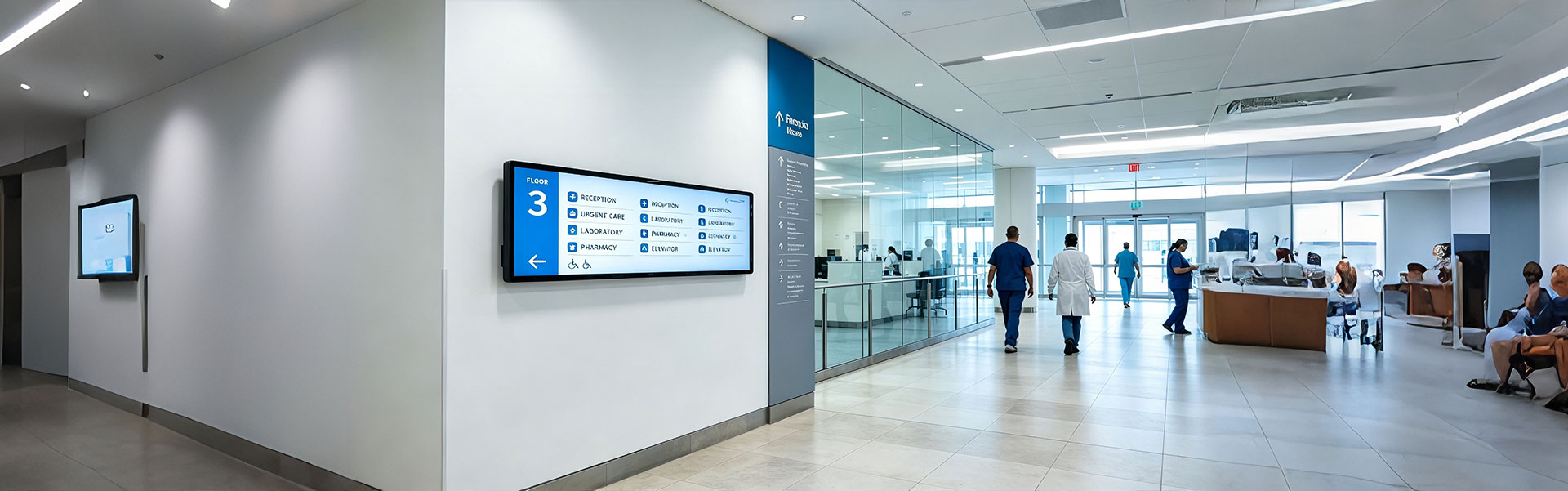
Floor Information Bar LCD Display Solution
Ultra-wide, high-brightness stretched bar LCD disp...
view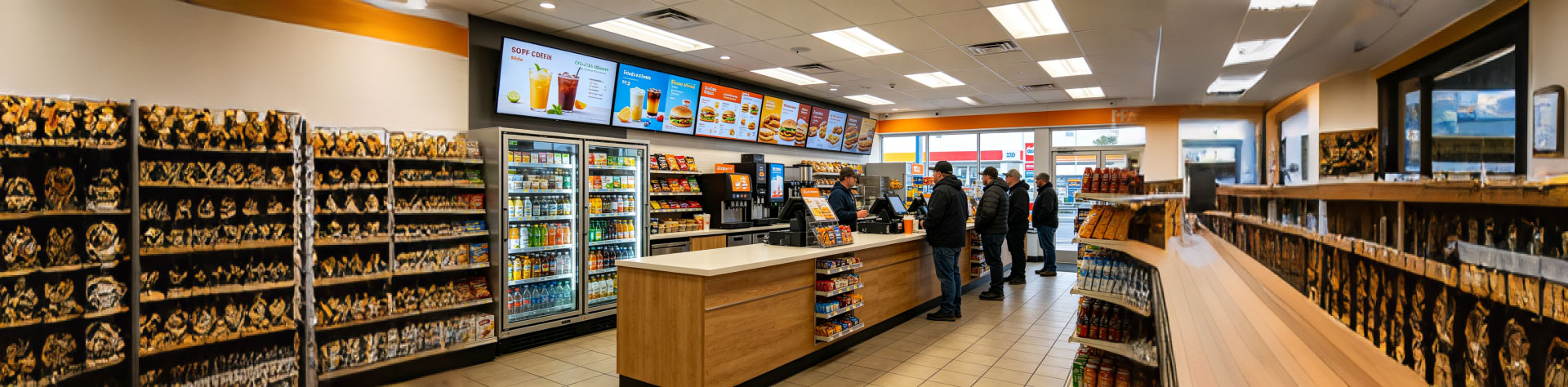
Convenience Store Bar LCD Display Solution
Ultra-slim, high-brightness stretched bar LCD disp...
view
Bus Passenger Information Stretched Bar Display Solution
A rugged, ultra-wide stretched bar display solutio...
viewRelated Products
You may also be interested in the following products
 3000 Nits
40 Inch 3000Nits Sunlight Readable Lcd Panel
 3000 Nits
32 Inch Sunlight Readable LCD Panel For Outdoor Industrial OEM
 3000 Nits
