Australia is one of the harshest proving grounds on earth for a commercial display. A screen that performs flawlessly in a climate-controlled showroom in Frankfurt or Shenzhen can fail within a single summer in Darwin, and it can fail in a way that costs the operator far more than the panel itself: a black rectangle where a revenue-generating menu board used to be, a wayfinding display that fogs over in coastal humidity, or an advertising totem that washes out to near-invisibility under the 1,100 W/m² of solar irradiance that hits a Queensland forecourt at midday. The engineering answer to that reality is not a brighter backlight bolted onto a consumer panel — it is a display designed from the substrate up for the specific combination of heat, ultraviolet load, salt, dust, wind and continuous duty found across the Australian continent.
Why the Australian Operating Environment Rewrites the Specification Sheet
Most display datasheets quote performance at 25 °C ambient and 50 % relative humidity. Very little of Australia operates that way. A digital signage installation has to survive at least four distinct stress regimes, often within a single national rollout:
| Environment | Typical ambient extremes | Dominant failure driver |
|---|---|---|
| Tropical north (Darwin, Cairns, Townsville) | 23–38 °C, 60–90 % RH, cyclone-rated wind zones | Humidity ingress, condensation, mould on optics, corrosion of connectors |
| Arid interior (Alice Springs, Pilbara, Kalgoorlie) | 5–46 °C, airborne dust and iron-ore fines | Thermal saturation, dust abrasion, UV embrittlement of seals |
| Coastal metro (Sydney, Perth, Gold Coast) | 8–40 °C, salt-laden aerosol | Salt-spray corrosion, galvanic attack, hazy cover glass |
| Alpine and southern (Thredbo, Hobart, Ballarat) | −10–35 °C, frost and freeze-thaw cycling | LCD response-time lag at low temperature, condensation on cold-start |
Each regime demands a different engineering response, and the failure points are rarely the ones buyers expect. Heat does not usually kill the panel glass — it degrades the LED backlight, the driver ICs and the polariser, and it accelerates every chemical reaction in the assembly. Salt does not simply "corrode steel"; it migrates through gaskets, attacks the exposed metal of connector shells and creates conductive paths that show up as intermittent faults months later. A specification written for a European mall will not cover any of it.
Brightness Is the First Number, but It Is Not the Only One
Luminance, expressed in candelas per square metre (cd/m², colloquially "nits"), determines whether content remains legible against ambient light. As a working rule for Australian conditions:
- 500–700 cd/m² — indoor interiors with controlled lighting: retail aisles, corporate reception, boardroom signage.
- 700–1,000 cd/m² — high-ambient indoor: airport concourses, shopping centre malls under skylights, window-facing displays behind glass.
- 1,000–1,500 cd/m² — semi-outdoor shaded positions, under awning or canopy, and drive-thru menu boards which are only partly shielded.
- 1,500–2,500 cd/m² — full direct-sun outdoor totems, fuel-price boards, bus shelters and roadside digital out-of-home.
- 2,500 cd/m² and above — west- and north-facing installations in low-latitude sites where the panel is struck by direct solar gain for hours each afternoon.
Raw luminance alone, however, is a misleading headline figure. The perceived legibility of a display is governed by contrast ratio under ambient illumination, not by peak brightness in a dark room. Two thousand nits behind a glossy cover glass with 8 % surface reflectance can look duller than 1,500 nits behind an anti-reflective laminated front. This is why the honest specification for an outdoor display states peak brightness together with the anti-glare treatment, the reflectance figure, and the contrast ratio measured with ambient light present.
Brightness also carries a thermal cost. Every additional nit is additional electrical power converted to heat inside a sealed enclosure, which means a 2,500 cd/m² unit cannot simply inherit the thermal design of a 700 cd/m² indoor screen. Backlight efficiency, local dimming and thermal path design are inseparable from the luminance target.
Optical Bonding and Anti-Reflective Treatment: Where Legibility Is Actually Won
An unbonded display has an air gap between the LCD cell and the protective front glass or polycarbonate. That gap creates two internal reflections — one at the cell surface, one at the inner face of the cover — and the result is a milky, washed-out image, particularly in bright ambient light. Optical bonding eliminates the gap by laminating the cover directly to the cell with a transparent index-matched adhesive. The effects are measurable and cumulative:
- Surface reflections drop sharply, so contrast under sunlight improves without increasing backlight power.
- The assembly becomes mechanically rigid, which raises impact resistance and reduces the risk of cell fracture in public-facing installations.
- Moisture cannot condense inside the air gap, which removes a common cause of fogging during rapid temperature transitions — for example, a screen that has been in cool overnight air meeting a 40 °C morning.
- Thermal transfer from the cell to the front glass improves, giving the thermal design one more path to the ambient air.
On top of the laminate, the cover surface treatment matters. Applications differ: a fully matte finish scatters reflections and is the right choice where viewers approach from wide angles, while an anti-reflective treated glass may be preferable where image sharpness and colour fidelity are the priority. For very bright locations, AR-coated glass combined with bonding is usually the strongest combination, and the difference against an untreated panel is immediately visible to any client standing beside both units in sunlight.
Thermal Management Is the Real Engineering Discipline
An LCD panel carries a specified operating temperature range — commonly 0 °C to 50 °C for commercial-grade glass — and a storage range that may extend to 60 °C. In an outdoor enclosure in central Australia, internal air temperature can exceed ambient by 15 to 25 °C under direct solar gain. Simple arithmetic shows why passive ventilation of an untreated cabinet is not a design: 45 °C ambient plus 20 °C solar rise puts the interior at 65 °C, well outside the panel's rated operation.
Effective thermal design for Australian conditions typically layers several strategies:
1. Solar load reduction
Shading geometry, low-absorption powder-coat finishes in light colours, and double-wall cabinet construction that creates a still-air insulating layer all reduce the heat actually reaching the panel. A dark charcoal enclosure that looks excellent in a render can add several degrees of internal temperature compared with a light-grey or white equivalent.
2. Active air management
Filtered forced-air cooling moves heat out of the enclosure and is the standard approach for medium and large outdoor formats. The critical detail is filter serviceability: a filter that clogs in a dusty environment turns a cooling system into an insulating blanket. Filters must be accessible without dismounting the display, and the service interval must be written into the maintenance contract.
3. Liquid and heat-pipe cooling
For very high brightness or fully sealed designs, closed-loop liquid cooling or heat pipes move heat from the backlight and cell to an external heat exchanger. Sealed loops avoid the ingress risk of forced-air systems and suit coastal or high-particulate sites, at the cost of higher unit price and more complex service.
4. Cold-weather operation
In southern alpine and highland sites, the opposite problem applies. Liquid crystal viscosity rises as temperature falls, slowing response time and producing visible smear on moving content. Internal heaters with thermostat control bring the panel into its rated range before content playback begins, and the controller should be configured to delay start-up accordingly rather than assume the display is instantly ready.
Ingress Protection, Impact and Corrosion
IP ratings describe protection against solids and liquids, and for outdoor Australian signage the practical baseline is IP65 for the display enclosure and IP66 where wind-driven rain and hose-down cleaning are expected. The rating is only as good as the weakest interface: cable glands, connector boots, access-panel gaskets and the seam between the display housing and its mounting structure. Gland selection and cable routing practice frequently determine whether an IP65-rated cabinet actually stays dry through a wet season.
Mechanical protection is captured by the IK impact rating. Public-facing street furniture, transport shelters and school or stadium environments should generally be specified at IK08 or above, with IK10 reserved for high-risk unsupervised locations. In cyclone and severe-wind regions, the mounting structure itself must be engineered to AS/NZS 1170.2 wind actions — the display is a sail, and a correctly specified screen on an under-engineered post is a liability rather than an asset.
Corrosion control for coastal sites should be evidenced by salt-spray testing to ISO 9227, with stainless-steel fasteners of an appropriate grade, powder-coat systems rated for exterior exposure, and attention to dissimilar-metal contact. Aluminium housings with stainless fixings are standard; mixed-metal assemblies without isolation washers are a predictable source of galvanic corrosion.
Custom Formats for Australian Commercial Applications
Off-the-shelf screens rarely fit the brief. Australian operators typically come to a manufacturer with a location problem rather than a product request, and the resulting builds vary widely:
- QSR drive-thru and outdoor menu boards — high-brightness, portrait or landscape, with sealed enclosures, heater options for southern sites, and mounting hardware matched to existing canopy structures. Content must be legible to a driver at 6–10 metres through a windscreen, which drives both luminance and font-size requirements.
- Retail window displays — window-facing screens facing outward, where the panel is backlit by the shop interior and front-lit by the street. These need high brightness plus bonding and careful thermal design, because the enclosure is often thin and ventilation is restricted by the lease fitout.
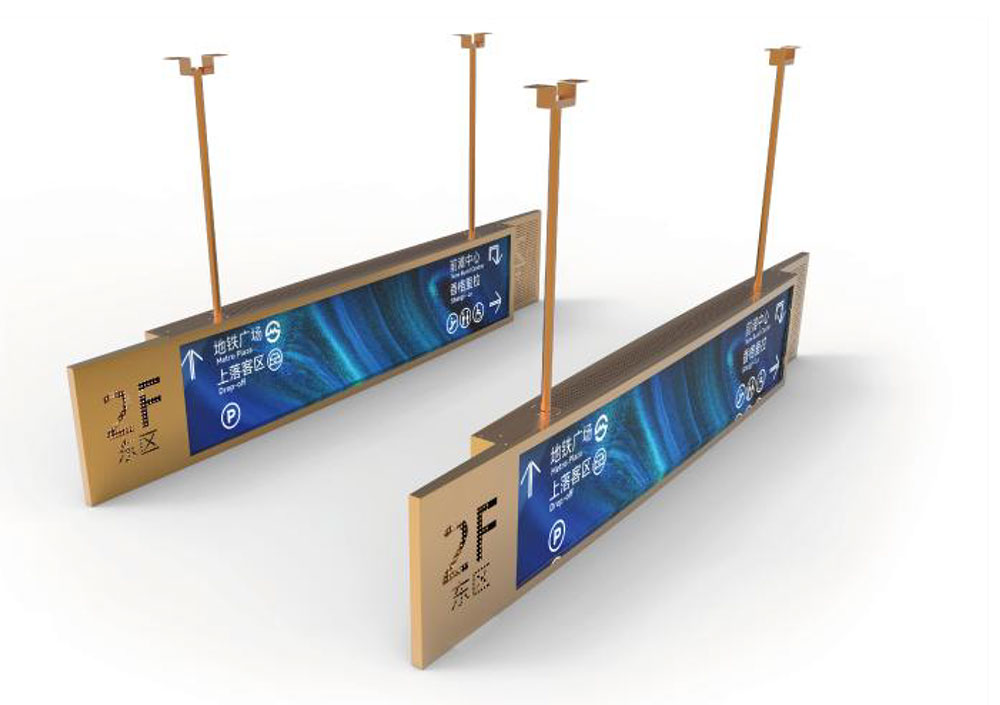
- Free-standing outdoor totems and pylon signs — double-sided formats, IP65/66, with internal CMS hardware and often integrated cameras or sensors. Wind loading, KEYWORDS: for Australian Commercial Displays Custom Digital Signage Displays for