Why the Bar-Type Format Has Become a Standard Building Block in Canadian Equipment Design
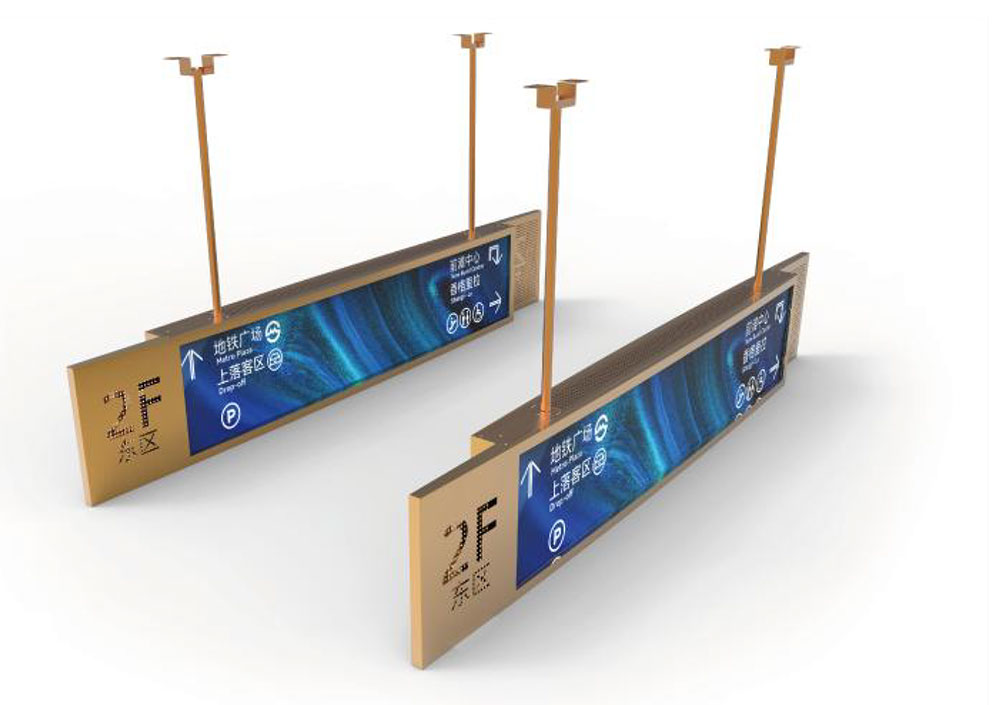
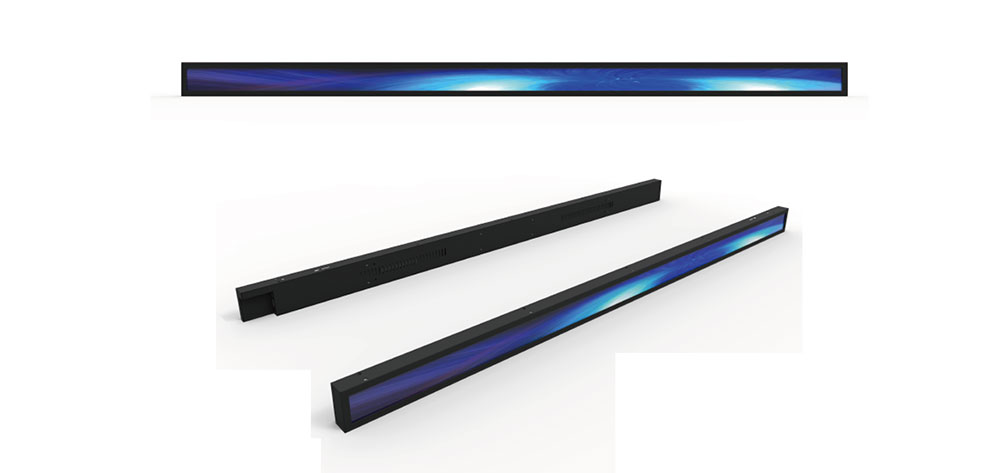
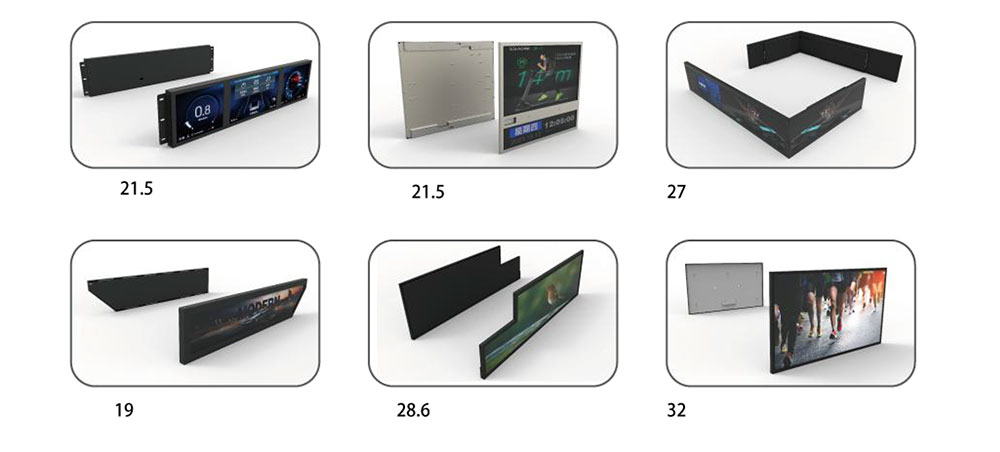
Walk through any modern Canadian equipment build — a transit shelter information pillar in Toronto, a fuel dispenser canopy outside Calgary, a combine harvester cab in Saskatchewan, a self-checkout lane in a Montreal grocery store — and you will increasingly find the same component: a long, narrow, high-brightness LCD. The stretched bar LCD (also called a bar-type, ultra-wide, or shelf-edge display) is a panel whose aspect ratio has been deliberately pulled away from 16:9 toward something like 16:4.5, 16:3, or even 8:1. Instead of forcing a square-ish display into a horizontal strip of available enclosure volume, designers specify the strip directly.
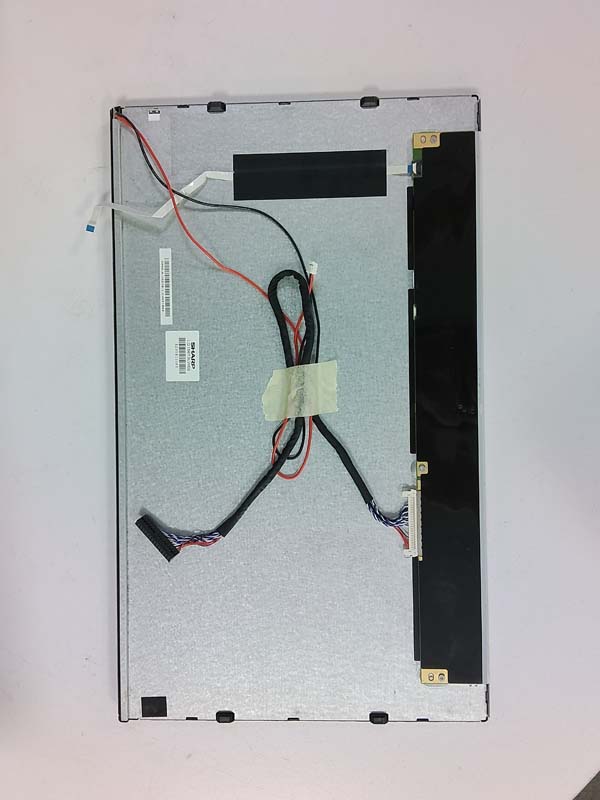
For Canadian equipment manufacturers, this format solves a very concrete problem. Equipment front panels are governed by ergonomics, weather sealing, and transport regulations far more than by display conventions. A ticket machine, a weigh-scale head, a bus destination sign, or a control console for a sprayer boom controller rarely has 300 mm of vertical clearance to spare. A stretched bar LCD lets the HMI occupy a 700 × 200 mm band, keep the bezel narrow, and preserve the structural rigidity of the surrounding housing.
What Actually Defines an Industrial-Grade Bar Display
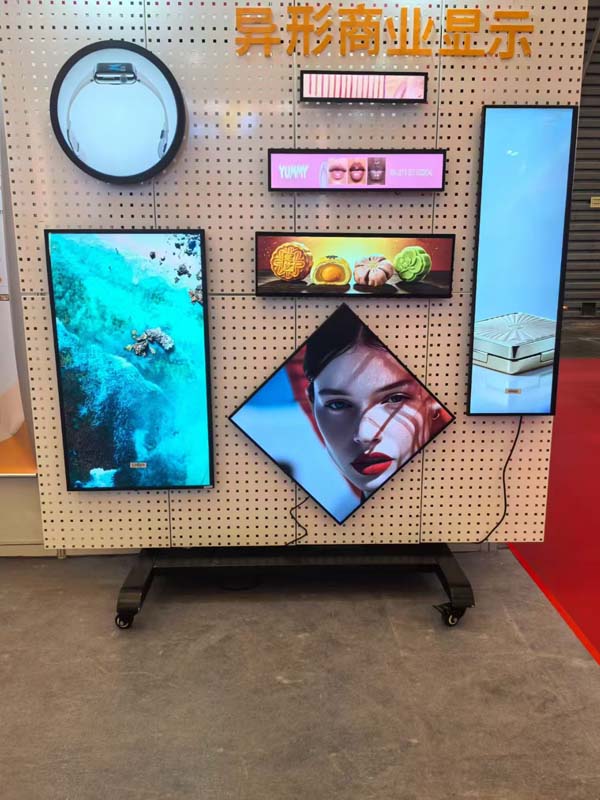
A consumer-grade stretched panel and an industrial one may look identical in a brochure photo. The differences show up in the qualification data and in the specification tolerances that manufacturers rarely publish on a datasheet first page.
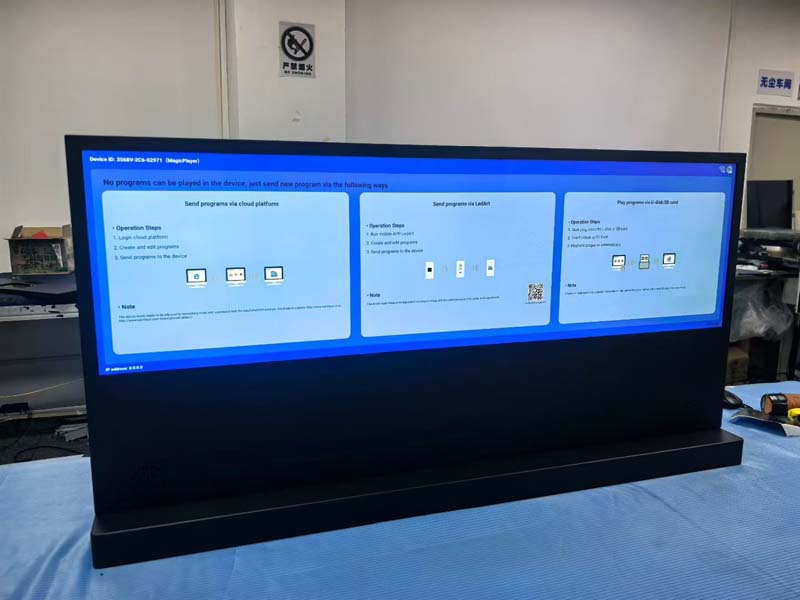
Panel formats and resolutions
Common industrial bar formats span roughly 23 to 50 inches diagonal, with active areas that run from about 530 × 130 mm up to 1200 × 300 mm. Resolutions cluster around 1920 × 540, 1920 × 480, 2880 × 640, 3840 × 1080, and 3840 × 800. Resolution choice is rarely about pixel density — at typical viewing distances of 0.5 to 3 metres, 1920 horizontal pixels is ample — and almost always about the host SoC. If the equipment's video pipeline is a fixed 1920 × 1080 framebuffer, a 1920 × 540 panel with a clean 2:1 vertical crop is far easier to integrate than a 3840-wide panel requiring scaler work.
Brightness classes and the Canadian light environment
Brightness specification is where most integration projects go wrong. Three practical classes exist:
- Indoor / sheltered (400–700 cd/m²): vending faces, kiosk interiors, HMI consoles inside cabs or control rooms. Standard transmissive panels with moderate backlight derating are sufficient.
- High ambient (1000–1500 cd/m²): covered outdoor locations, transit shelters with glazing, drive-through canopies. Requires enhanced backlight, higher-contrast panel treatment, and attention to thermal load.
- Sunlight readable (1800–2500+ cd/m²): fully exposed outdoor faces, fuel dispensers, curbside signage. At this level, brightness alone is not enough — optical bonding of the cover glass, anti-reflective and anti-glare surface treatments, and a high-contrast (often 1000:1 or better) panel are mandatory to keep the image legible under direct summer sun.
Canada's solar geometry is a design trap for manufacturers who prototype in mild climates. Southern Ontario and the Prairie provinces receive intense direct irradiance in June and July, with sun angles that strike near-horizontal outdoor displays almost normal to the surface during early morning and late afternoon. A display that reads well at noon can be unreadable at 7 p.m. in July. Design reviews should model the worst-case incidence angle for the specific installation latitude, not the average.
Cold-Climate Engineering: The Defining Canadian Requirement
This is the single largest differentiator between a display designed for export to mild markets and one that survives a Canadian winter. Standard industrial LCD modules are typically rated for operation from 0 °C to 50 °C and storage from −20 °C to 60 °C. Equipment deployed in Manitoba, Northern Ontario, Alberta, or any territory will routinely see −35 °C ambient, and interior cabinet temperatures that follow ambient within a few degrees.
Several distinct failure modes appear below freezing, and each needs its own mitigation:
Liquid crystal response time and the "smear" effect
LC viscosity rises sharply as temperature falls. Below roughly −10 °C, a conventional panel shows visible response lag; below −20 °C, motion smears heavily and contrast drops; near −30 °C, the panel may not produce a usable image at all. Wide-temperature liquid crystal formulations extend the operating window to −30 °C or −40 °C, but they usually trade off some room-temperature response speed and require careful gamma and overdrive tuning by the panel maker. Manufacturers should insist on the actual low-temperature operating curve, not just a headline number.
Heater integration and thermal ramp
For cold-start requirements — equipment that must display a legible screen within 60 to 120 seconds of power-on at −40 °C — an integrated transparent heater film or a resistive heater plate behind the light guide is the standard solution. Practical design points:
- Heater power density typically runs 0.3–1.0 W per square decimetre; a 36-inch bar panel may need 25–60 W to ramp from −40 °C to operating temperature in a defined time.
- Thermistor feedback with a hysteretic controller prevents heater/backlight oscillation and protects against localized hot spots.
- Backlight self-heating must be counted in the thermal budget — at 1500 cd/m², the LED array contributes meaningful heat that shortens ramp time but also raises steady-state panel temperature in summer.
- Heater inrush current should be verified against the equipment's DC bus; a 48 W heater on a 24 V rail draws 2 A continuously during ramp, which matters for battery-backed or solar-powered installations.
Condensation and ingress
Freeze-thaw cycling in coastal British Columbia and in spring across the country produces condensation inside enclosures that are not properly sealed or desiccated. A bonded front stack eliminates the internal air gap between cover glass and panel, removing the surface where fog forms. Beyond that, enclosure design needs a pressure-equalizing breathable vent with a hydrophobic membrane, desiccant where appropriate, and a condensation path that does not drain across the display's flex connectors.
Compliance and Certification Landscape for the Canadian Market
Equipment manufacturers selling into Canada face a certification stack that is similar to, but not identical with, the United States. Getting the display's contribution right early avoids late-stage redesign.
| Requirement | Typical application | Display-side implication |
|---|---|---|
| CSA / cUL / cULus mark to CAN/CSA-C22.2 No. 62368-1 | Any mains-powered equipment | Backlight driver and inverter module must be evaluated as a component; UL-recognized driver boards with file numbers shorten the equipment submission |
| ICES-003 / ISED EMC | All digital equipment sold in Canada | LVDS/eDP cable shielding, clock spreading, and grounding strategy at the panel interface |
| NEMA 4 / 4X or IP54–IP66 | Outdoor cabinets, washdown food equipment | Bonded stack, gasket geometry, connector sealing |
| CSA/UL 60950-1 legacy or 62368-1 hazard-based | Legacy product lines | Documented creepage/clearance on the backlight HV section |
| Bilingual labeling (English/French) | Consumer-facing equipment, Quebec in particular | UI string capacity in the bar format's limited height; character-width planning for accented glyphs |
Two points deserve emphasis. First, the French-language requirement under Quebec's Charter of the French Language — strengthened by recent legislative amendments — affects not only product labeling but customer-facing interface text. A 200 mm-tall bar display showing a status line has room for roughly one line of 24-point text; French strings for the same message frequently run 15–30 percent longer than English. Interface layouts and font stacks must be validated in both languages before tooling is cut. Second, a display supplied without a recognized driver board shifts the electrical evaluation burden entirely onto the equipment manufacturer. Sourcing a panel and a matched, pre-evaluated backlight driver as a pair is usually worth the small cost premium.
Electrical and Mechanical Integration Considerations
Interface selection
Most industrial bar panels expose LVDS or eDP. V-by-One HS appears on higher-resolution and larger formats. Where the equipment's host processor outputs HDMI or DisplayPort, an integrated scaler board converts and also provides brightness control, OSD, and, in some designs, ambient-light-adaptive dimming. For transportation and public-facing equipment, the adaptive dimming feature is not cosmetic: a 2000 cd/m² panel run at full output overnight is a light-pollution complaint waiting to happen, and municipal procurement documents increasingly specify automatic night dimming.
Lifetime, burn-in, and static content
Bar displays in signage and equipment HMI roles often show nearly static content for thousands of hours: a fixed route number, a fixed price field, a persistent status bar. This is exactly the usage pattern that produces image sticking and differential LED aging. Mitigations include:
- Specifying panels with image-sticking resistance data at 500–1000 hours of static test pattern
- Implementing pixel-shift or subtle content rotation in firmware
- Derating backlight current below the panel's maximum to extend L70 life — a 1500 cd/m² panel driven at 70 percent output can roughly double usable lifetime
- Designing for field-replaceable backlight or panel modules where service life exceeds 7 years
Mechanical mounting in vibrating equipment
Mobile equipment — transit buses, agricultural and construction machines, forestry and mining vehicles — imposes vibration and shock profiles that desk-designed brackets fail. Requirements typically reference IEC 60068-2-6 sinusoidal vibration and 60068-2-27 shock, but the practical rules are simpler: support the panel along its full long edge rather than at four corner bosses, avoid mounting points that torque the frame, use thread-locking fasteners with defined torque values, and route flex cables with a service loop that has strain relief at both ends. A 1-metre-long bar panel is a lever arm; a single dropped wrench during assembly or a pothole at −30 °C can delaminate a bonded stack that was never designed for torsional load.
Where Canadian Manufacturers Are Deploying Bar Displays
Demand in the Canadian market concentrates in a handful of segments, each with a distinct specification centre of gravity:
- Transit and passenger information: bus and light-rail interior and exterior destination signs, platform information strips. Priorities: wide temperature range, high brightness for exterior units, EN 50155-adjacent environmental robustness, long service life, and dimming control.
- Retail and self-service: self-checkout lanes, shelf-edge and cooler-door strips, queue-management displays. Priorities: 500–700 cd/m², high colour consistency across units, low power, slim depth behind glazing.
- Fuel and convenience retail: dispenser heads and price panels. Priorities: 2000 cd/m²+ sunlight readability, bonded AR stack, NEMA 4X sealing, hazardous-location coordination with the dispenser's own certification.
- Agriculture and heavy equipment: cab displays, implement control heads, grain-cart and sprayer HMIs. Priorities: −40 °C cold start, vibration tolerance, daylight readability in open fields, sunlight-load thermal management.
- Industrial automation and building systems: machine vision status strips, elevator and lobby information, cleanroom and cold-storage indicators, access-control panels.
- Medical and laboratory equipment: status bars and control strips on analysers and imaging peripherals, where cUL recognition and long product lifecycle support matter most.
Qualification and Lifecycle Management: The Part Nobody Budgets For
Industrial equipment programs in Canada commonly run 7 to 12 years of production. That reality changes how a display should be sourced. A bar-format panel is a niche product with fewer second sources than a standard 16:9 industrial panel, so lifecycle risk must be managed contractually rather than assumed away.
A workable sourcing framework includes: written commitment to availability for the program duration plus a defined last-time-buy window; formal product change notification with a 90- to 180-day review period before any panel revision ships; frozen firmware and timing parameters for the sourced revision; retained golden samples for incoming inspection; and an agreed EOL bridge — either a drop-in successor or engineering support for a re-spin, including mechanical drawing compatibility for the enclosure cutout.
Qualification testing should mirror the deployment environment rather than a generic datasheet checklist. A defensible test plan for a Canadian outdoor installation includes: thermal cycling from −40 °C to +65 °C with operational cold-start verification at the low extreme; damp heat at 40 °C/93 percent RH; solar loading simulation at 1120 W/m² to confirm the panel does not exceed its maximum operating temperature inside the enclosure; salt fog for coastal and road-salt exposure; EMC pre-scan at the panel interface; and a 1000-hour static-pattern burn-in check with luminance and chromaticity measurement before and after.
A Practical Specification Checklist
Before committing to a bar-format display, equipment manufacturers should be able to answer each of the following in writing:
- What is the lowest ambient temperature at which the unit must display a legible, correct image, and within how many seconds of power-on?
- What is the maximum panel surface temperature in the enclosure under worst-case summer solar load, and what is the panel's rated operating maximum?
- Is the front stack optically bonded, and is the surface treatment matched to the dominant reflection geometry of the installation?
- What is the required horizontal and vertical resolution, and can the host render it natively without scaling artifacts?
- Which certification marks must the display subsystem carry, and does the supplier hold component recognition for the driver board?
- How much vertical text height is available, and have all UI strings been validated in both English and French at that height?
- What dimming range is required, and is control via PWM, I²C, or a scaler OSD?
- What is the contracted availability window, and what are the PCN and last-time-buy terms?
- How is the panel supported mechanically along its long edges under vibration?
- What are the field-replacement procedures and spare-part lead times for a unit installed in a remote location?
Conclusion
The stretched bar LCD is no longer a novelty format for a few signage applications. For Canadian equipment manufacturers it has become a rational default whenever the HMI must occupy a wide, shallow band inside a sealed, thermally stressed, vibration-exposed enclosure operating across a 100 °C annual ambient swing. Getting it right is less about picking the brightest panel in a catalogue and more about matching the brightness class, thermal architecture, bonding, certification path, and lifecycle terms to a specific deployment — which is precisely the engineering conversation that belongs at the concept stage, not at the first prototype build.
HITULCD supplies high-brightness stretched bar LCD modules with wide-temperature options, integrated heater control, optical bonding, and matched driver electronics, and works with Canadian equipment manufacturers from specification review through qualification testing and l KEYWORDS: Industrial Stretched Bar LCD Displays for Canadian Equipment Manufacturers