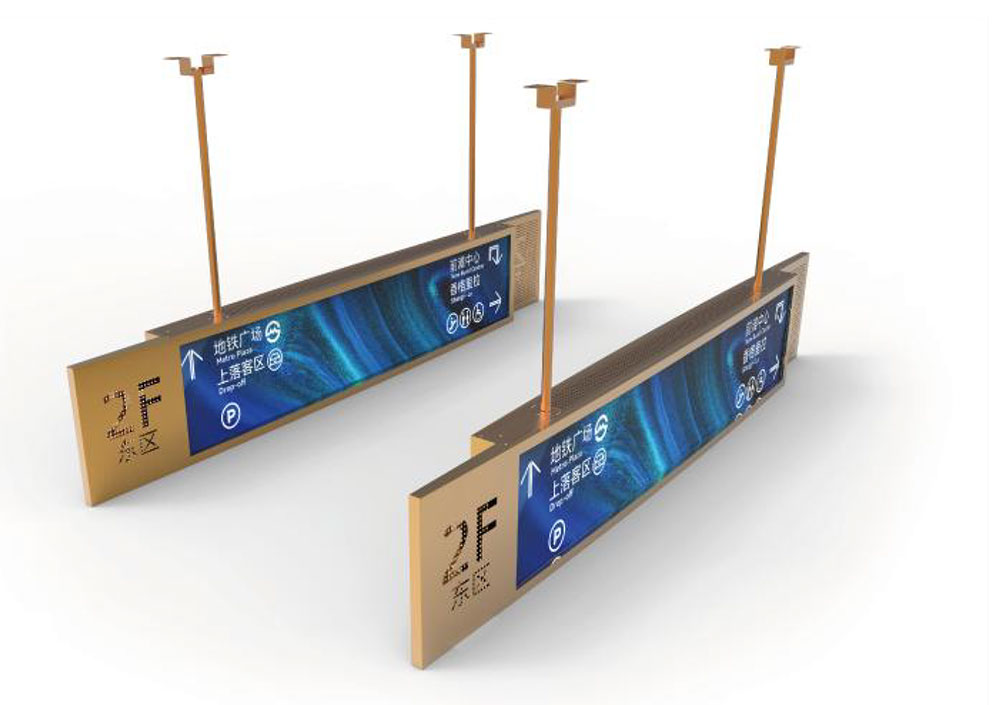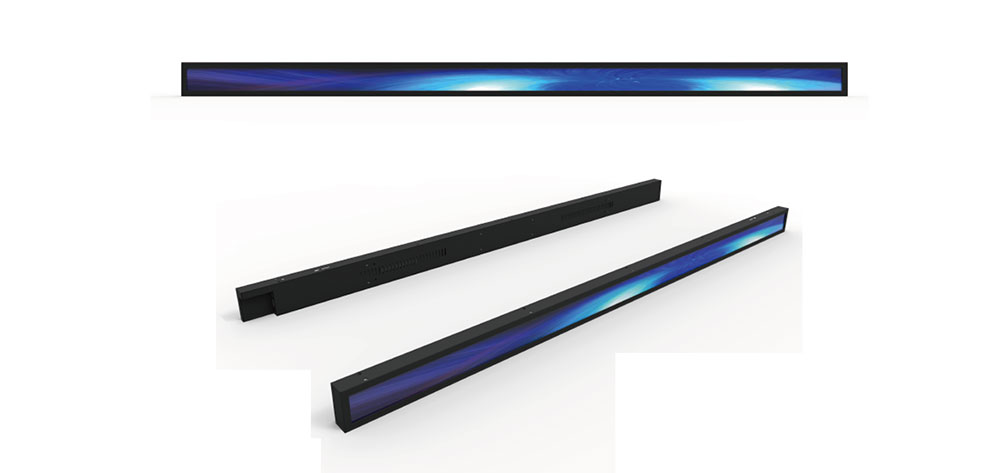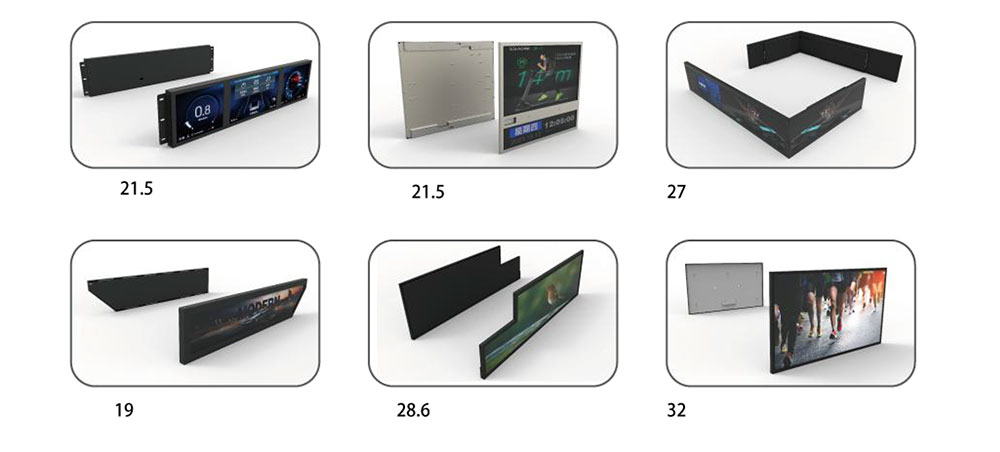
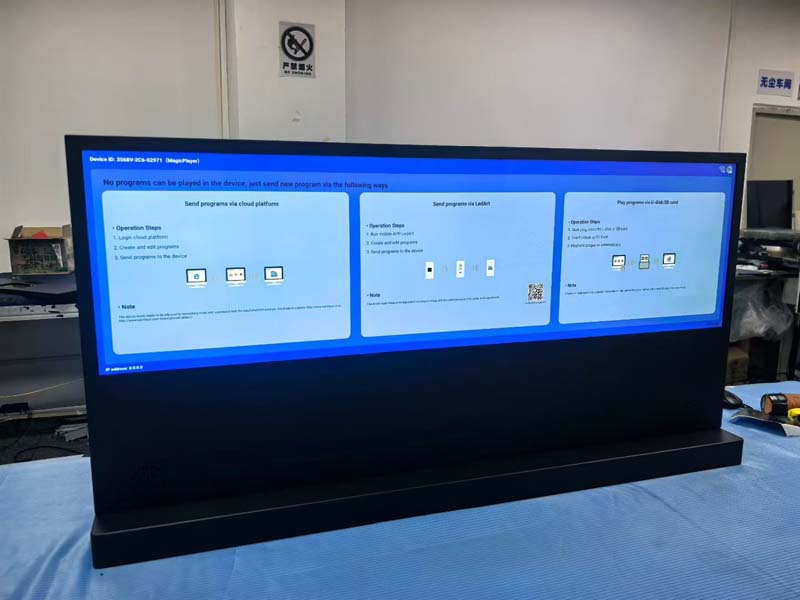
Dot-matrix LED signs are being retired across metro systems, light-rail networks and mainline stations, and the replacement is almost always a stretched LCD. The reason is structural rather than fashionable: passenger information sits in places that are wide and short — above a platform edge, on a carriage ceiling, beside a doorway, under a luggage rack — and a 16:9 panel in that space either wastes half the aperture or gets cropped into something unreadable. A custom stretched LCD, cut to a 16:4.5, 16:3 or even 16:1 ratio and driven at 1920×540 or 3840×1080, fills the geometry exactly and puts a full-colour, multilingual, dynamically updated information surface where a scrolling LED strip used to be.
Why the Aspect Ratio Is a System Decision, Not a Cosmetic One
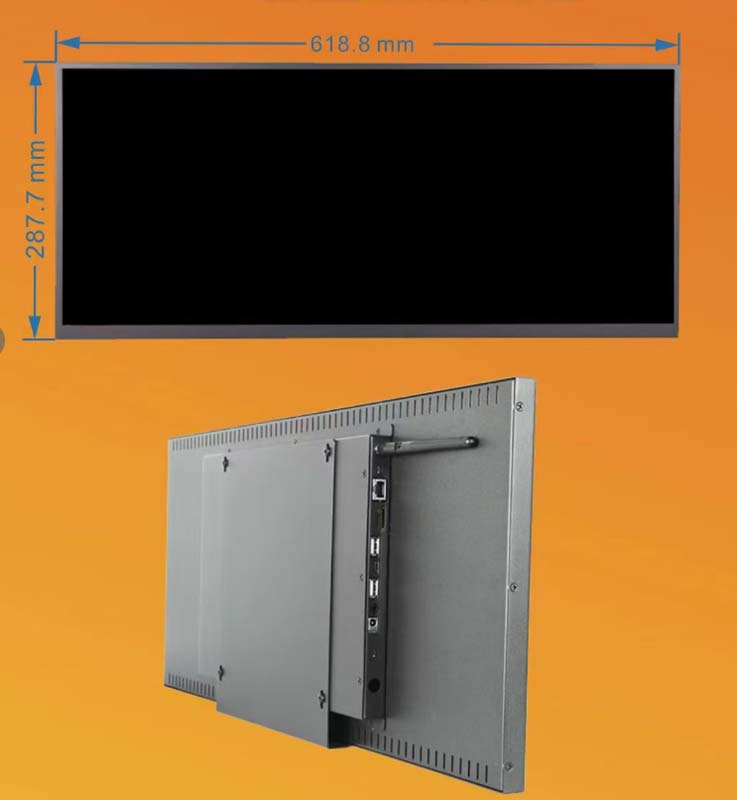
Stretched displays are built around the native timing of the panel. Standard panels are cut from a mother glass in a fixed set of aspect ratios, so a true stretched format usually means either a purpose-cut panel or an industrial panel designed for the digital-signage shelf (28", 37", 43", 47" bar types are common). The choice cascades through the whole design:
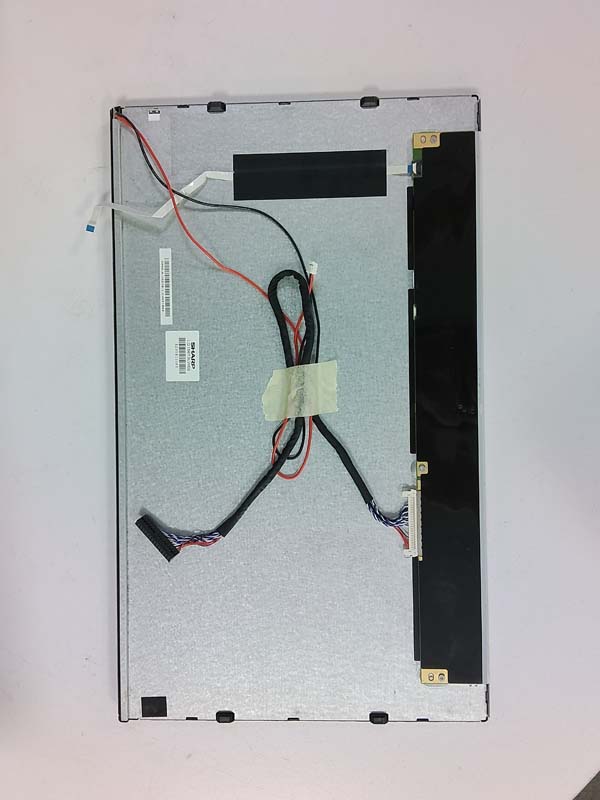
- Resolution and pixel pitch determine legibility. For a platform display read at 8–12 metres, a Latin capital letter should subtend roughly 20–30 mm of physical height; that fixes the minimum character height, which fixes how many lines of text fit, which constrains the panel height and resolution together. A 1920×540 panel at 37" gives about 0.43 mm pixel pitch — comfortable at 10 m, tight at 20 m.
- Native timing affects the driver chain. Unusual resolutions often fall outside standard LVDS/eDP timing tables, so the T-CON and the controller board must be matched to the panel rather than assumed.
- Mechanical integration drives the enclosure. Bezel width, mounting bosses, connector exit direction and the position of the backlight driver are all customisable and should be specified once, early, because they are difficult to change after tooling.
Brightness, Contrast and the Sunlight Problem
Most PIS failures in the field are optical, not electronic. A 400-nit commercial panel behind a sheet of cover glass becomes unreadable in a glazed concourse at midday, because the reflected ambient light competes directly with the emitted image. There are three levers, and good designs use all three:
1. Emitted luminance
Indoor concourse and train-interior units typically run 700–1000 nits. Semi-outdoor platform displays, where direct sun can strike the face at a shallow angle, need 1500–2500 nits, and fully exposed roadside or canopy-edge units go to 3000 nits. Every additional nit costs electrical power and, more importantly, heat inside a sealed enclosure.
2. Reflected luminance
An anti-reflective (AR) coating on the front glass can drop surface reflection from roughly 4% to under 1%, which is optically equivalent to a large increase in usable contrast without any extra backlight power. Anti-glare (AG) treatment, by contrast, spreads the reflection over a wider angle: the display stops acting as a mirror, but total reflected energy is unchanged. For sunlit platforms an AG/AR hybrid is usually the right compromise.
3. Optical bonding
Filling the air gap between the panel and the cover glass with an index-matched optical adhesive eliminates the internal glass-air-glass reflection path, raises contrast under high ambient light, improves impact resistance, and — critically for tunnels and coastal routes — prevents condensation fogging the inner surface. Bonding also removes the risk of dust ingress into the gap over a ten-year service life.
Thermal Design Inside a Sealed Enclosure
A high-brightness 37" bar display can dissipate 120–180 W, and it usually has to do so in a fanless IP54/IP65 box mounted in a ceiling void where the ambient air is already warm. The heat path matters more than the raw figure:
- Use a direct-lit LED backlight with local dimming or global dimming tied to an ambient light sensor, so the display runs at 30% output at night and in tunnels. This is the single largest energy and thermal saving available, and it also reduces light trespass into the cab at night.
- Specify a metal back chassis with a defined thermal interface pad to the enclosure wall, and require the supplier to publish a derating curve of luminance versus ambient temperature rather than a single headline number.
- Consider splitting the backlight into independently driven strings so a single LED string failure degrades luminance gracefully instead of blanking the screen — a requirement that appears in several operator specifications for safety-related information.
- Verify that the panel's storage and operating temperature range matches the vehicle class; −30 °C cold start with heater film is common for northern European and Chinese northern-latitude rolling stock.
Standards and Approvals That Actually Apply
Rail procurement is standards-driven, and a display that is not documented against the right clauses will fail type approval regardless of image quality. The core set for a passenger information display is:
| Standard | What it covers | Typical target |
|---|---|---|
| EN 50155 | Electronic equipment on rolling stock: temperature, supply voltage, vibration, humidity | Class OT4 (−40 to +70 °C), supply variation 0.7–1.25 Un |
| EN 61373 | Shock and vibration, body-mounted or bogie-mounted | Category 1, Class B for body-mounted equipment |
| EN 45545-2 | Fire behaviour of materials — critical for plastic bezels, adhesives and light guides | HL1 to HL3 depending on vehicle category and location |
| EN 50121-3-2 | EMC, emissions and immunity on rolling stock | Full compliance, plus EN 55032 for wayside installations |
| IEC 62236 | Railway EMC, wayside and station equipment | Station-mounted displays |
| RoHS / REACH | Restricted substances and SVHC declaration | Full RoHS 3 compliance, REACH SVHC below 0.1% with declaration |
Two practical notes. First, EN 45545-2 applies to the whole assembly, not just the panel: the optical bonding adhesive, the light guide plate and the flame-retardant grade of the polycarbonate bezel all need test evidence. Second, the RoHS declaration should be per-part-number and traceable to the manufacturer's bill of materials, because operators increasingly audit the supply chain rather than accepting a generic certificate.
Interfaces, Control and Remote Monitoring
A PIS display is a node in a network, not a monitor on a cable. Practical requirements that come up repeatedly in tenders:
- Input flexibility: HDMI or DisplayPort from the media player, with LVDS or eDP internally to the panel. On-train systems often distribute over Ethernet with a local decoder, so an all-in-one unit with RJ45, HDMI and a scaler is preferable to a bare panel.
- Brightness control: an ambient light sensor input with a defined dimming curve, plus a serial or IP command to override it for maintenance and night stabling.
- Health telemetry: backlight hours, internal temperature, panel status and error counters exposed over SNMP or a simple JSON endpoint, so a depot can replace a unit before it fails rather than after a complaint.
- Content safety: no uncontrolled external inputs on a public-facing unit; disable unused ports at the firmware level, since an accessible HDMI socket on a platform is an attack surface.
Long-Term Supply, Image Sticking and Dead Pixels
Rolling stock lives 25–30 years and station equipment 10–15. A display qualified today must remain available, or remain form-fit-function replaceable, for a decade. Ask for a written product longevity statement, a last-time-buy notification period of at least 12 months, and a documented change-notification process for panel revisions, because a silently substituted T-CON or LED bin will change the optical and thermal behaviour of an approved unit.
Two panel-level issues deserve explicit specification. Static PIS layouts — a permanent route diagram, a fixed header bar, a station name box — will cause image sticking on any LCD held at the same content for months; mitigations include periodic pixel-shift, a screen-saver rotation and, for truly static content, segmented or e-paper alternatives. Dead-pixel acceptance should follow a defined class (ISO 9241-307 Class II is a reasonable baseline) with a stated maximum for bright sub-pixel defects, since a single stuck white pixel is far more visible on a dark platform display than a dark one.
A Procurement Checklist
- Exact active area, aspect ratio, native resolution and pixel pitch, with mechanical drawing including bezel and mounting holes.
- Luminance at the glass, measured after bonding and cover glass, plus the derating curve against ambient temperature.
- Contrast ratio and reflectance figures — specify measurement geometry, not just a headline number.
- Cover glass type, thickness, hardness, AR/AG treatment and impact rating (IK07/IK08 where vandalism is a risk).
- Operating and storage temperature, cold-start behaviour and heater option.
- Ingress protection, condensation strategy and pressure-equalisation vent.
- Interface set, connector type and position, cable length and bend radius.
- Standards evidence: EN 50155, EN 61373, EN 45545-2, EN 50121-3-2, RoHS and REACH declarations per part number.
- Backlight lifetime to 50% luminance at rated temperature, MTBF calculation, and warranty terms including luminance depreciation.
- Supply longevity commitment, change notification and spare-part availability period.
Conclusion
A stretched LCD for railway passenger information is not a standard monitor with a different shape. It is a jointly optimised optical, thermal and mechanical system whose performance is set by the reading distance and the ambient light at the installation point, and whose acceptance is set by the rail standards regime. Getting the aspect ratio, the bonded optical stack, the luminance derating curve and the qualification evidence right at specification stage is what separates a display that survives a decade of platform duty from one that is legible only on the bench.
KEYWORDS: stretched LCD display, railway passenger information display, custom bar LCD panel, high brightness LCD, EN 50155 display