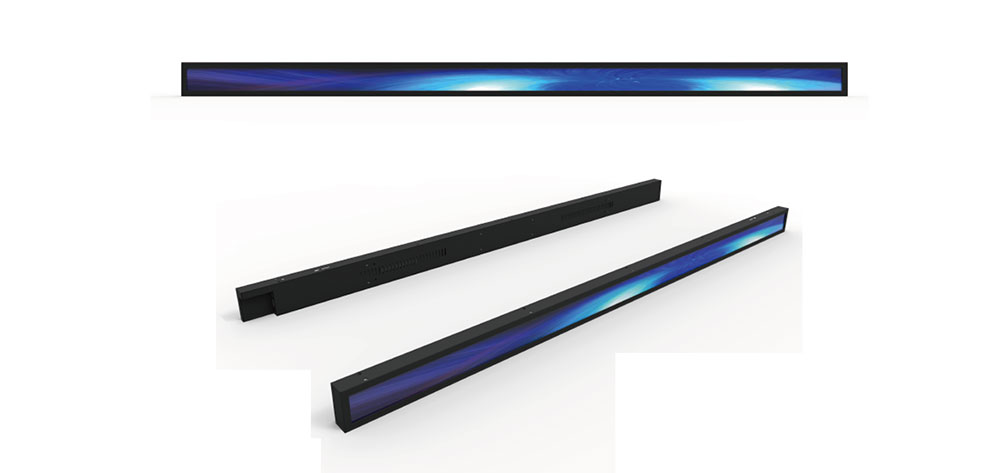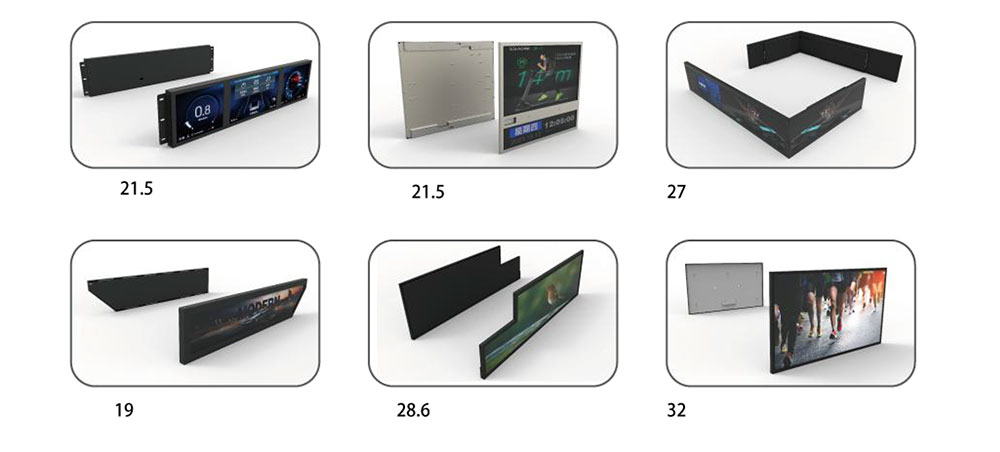
Bar-type LCDs — the long, narrow "stretched" panels that measure anywhere from 3:1 to 16:1 in aspect ratio — have quietly become one of the fastest-growing display categories in industrial and commercial hardware. They hang above supermarket shelves, sit inside metro handrails, clip onto bus stop totems, run along casino table edges, and serve as status strips on medical and industrial equipment. Unlike a standard 16:9 monitor, a bar display is almost never bought off the shelf. The enclosure, the cut-out, the mounting bosses, the connector exit, the brightness, and the viewing window are all determined by the product the customer is building — which is exactly why OEM and ODM projects dominate this market.
Below are the ten custom bar LCD architectures that cover the overwhelming majority of real-world OEM/ODM requirements, with the technical parameters, integration characteristics, and customization levers that matter for each. Sizes, brightness figures, and interfaces quoted here are typical starting points; every one of them can be re-specified during the ODM phase.
1. Sunlight-Readable High-Brightness Shelf-Edge Bar LCD (1000–2500 nits)
This is the single most requested custom bar display configuration. Retail shelf-edge and window-facing installations place the panel in direct or indirect daylight, where a conventional 300–500 nit module becomes a grey mirror.
- Typical sizes: 23.1", 28", 35", 37", 43", 47.6" strip formats; narrower 8.8" and 12.3" variants for compact shelving.
- Brightness: 1000 nits for indoor-but-bright environments; 1500–2000 nits for window-facing; 2500 nits for outdoor totems with partial shading.
- Resolution: 1920×540 or 2880×540 for long horizontal runs; 3840×1080 where the strip is tiled into logical columns.
- Key engineering: high-efficiency LED backlight with a redesigned light guide and reflector stack, thermal path through an aluminium backplate, and a driver board with current derating above 60 °C ambient.
Why it works for OEMs: brightness is a backlight decision, not a panel decision, so it can be tuned per project without changing the mechanical outline. A 1000-nit and a 2000-nit version of the same bar display can share the identical front bezel and mounting hole pattern, letting a customer ship one enclosure across multiple SKUs.
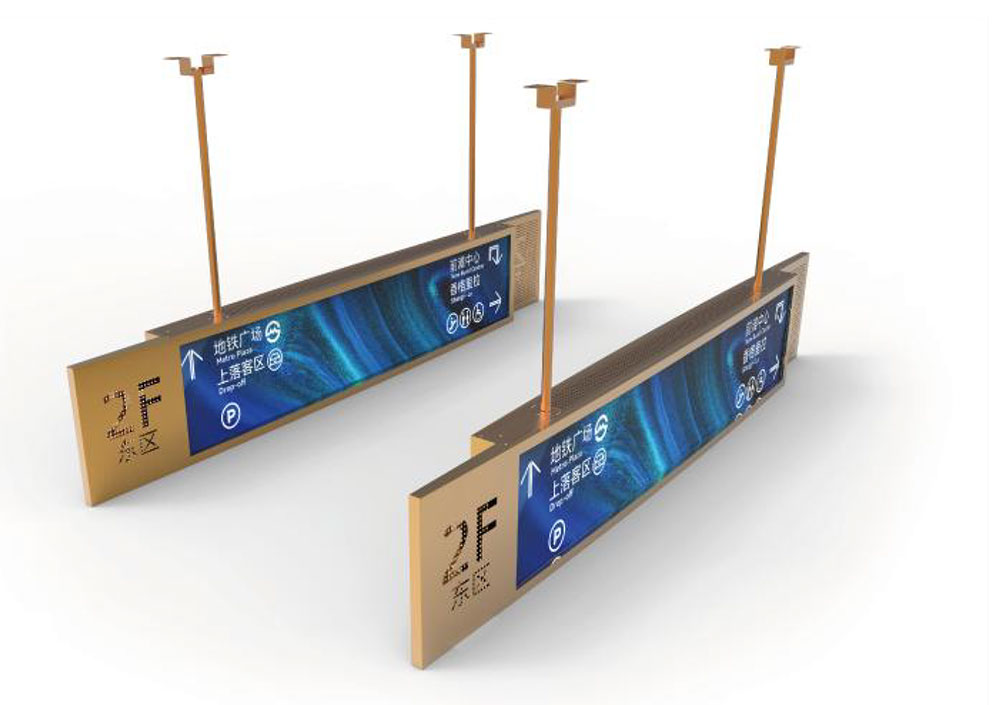
2. Ultra-Wide Stretched Bar Display for Transportation and Wayfinding
Passenger information systems — metro car interior strips, platform edge displays, bus destination bars — need extreme aspect ratios and long service life at fixed content.
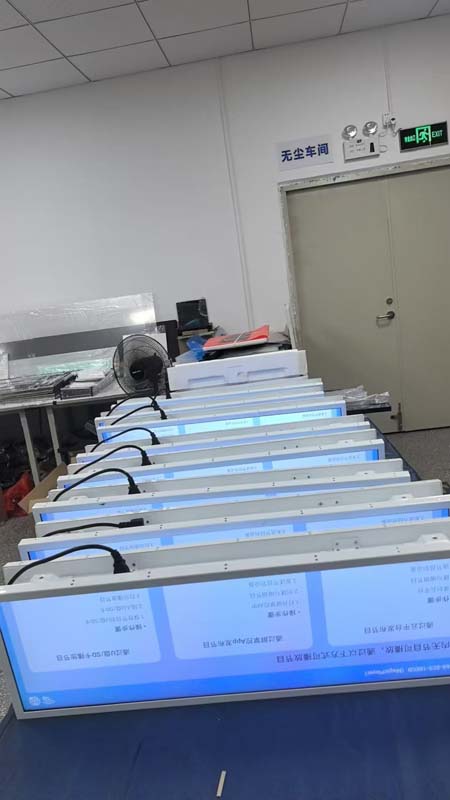
- Aspect ratios: 8:1 to 16:1, with resolutions such as 1920×240 and 3840×540.
- Brightness: 700–1000 nits, often paired with an anti-glare (AG) front polarizer rather than a glossy finish.
- Reliability targets: 50,000–70,000 hours to half-brightness, fanless operation, and vibration resistance to EN 61373 cat. 1 class B for rolling stock.
- Interface: LVDS or eDP for direct board-to-board connection, with a locking connector to survive vibration.
ODM lever: the backlight can be split into independently dimmable zones so that a failure in one segment degrades gracefully instead of blanking the whole strip — a decisive advantage in public-transport tenders.
3. Wide-Temperature Rugged Bar LCD for Outdoor Kiosks and EV Charging
Outdoor enclosures experience the full range: −30 °C winter mornings to +80 °C internal air temperature behind a sealed glass front in summer sun.
- Operating range: −30 °C to +85 °C storage, −20 °C to +70 °C operating, with heater film options for sub-zero start-up.
- Optical bonding: full lamination of the cover glass to the panel eliminates the internal air gap, removing condensation risk and cutting front-surface reflections by roughly a factor of three.
- Thermal design: ITO heaters or a resistive heater ring for cold climates; a graphite or copper spreader bonded to the rear for hot climates.
- Brightness: 1500–2500 nits with automatic ambient-light dimming to manage heat load.
This configuration is the standard choice for EV charger status bars, parking-garage guidance strips, and outdoor vending fascia.
4. Custom Outline and Corner-Radius Bar LCD for Retail Fixtures
When the display has to disappear into a wooden shelf or a moulded plastic fascia, the outline itself becomes the product. Custom tooling allows non-rectangular shapes, rounded corners down to R3, asymmetric bezels, and cut-out notches for sensors or fasteners.
- Typical sizes: 7", 10.1", 12.3", 16.9" bar panels.
- Customization: bespoke FPC routing, rear-side component relocation, side-exit versus bottom-exit connectors, and tapped mounting inserts positioned to the customer's fixture drawing.
- Bezel: 1.0–2.0 mm active-area-to-edge on narrow-bezel variants, or a wide painted border that hides the bonding line.
Expect a tooling and NRE phase, typically 4–8 weeks, followed by a first-article sample round before mass production. For ODM customers this is usually the point where the display stops being a component and becomes part of the industrial design language.
5. PCAP Touch-Integrated Bar Display for Interactive HMI
A capacitive touch layer over a long, narrow panel is not simply a scaled-down phone touchscreen — the ITO pattern must be re-routed for the aspect ratio, or the reported coordinates will drift at the extremities.
- Touch types: projected capacitive with 2–10 point multitouch, or single-point resistive for gloved industrial use.
- Cover glass: 1.1–3.0 mm chemically strengthened glass, with optional anti-fingerprint, anti-glare, or antibacterial coatings.
- Controller: USB HID for plug-and-play with Windows/Linux/Android, or I²C for embedded hosts.
- Brightness penalty: expect 8–12% loss through the touch stack; specify the backlight accordingly rather than accepting a dim result.
Common applications include self-checkout lanes, gaming machine button bars, lab instrument control strips, and interactive retail price rails.
6. Tiled Multi-Panel Bar Wall with Seam-Matched Bezel
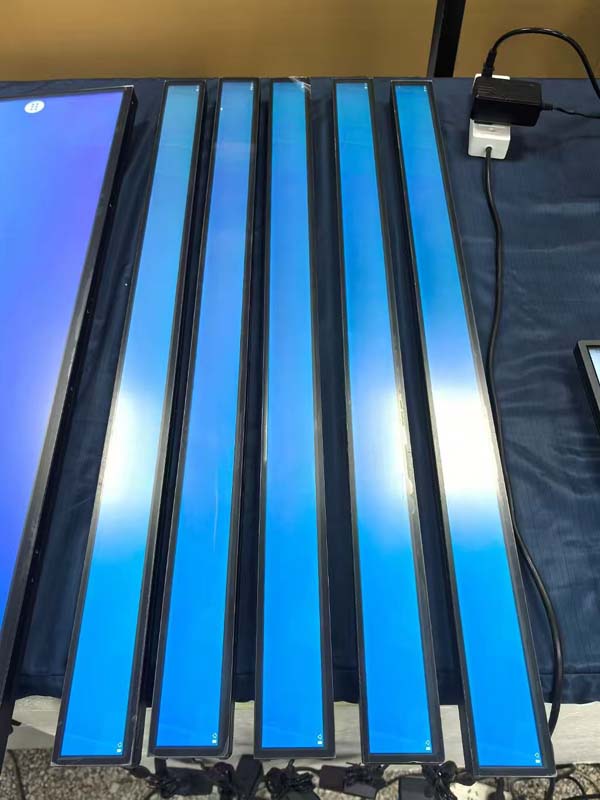
For very long runs — a 3-metre supermarket shelf, an airport baggage hall, a stadium concourse — a single panel cannot cover the span. The solution is a set of identical bar modules with bezels engineered so that the visual gap between active areas is uniform, typically 3–6 mm.
- Alignment: factory-calibrated brightness and colour matching across panels (ΔE < 3 between units in a set).
- Signal distribution: daisy-chain LVDS, DisplayPort MST, or a distributed player architecture with frame-locked playback.
- Power: shared PSU with sequenced start-up to avoid inrush tripping.
The ODM value here is in the calibration and the daisy-chain board design, not the glass. Customers who attempt this with mixed panel batches almost always end up with visible stripes.
7. Open-Frame Plug-and-Play Bar Monitor Module (HDMI/eDP Ready)
Many OEM teams want to skip panel-level integration entirely: they want a finished, chassis-less monitor that mounts behind a window and accepts a standard video signal.
- Contents: panel, LED driver, AD board with HDMI 1.4/2.0 and optional eDP input, OSD or serial control, 12 V or 24 V DC input.
- Mounting: VESA-compatible or customer-specific standoff pattern, with the panel protected by a thin metal carrier.
- Controls: RS-232 or USB service port for brightness, power scheduling, and input switching — important for unattended signage fleets.
This is the fastest route from concept to pilot deployment: the customer's mechanical engineer designs around a known outline, and firmware-level tuning stays with the display supplier.
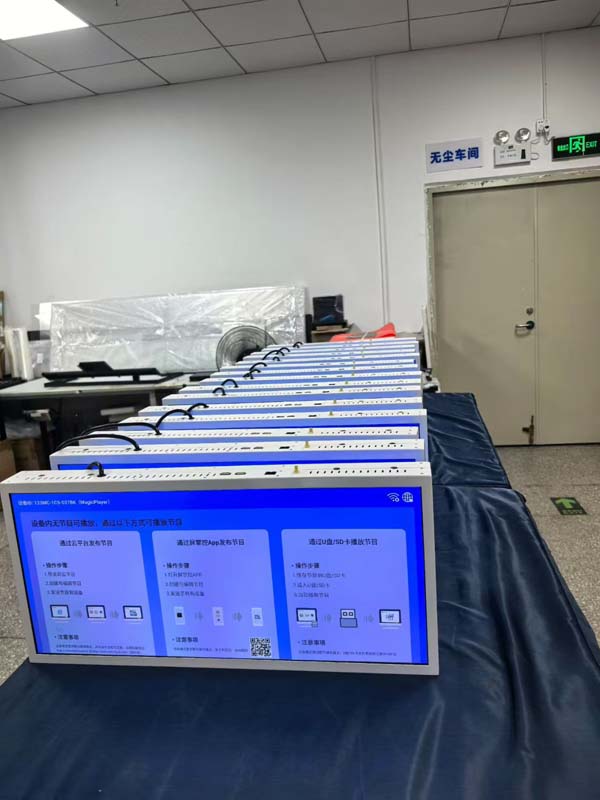
8. Smart Bar Display with Embedded Android SoC
Adding an SoC turns the bar LCD into a networked endpoint with no external player, no cable run, and no separate enclosure for electronics.
- Platforms: quad-core ARM SoCs running Android 9–13, with 2–4 GB RAM and 16–32 GB eMMC.
- Connectivity: Wi-Fi, Bluetooth, optional PoE, optional 4G; content managed over a cloud CMS or a local MDM.
- Storage of local caching so playback survives network loss — essential for retail price rails where a blank strip is a commercial problem, not a cosmetic one.
- Power: 12–24 V DC, typically 15–35 W for a 28" high-brightness strip.
Heat is the constraint. A sealed smart bar display running at 1500 nits in a closed aluminium extrusion needs a designed thermal path and, in most cases, a brightness ceiling of around 1000 nits unless active cooling is acceptable.
9. Circular-Polarizer and Optical-Bonded Bar Display for Window Installation
A display behind shop glass fights two problems: reflections of the street, and the fact that a standard linear polarizer looks washed out when viewed through sunglasses or at an angle through glass.
- Circular polarizer: converts the output to circular polarization, restoring contrast for sunglass wearers and reducing the double-image effect created by the shop window's own reflection.
- Optical bonding to the window: in premium installations the panel is bonded directly to the interior face of the shop glass, removing the air gap and eliminating internal reflection entirely.
- AR coating: multi-layer anti-reflective coating on the outer surface, reducing reflectance to below 1%.
This is a specialised ODM configuration normally reserved for flagship retail and automotive showroom work, where the display is meant to look like it is printed on the glass.
10. Long-Life Low-Power Bar LCD for Battery and 24/7 Operation
Two opposing requirements share one architecture: devices that must run for years without maintenance, and portable devices that must run for weeks on a battery.
- 24/7 industrial variant: 70,000-hour LED lifetime, derated drive current, overheat protection with automatic brightness fold-back, and a fanless passive thermal design.
- Low-power variant: 300–500 nit backlight, 5–8 W typical consumption for a 10.1" bar panel, deep-sleep modes with MCU wake on motion or button input, and 3.3 V/5 V input for direct battery-rail operation.
- Content strategy: for e-paper-like applications, partial refresh and static-image retention management extend panel life and reduce average power dramatically.
Electronic shelf labels with live pricing, handheld meter readouts, and battery-powered medical strip indicators all fall into this category.
Choosing Between OEM and ODM: What to Specify First
The distinction is not cosmetic. OEM means the customer owns the design and buys a display built to their drawing; ODM means the supplier owns part or all of the design and the customer brands it. The commercial and technical implications differ sharply.
| Parameter | OEM Project | ODM Project |
|---|---|---|
| Mechanical outline | Customer drawing, custom tooling | Supplier platform, minor modification |
| NRE / tooling | Borne by customer, 4–10 weeks | Often amortised or waived at volume |
| MOQ | Typically 500–3,000 pcs | Typically 100–500 pcs for platform variants |
| Firmware ownership | Customer or supplier, per contract | Supplier |
| Time to first sample | 8–14 weeks | 2–5 weeks |
| Best fit | High-volume, brand-differentiated products | Fast market entry, pilot deployments, SKU proliferation |
The Custom Bar LCD Specification Checklist
Regardless of which of the ten architectures applies, an ODM brief is only as good as the parameters attached to it. The following list is what a display engineering team needs before quoting accurately:
- Active area and outline dimensions, with tolerances and a mechanical drawing showing mounting holes and connector position.
- Resolution and interface — LVDS, eDP, MIPI DSI, HDMI, or RGB — plus the host platform and its available lanes.
- Brightness target and dimming range, with ambient light conditions and whether dimming is PWM or DC.
- Colour gamut and white point — sRGB, DCI-P3, or a customer-specific calibration target.
- Viewing angle requirement — critical for bar displays, where a 178°/178° IPS-class panel and a TN-class strip behave very differently on a low shelf.
- Operating temperature, humidity, and ingress protection, including storage extremes during shipping.
- Touch requirement, cover glass thickness, surface treatment, and gloved or wet-finger operation.
- Expected lifetime and duty cycle — 8 hours a day and 24/7 demand different LED bins and different driver derating.
- Certification and compliance targets — CE, FCC, RoHS, REACH, and any rail or medical standard the end product must meet.
- Annual volume, ramp curve, and lifecycle commitment — 3 to 5 years of supply continuity is the single most important clause in a bar display contract.
Validation: What to Test Before Mass Production
Bar displays fail in specific, predictable ways, and each failure mode has a corresponding validation gate:
- Thermal soak at maximum brightness at the highest specified ambient, with brightness and colour measured before and after — this catches inadequate backlight thermal design.
- Thermal cycling from −30 °C to +80 °C, 20+ cycles, checking for delamination in bonded assemblies and for light-guide warpage.
- Drop and vibration testing on the packed unit, plus a chassis-level vibration sweep for transport applications.
- Brightness uniformity mapping across the full strip — long panels are prone to end-to-end falloff that a 9-point measurement will miss entirely.
- Ageing at rated current for 168 hours minimum, w KEYWORDS: Best 10 Custom Bar LCD Display Solutions for OEM and ODM Projects