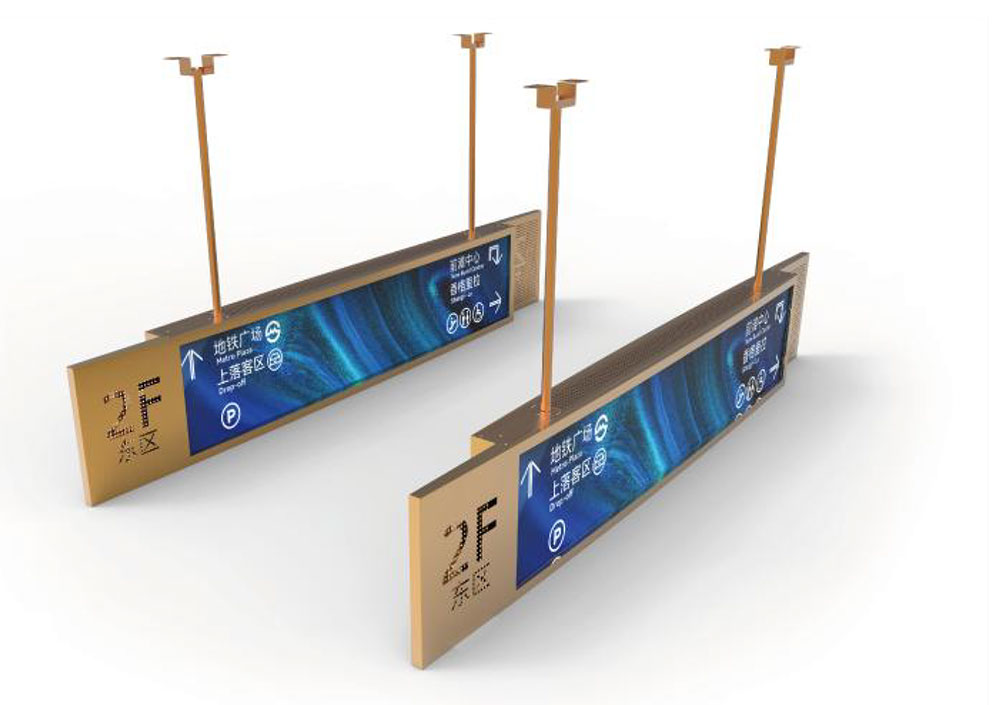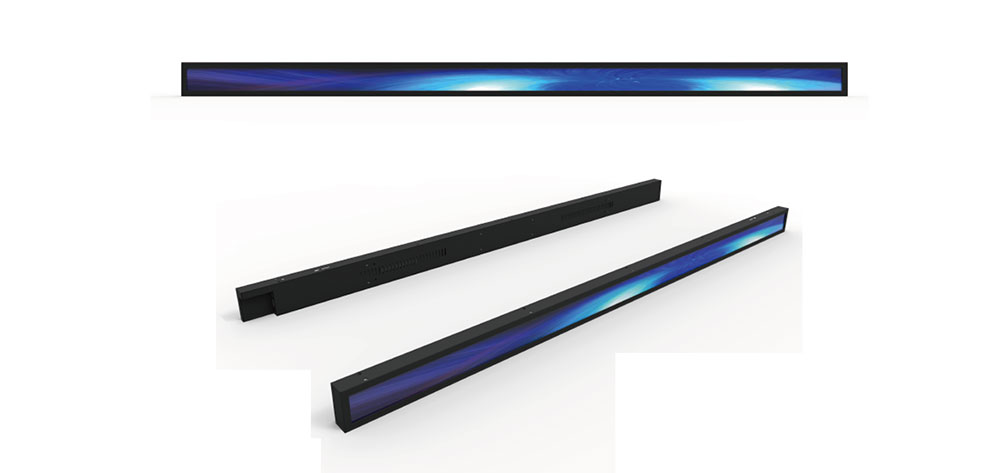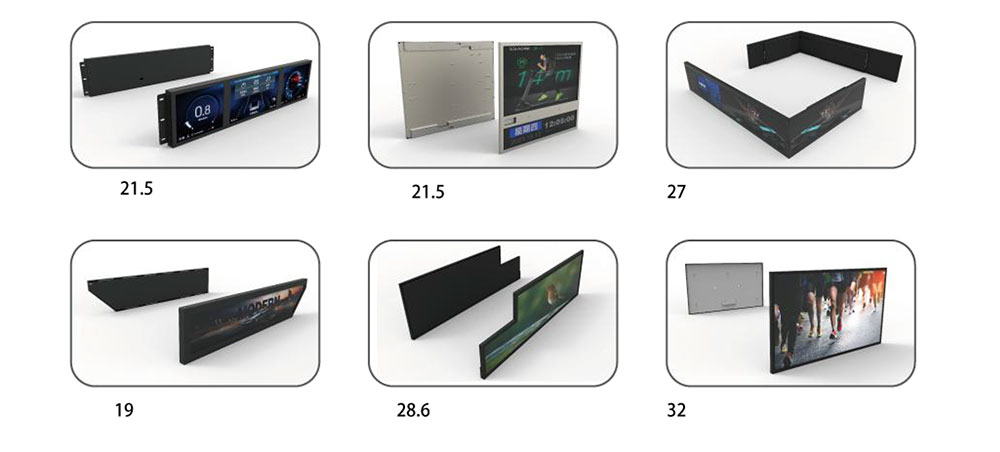
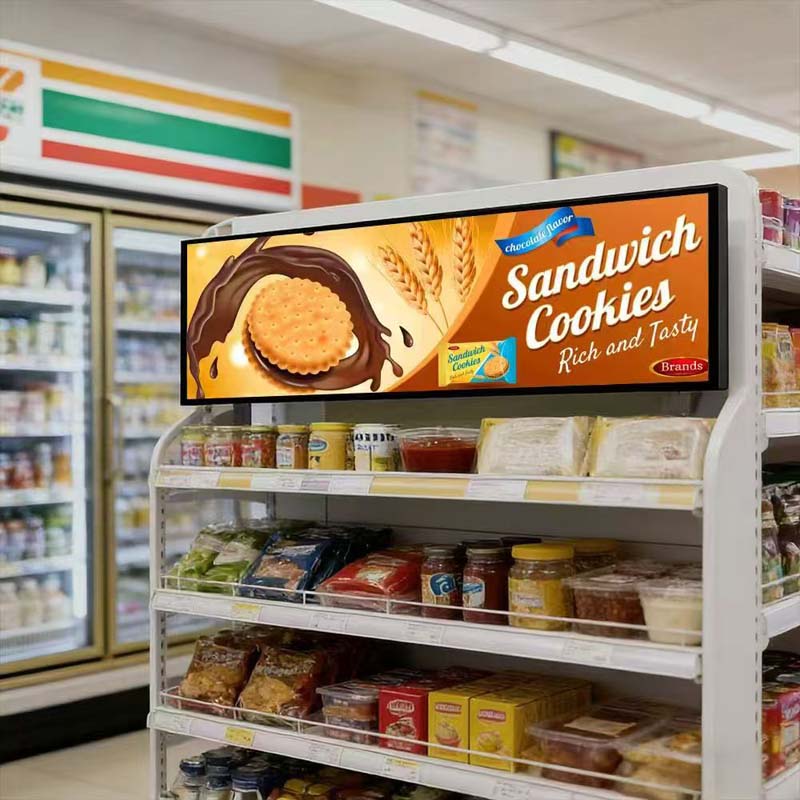
Elevators are one of the few remaining environments where an audience is captive, close to the screen, and physically unable to look away for 20 to 90 seconds at a time. That makes the lift car and the floor landing commercially attractive real estate — yet the geometry of a lift car actively rejects almost every display that was designed for a desk or a living room. A standard 16:9 monitor wastes vertical space above the handrail, blocks the car operating panel, or forces a housing deep enough to intrude on the cabin envelope. The bar-type LCD — a stretched panel typically between 16:3 and 16:4.5 in aspect ratio — exists because the elevator industry needed a display whose proportions matched the architecture rather than the other way round.
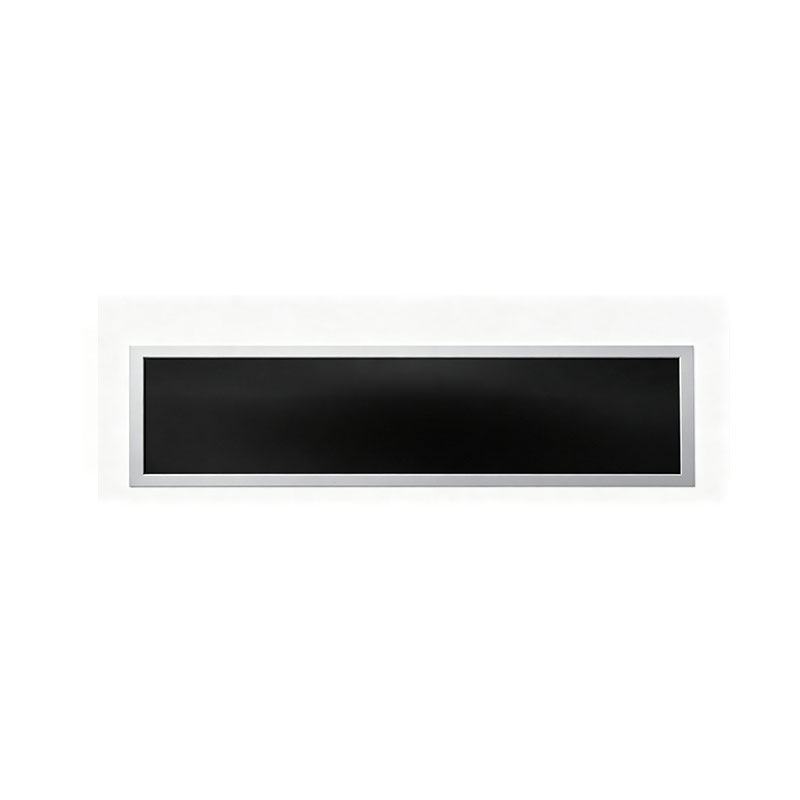
What "Bar Type" Actually Means at the Panel Level
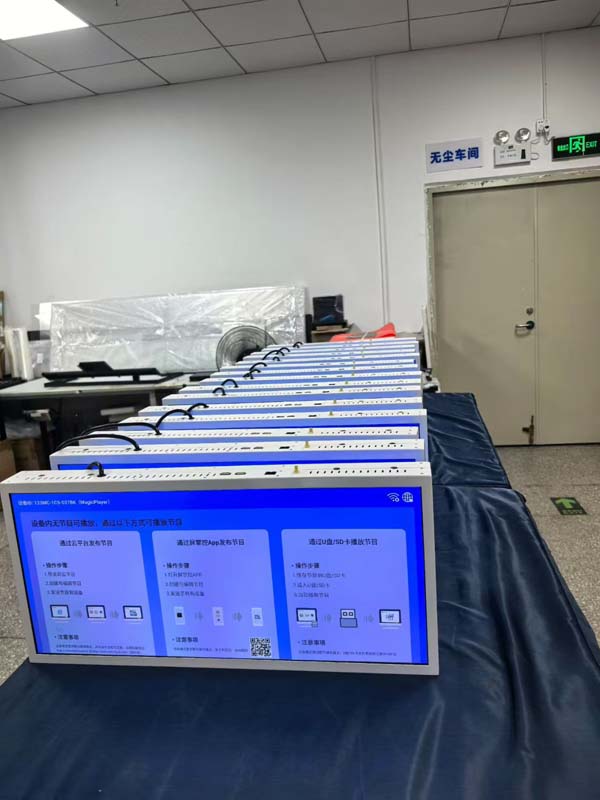
A bar LCD is not a cropped 16:9 panel. Internally it is a distinct glass layout: the array is cut to a wide, short active area, and the gate and source driver arrangement is redistributed accordingly. Common active areas run from roughly 500 × 120 mm (23–24 inch class) through 700 × 200 mm (28–29 inch) up to 1,100 × 310 mm (48–49 inch), with resolutions such as 1920 × 360, 1920 × 540, 2560 × 720, 2880 × 540 and 3840 × 1080. Because these are genuine panel formats and not scaled images, text and logos render at native pixel density instead of being stretched, which matters enormously for a screen that people read from 0.6 to 1.5 metres away.
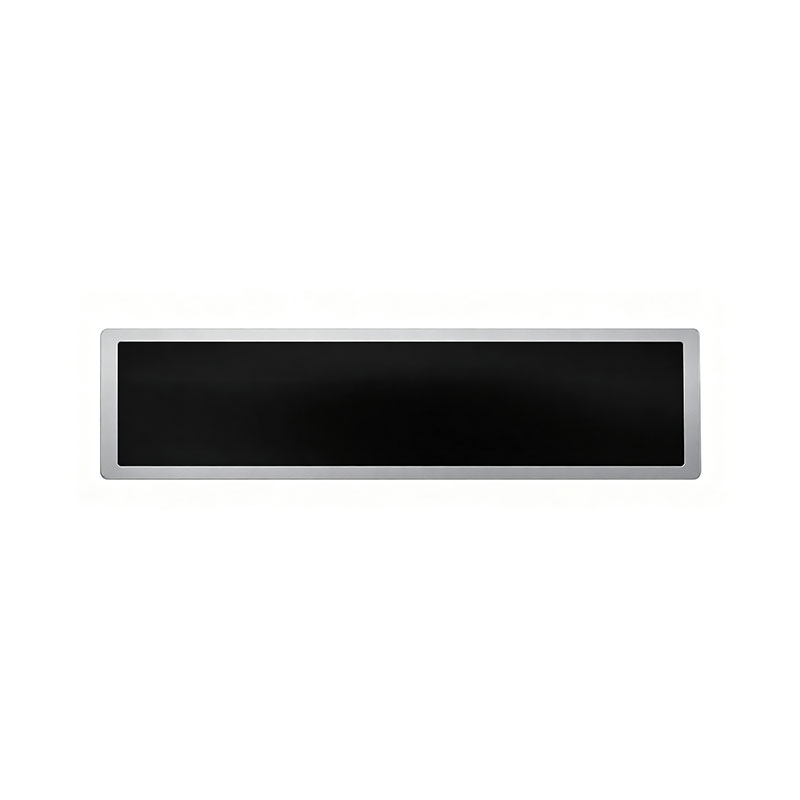
Three consequences follow from the geometry, and they drive every downstream engineering decision:
- Backlight length is the thermal bottleneck. A 1,100 mm light guide or light bar concentrates heat along a narrow strip rather than spreading it over a large area, so thermal design becomes the limiting factor on brightness and lifetime.
- Uniformity is harder to hold. Long, thin light guides suffer from light falloff toward the far end and from ripple artefacts near the LED entry edge; a 28-inch bar panel with the same uniformity specification as a 28-inch 16:9 panel is a materially more difficult product.
- Mechanical stiffness is low in the short axis. The glass and the frame both need additional support to survive transport and lift-door vibration without flexing the cell gap.
Where the Display Goes Determines What It Must Be
Elevator projects fail most often not because the panel was poor but because the specification ignored the installation zone. Each position imposes a different optical, thermal and compliance envelope.
| Installation zone | Typical size band | Brightness target | Dominant constraint |
|---|---|---|---|
| Inside the car, above the handrail or beside the COP | 23"–29" bar | 400–700 cd/m² | Depth, weight, power budget, EMC, fire-rated materials |
| Car door frame / door jamb strip | 19"–29" ultra-narrow bar | 500–800 cd/m² | Extreme aspect ratio, cable routing through the door operator, flex-cycle tolerance |
| Floor landing / hall indicator panel | 29"–49" bar | 1,000–2,500 cd/m² | Ambient light and window glare, wide temperature, dust ingress |
| Lobby or elevator bank totem (integrated bar) | 43"–57" bar or multi-panel array | 1,500–3,000 cd/m² | Sunlight loading, rain/UV exposure if semi-outdoor, service access |
The in-car and hall specifications are not the same product with a different brightness setting. A hall display that must hold legibility in 60,000 lux of window spill needs a fundamentally different backlight, usually direct-lit with local dimming or a high-output edge-lit design with a light-recycling polariser, and it needs a thermal path that survives being backlit at full power for 18 hours a day.
Optics: The Specifications That Decide Whether the Product Feels Premium
Brightness is only half the story
For advertising, the perceptual quality metric is not peak luminance but legibility under reflection. In a lift car with brushed stainless steel walls and a ceiling spotlight, specular reflection from a glossy cover glass can exceed the panel's own output. Two countermeasures are worth the cost: an anti-glare (AG) treatment with a haze value around 3–10 percent depending on the light source geometry, and, where the budget allows, optical bonding of the cover glass to the cell using a refractive-index-matched adhesive. Bonding removes the internal air gap, which typically eliminates 4–6 percent of surface reflection at each interface and, more importantly, removes the double-image ghosting that makes cheap elevator screens look blurred.
Uniformity and Mura
Demand a nine-point or thirteen-point luminance uniformity figure — 75 percent minimum for advertising-grade, 80–85 percent for premium installations — measured at maximum brightness after a 30-minute warm-up, not at 50 percent drive. Also require a mura specification with a defined limit on visible blotches under a grey field at 30 cd/m², because large-area low-grey mura is far more noticeable on a bar panel than on a conventional monitor where the eye scans a smaller region.
Viewing angle asymmetry
In a lift car, viewers stand at the side as often as in front. On a 28-inch bar panel, a person standing 0.8 m to the side of a display viewed from 1.2 m is looking at roughly 34 degrees off-axis horizontally; at the far corner of a large car this can approach 60 degrees. IPS-class panels with a horizontal/vertical contrast ratio above 10:1 at 85 degrees are the safe choice. VA panels offer better on-axis contrast but their off-axis gamma shift visibly darkens the far end of a bar display, which reads as a defect to an advertiser reviewing a photo.
No-flicker and camera compatibility
Modern content includes smartphone-shot social video and QR codes. Use DC-dimming or high-frequency PWM above 3,000 Hz with a modulation depth below 10 percent, otherwise rolling bands appear in mobile footage and QR scanning reliability drops in low-brightness night modes.
Backlight and Thermal Architecture
Three configurations dominate, and the choice should be made explicitly rather than inherited from whatever the panel vendor offers by default.
- Edge-lit single-side entry — lowest cost, thinnest module (down to 12–15 mm total), but the weakest uniformity at long lengths and the highest local heat density at the LED bar. Suitable for 23–29 inch in-car panels at 400–600 cd/m².
- Edge-lit dual-side entry — two light bars feeding from both ends, which halves the required guide length per source and improves uniformity by 5–10 points. This is the pragmatic default for 29–49 inch bar panels.
- Direct-lit with a 2D or 1D dimming zone map — highest brightness (1,500 cd/m² and above), best uniformity, and the only route to true HDR in a bar format, but the module becomes 30–45 mm thick and heat is spread across the rear of the panel, requiring a machined aluminium back plate with fins or a heat pipe to the housing.
Thermal budgeting should be done in writing. A common failure mode is a 700 cd/m² in-car panel installed in a car with no HVAC in a subtropical climate, where the interior air reaches 50–55 °C in summer. LED junction temperature rises, luminous output falls, and the panel compensates by drawing more current — a loop that ends in accelerated lumen depreciation or a driver shutdown. Specify the operating ambient temperature honestly (0–50 °C is typical for in-car, −10 to 60 °C for hall), require a derating curve rather than a single number, and insist on a thermal test report at maximum brightness in a 50 °C chamber with the display mounted in its production housing, not on a bench.
Electrical and Mechanical Integration into the Lift System
Power and inrush
Elevator controllers generally provide a limited auxiliary DC rail, often 12 V or 24 V, and the lift's own safety chain cannot tolerate a supply dip. Specify a wide-input DC-DC front end (9–36 V), a controlled inrush current, reverse-polarity and surge protection to the level the site requires, and a measured power figure at maximum brightness — a 28-inch bar panel commonly draws 20–35 W, and a 49-inch hall panel can exceed 90 W. For car-top or travelling-cable installations, the current draw must be added to the existing travelling cable budget; retrofits frequently require a separate power pair.
Depth, weight and mounting
Car wall thickness is typically 40–60 mm including cladding, and the COP, handrail and door frame all compete for that volume. A bonded, edge-lit bar module with a 15 mm panel stack plus a 10 mm driver cavity plus 5 mm of aluminium structure fits; a direct-lit module usually does not. Weight matters for the same reason as vibration: hanging 3–5 kg of display off thin stainless cladding requires a load-spreading bracket tied back to the car frame, not just four M4 inserts into the panel skin.
Vibration and mechanical endurance
Lift cars generate continuous low-amplitude vibration, plus door-close impulses and, in machine-room-less designs, motor and brake transients transmitted through the guide rails. Require a sine sweep and random vibration qualification representative of the installation — 10–500 Hz at 1.0–1.5 g with dwells at the car's structural resonances — plus a shock test for the door-frame variant, where the display is mounted on a moving element. The specific mechanical risk in a bar panel is cell-gap variation: flexing the glass changes the gap locally and produces a permanent green or purple pressure mark. Specify a stiffener plate or a full-length extruded frame, and verify with a white-field inspection after the vibration test, not before.
EMC in a hostile electrical environment
A lift car shares its power and its physical space with a variable-frequency drive, brake coils and door operator. Apply the lift-specific EMC standards for the market — EN 12015 and EN 12016 in Europe, the equivalent requirements referenced by the applicable lift code elsewhere — and test immunity against fast transients and radiated fields at the levels the drive actually produces, not the generic domestic levels. On the signal side, use shielded LVDS or eDP runs, ground the shield at the display end, and keep the panel's flexible tail away from the brake coil harness.
Safety, Fire and Life-Safety Behaviour
This is the section that separates a genuine elevator product from a consumer display with a bracket. Three topics must be settled with the lift consultant before tooling.
Materials and fire performance. Interior car materials are subject to fire and smoke requirements; in European practice this means a reaction-to-fire classification for the housing, diffuser, adhesives and cable jackets, typically something in the B-s1,d0 class or the level the notified body accepts for the specific car. Halogen-free, low-smoke cable and flame-retardant PC/ABS or aluminium housings are standard. Keep the material certificates and test reports on file — they are requested at handover far more often than datasheets.
Content priority and override. The display must never obscure a life-safety function. Design the content pipeline so that fire-service mode, alarm state and evacuation messaging pre-empt advertising at the hardware or the player firmware level, not merely at the CMS scheduling level. Provide a dry-contact or bus input from the lift controller and document the state machine: normal advertising, emergency message, blank with backlight off, and display-off on fire recall. Auditors will ask what happens when the network is down during an alarm — the answer must be "the override still works locally".
Certification path. The display is a component inside a lift that is itself subject to the Lift Directive and its standard family, so the practical route is to supply a component-level declaration (CE, UKCA, FCC, RoHS, REACH as applicable) with a technical file that the lift integrator can reference, plus the fire and EMC evidence above. Agree in writing who carries which declaration — ambiguities here delay site acceptance by weeks.
Signal Chain, Content and Connectivity
Two architectures are common. The monitor approach keeps the display as a dumb panel with LVDS or eDP input and places an Android or Linux player in a separate enclosure, which simplifies panel sourcing and lets the lift integrator standardise on one media player. The integrated approach mounts a system-on-module directly on the panel's rear, producing a single device with Ethernet, Wi-Fi or 4G/5G, storage, and a single power connection — attractive for retrofits where cavity space is unavailable.
Either way, request these capabilities explicitly:
- Split-screen zones with independent scheduling, so the bar's long axis can carry a floor/date strip, a brand loop, and a notification area simultaneously.
- Native scaling that respects the panel's true aspect ratio and a documented safe-area inset, so content never loses its edges behind the bezel.
- Lift-status integration via dry contacts, RS-485, CAN or a TCP/API feed, enabling direction arrows, current floor, load status and arrival prediction to be rendered by the display itself rather than duplicated in a separate indicator.
- OTA update with A/B partition rollback — a failed update on a lift display in a 40-storey building is a service call, not a support ticket.
- Telemetry: backlight hours, panel temperature, input voltage, network state, playback log. This is the difference between reactive maintenance and knowing that panel 14 in the north tower is running 12 °C hotter than its neighbours.
- Ambient-light-adaptive brightness for hall installations, which cuts power, extends backlight life and improves perceived contrast at night.
Customisation Scope and the Development Sequence
A custom bar LCD programme typically draws on five adjustable layers, in ascending order of cost and lead time:
- Off-the-shelf panel, custom integration — housing, bracket, cover glass with printed black border and logo, cable length and connector, firmware. Lead time 4–8 weeks, minimal tooling.
- Custom backlight on a standard cell — brightness uplift, dual-side entry, improved uniformity, extended temperature. Requires an optical simulation and a new light guide tool.
- Custom cover glass — AG/AR coating, chemically strengthened glass, asymmetric border printing for a specific car wall cutout, capacitive touch if a wayfinding interface is wanted.
- Custom active area or resolution — the highest-value option when the architecture demands an exact fit, but it carries panel tooling, new driver IC bonding and a full qualification cycle.
- Fully integrated product — panel, driver, SoC, housing, certification and CMS compatibility delivered as one unit under a single part number.
Run the programme as a staged gate process: specification freeze with a signed requirements document, optical and thermal simulation, A-sample for mechanical fit in a real car wall, B-sample for full environmental and EMC qualification, then pilot production with a first-article inspection. Two validation items are routinely under-specified and should be added deliberately: a 500-hour high-temperature operating soak at maximum brightness with periodic luminance measurement to build a real depreciation curve, and a static-image burn-in test with a fixed logo for 200 hours to characterise image sticking — a genuine risk for advertising panels that display the same brand mark in the same position for months.
Field Reliability and Serviceability
Design for the maintenance reality: a technician with a lift stopped between floors and ten minutes of access. Front-serviceable modules with captive fasteners KEYWORDS: Custom Bar LCD Displays for Elevator Advertising and Information Panels